Difference Between Recursion and Iteration in DSA: Explained
Have you ever wondered why the same problem in Data Structures and Algorithms can be solved using either recursion or iteration?
This comparison comes up often because both approaches handle repetition differently and directly impact how efficient and readable your solution is. Interviewers frequently ask this question to test your problem-solving clarity and understanding of execution flow.
In this article, let us learn the key difference between iteration and recursion in DSA, with clear explanations and practical insights.
What is Recursion in DSA?
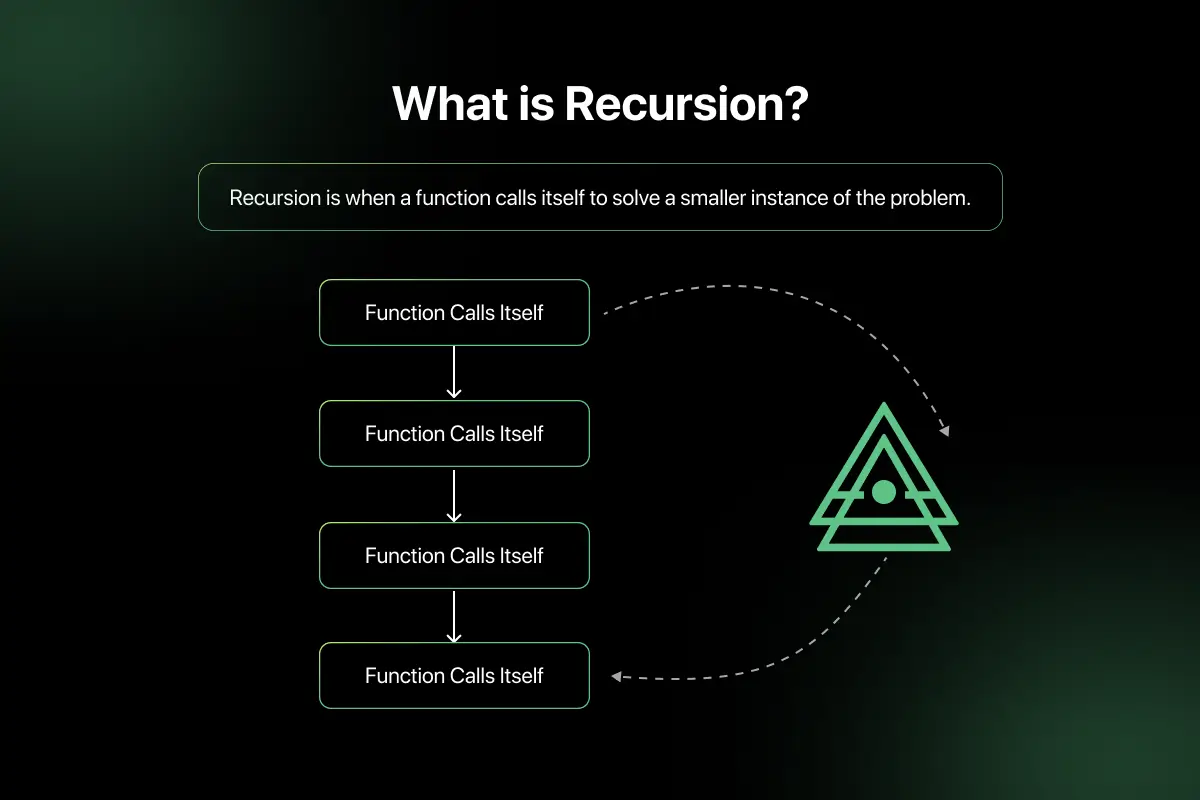
Recursion in Data Structures and Algorithms is a technique where a function solves a problem by calling itself with a smaller or simpler input until a stopping condition is reached. In simple terms, the function keeps breaking the problem into smaller parts and reuses the same logic to solve them. This process continues until the base case is met, after which the function calls return one by one to produce the final result.
Key components of recursion:
- Base case: The condition that stops further recursive calls and prevents infinite execution
- Recursive case: The part where the function calls itself with a reduced problem
- Call stack usage: Each function call is stored in the call stack until it completes
- Typical flow of execution: Function calls go deeper until the base case, then return in reverse order
What is Iteration in DSA?
Iteration in Data Structures and Algorithms is a technique where a set of instructions is repeated using loops instead of function calls. It solves problems by executing the same block of code multiple times until a specified condition is met.
Unlike recursion, iteration does not involve calling a function repeatedly, making the execution flow more straightforward to track.
Key components of iteration:
- Use of loops: Repetition is handled using loops such as for and while
- Loop condition: A condition that decides whether the loop should continue or stop
- Update or termination logic: Values are updated in each iteration to eventually meet the stopping condition
- Memory usage: No extra stack frames are created, resulting in more efficient memory usage
Recursion vs Iteration: Core Differences
The table below shows the difference between recursion and iteration:
| Aspect | Recursion | Iteration |
| Definition | A technique where a function calls itself to solve smaller subproblems | A technique where a loop repeatedly executes a block of code |
| Approach | Breaks a problem into smaller versions of the same problem | Repeats instructions until a condition becomes false |
| Memory usage | Uses more memory due to the function call stack | Uses less memory as no extra stack frames are created |
| Execution speed | Generally slower due to function call overhead | Generally faster because loop execution has less overhead |
| Code readability | Often cleaner and more intuitive for complex problems | Usually easier to understand for simple repetitive tasks |
| Stack usage | Uses the call stack for each recursive function call | Does not use the call stack repeatedly |
| Risk of errors | Risk of stack overflow if the base case is missing or deep recursion occurs | Risk of infinite loops if the loop condition is incorrect |
| Interview preference | Preferred for problems like trees, graphs, and divide-and-conquer logic | Preferred when efficiency and simplicity are important |
Recursion vs Iteration Examples
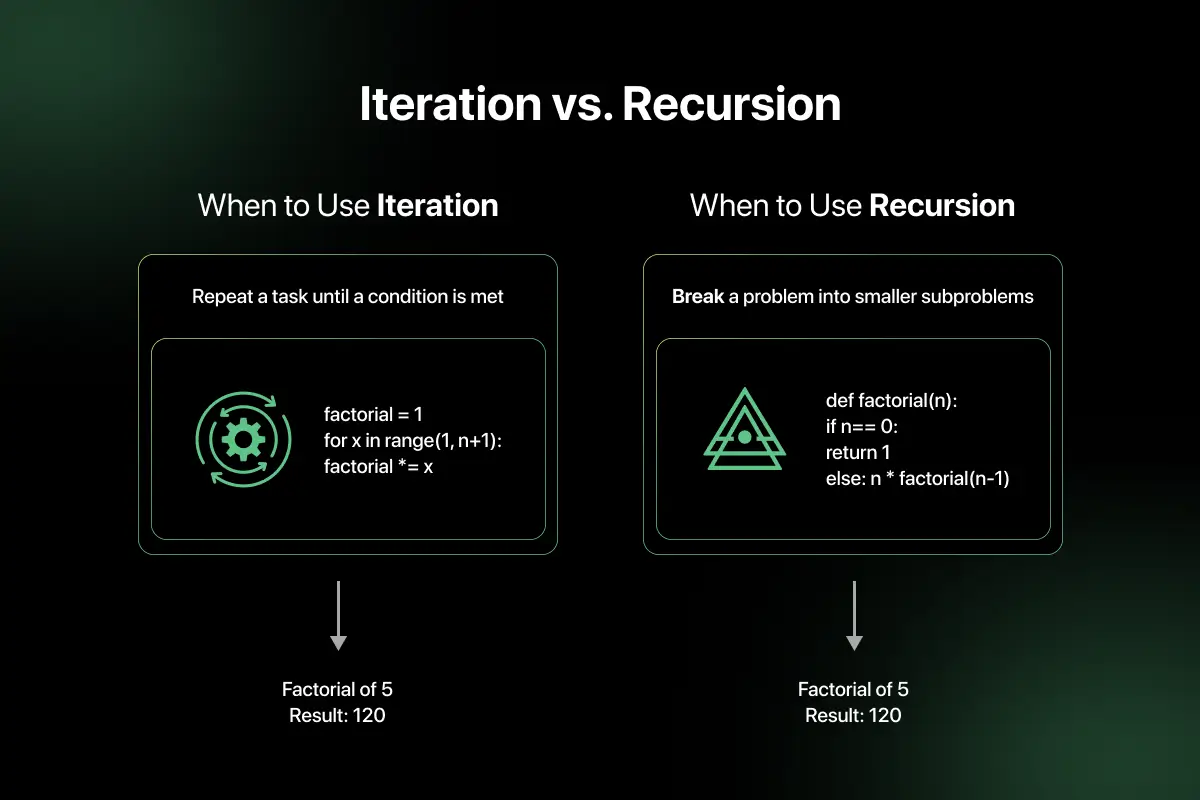
To clearly understand the recursion and iteration difference, let us solve the same problem using both approaches. This makes it easier to see how the flow of execution changes while the logic remains the same.
Below are difference between recursion and iteration with examples:
Example: Factorial of a Number
Using Recursion
int factorial(int n) {
if (n == 0)
return 1;
return n * factorial(n – 1);
}
In the recursive approach, the function keeps calling itself with a smaller value until it reaches the base case. Once the base case is met, the results are returned step by step through the call stack.
Using Iteration
int factorial(int n) {
int result = 1;
for (int i = 1; i <= n; i++) {
result *= i;
}
return result;
}
In the iterative approach, a loop is used to repeatedly multiply values until the final result is obtained. The execution happens in a single flow without additional function calls or stack usage.
This example highlights that recursion works through repeated function calls, while iteration uses loops to achieve the same outcome in a more direct execution flow.

When Should You Use Recursion?
- Problems with a natural recursive structure: Recursion is ideal when a problem can be broken into smaller subproblems that follow the same pattern, such as nested or hierarchical tasks.
- Tree and graph traversal: Traversing trees and graphs becomes simpler with recursion because each node can be processed using the same function logic.
- Divide and conquer algorithms: Algorithms like binary search and merge sort naturally use recursion to divide a problem into smaller parts and combine the results.
- Cleaner logic over performance: Recursion is useful when code clarity and logical simplicity are more important than memory or execution efficiency.
When Should You Use Iteration?
- Performance-critical applications: Iteration is preferred when execution speed and memory efficiency are important, as loops avoid the overhead of repeated function calls.
- Large input sizes: Iterative solutions handle large inputs better because they do not risk deep call stacks that can cause runtime issues.
- Simple repetitive tasks: Tasks that involve straightforward repetition, such as counting or linear traversal, are easier to implement using loops.
- Avoiding stack overflow: Iteration is a safer choice when the recursion depth could become large and lead to stack overflow errors.
Performance Comparison: Time and Space Complexity
When comparing recursion and iteration, the main performance difference usually comes from memory usage rather than execution time. In most practical problems, both approaches perform similar operations, but they manage resources differently during execution.
- Time complexity: In many cases, recursion and iteration have the same time complexity because they solve the problem using the same number of steps.
- Space complexity: Recursion uses additional space for each function call due to the call stack, while iteration typically uses constant extra space.
- Memory usage: Recursion often consumes more memory because each recursive call stores local variables and return addresses on the stack.
Common Mistakes Students Make To Differentiate Between Iteration and Recursion
- Missing the base case in recursion: Forgetting a proper base case can lead to infinite recursive calls and program crashes.
- Using recursion for simple loops: Applying recursion to problems that can be easily solved with loops often makes the solution inefficient and harder to follow.
- Ignoring stack overflow risks: Not considering recursion depth can cause stack overflow errors, especially with large input sizes.
- Writing unclear recursive logic: Poorly structured recursive code makes it difficult to trace execution and explain the solution during interviews.
Recursion vs Iteration in Interviews
In technical interviews, the goal of asking about recursion versus iteration is not just to check syntax knowledge, but to evaluate how well you understand problem-solving approaches and execution flow. Interviewers want to see whether you can choose the right technique and clearly justify your decision.
- When recursion is preferred: For problems involving trees, graphs, or divide-and-conquer logic, where recursion naturally fits the structure.
- When iteration is safer: For performance-sensitive problems or large inputs, where avoiding deep call stacks is important.
- Importance of explaining trade-offs: Clearly explaining why you chose recursion or iteration shows strong conceptual understanding and interview readiness.
Recursion vs Iteration: Which One Should You Learn First?
For beginners, it is better to start with iteration because loops are easier to understand and help build a strong foundation in control flow.
Once you are comfortable with loops, learning recursion adds depth to your problem-solving skills and helps you handle complex problems like trees and divide-and-conquer algorithms.
For placements, both recursion and iteration are mandatory, as interviewers expect you to understand and apply each approach effectively.
Final Thoughts
Recursion and iteration are both essential tools in Data Structures and Algorithms, each suited to different types of problems. Rather than memorizing rules, focus on understanding how each approach works and where it fits best.
This clarity helps you write better code, avoid common mistakes, and explain your decisions confidently. For placements and real-world development, knowing when to use recursion or iteration is a key problem-solving skill.
FAQs
Recursion is better for naturally recursive problems, while iteration is better for efficiency and simple repetitive tasks.
Recursion is considered expensive because each function call consumes extra memory due to call stack usage.
Most recursive solutions can be converted to iterative ones using loops and explicit stack data structures.
Recursion is important for placements in India because it is commonly tested in coding and DSA interviews.
Iteration is usually faster because it avoids function call overhead and uses memory more efficiently.



Aarthy is a passionate technical writer with diverse experience in web development, Web 3.0, AI, ML, and technical documentation. She has won over six national-level hackathons and blogathons. Additionally, she mentors students across communities, simplifying complex tech concepts for learners.



Aarthy is a passionate technical writer with diverse experience in web development, Web 3.0, AI, ML, and technical documentation. She has won over six national-level hackathons and blogathons. Additionally, she mentors students across communities, simplifying complex tech concepts for learners.
Related Posts
Difference Between Greedy and Dynamic Programming
When solving optimization problems, programmers often face situations where multiple choices are available at every step. Choosing the right approach …
Warning: Undefined variable $post_id in /var/www/wordpress/wp-content/themes/placementpreparation/template-parts/popup-zenlite.php on line 1050
so far feels like...
