How to Improve DSA Skills and Problem Solving

Have you ever noticed that strong problem solvers almost always have solid DSA skills?
Data Structures and Algorithms shape how you think, approach problems, and arrive at efficient solutions, which is why they are heavily tested in interviews and used in real-world software development.
In this article, you will learn how to improve your DSA skills and build a structured problem-solving approach that works both in interviews and practical scenarios.
Understanding the Role of DSA in Problem Solving
Data structures are not just containers to store data; they define how data is organized, accessed, and modified during problem-solving.
Choosing the right data structure reduces unnecessary operations, simplifies logic, and allows you to focus on solving the core problem efficiently.
This is why understanding what is the role of data structure in problem solving is fundamental to becoming a strong problem solver.
- Organize data efficiently: Data structures arrange data in a way that makes operations like searching, insertion, and deletion faster and more predictable.
- Algorithms depend on data structures: The efficiency and feasibility of an algorithm often rely on the underlying data structure used to process the data.
- Optimize time and space: The correct data structure helps reduce time complexity and memory usage, leading to more scalable and efficient solutions.
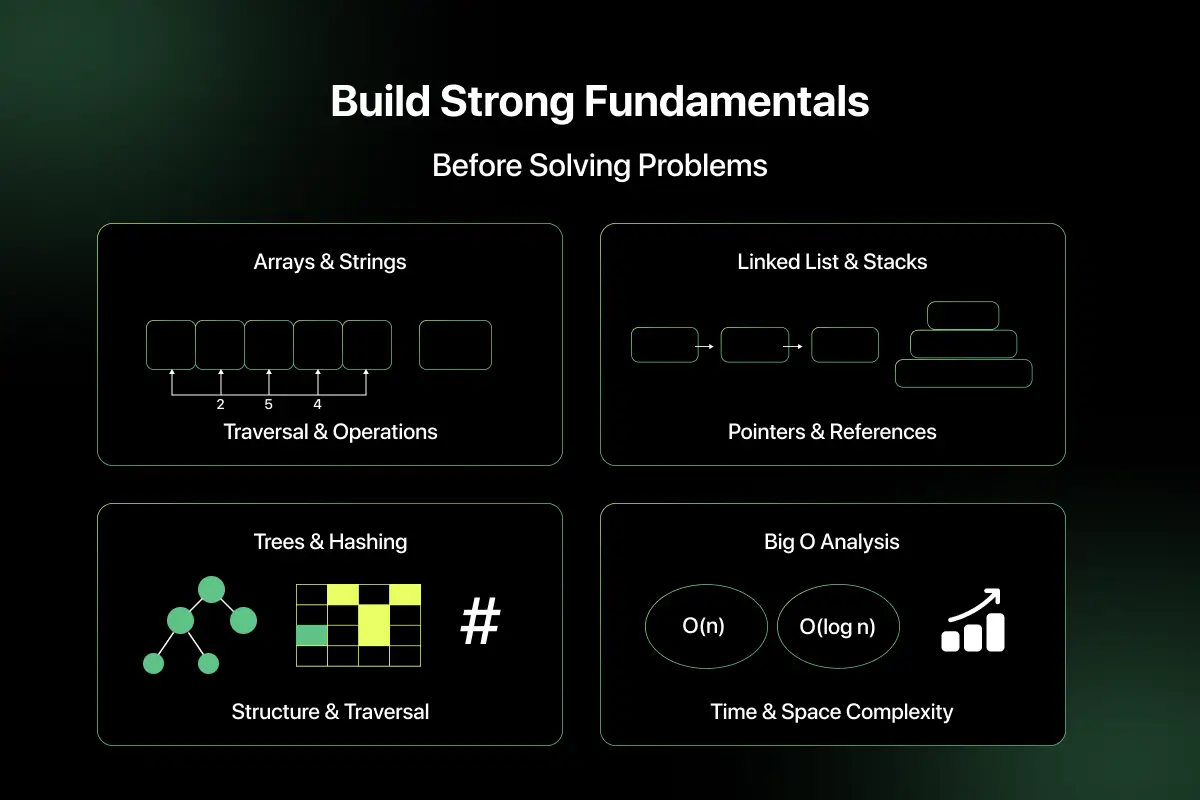
Build Strong Fundamentals Before Solving Problems
Many students struggle with problem-solving because their fundamentals are weak, not because the problems are too hard.
To understand how to improve data structures and algorithms, you must first build clarity in core concepts before attempting complex problems.
Strong basics help you recognize patterns, choose the right approach, and avoid confusion during problem solving.
- Arrays, strings, and basic operations: Learn traversal, indexing, and common operations, as these form the base of most problems.
- Linked lists, stacks, and queues: Understand how data flows and how pointers or references affect problem logic.
- Trees, hashing, and basic graphs: Focus on structure, traversal methods, and common use cases in problem solving.
- Time and space complexity basics: Know how to analyze performance to choose efficient solutions from the start.
Learn the Problem-Solving Concept in Data Structures
The problem solving concept in data structure goes beyond writing code for a given problem. It focuses on understanding what the problem is asking, how the data is structured, and which operations are required to reach an efficient solution.
In DSA, problem solving starts with analyzing the input and constraints, then deciding how data should be stored and accessed to simplify the logic.
Effective problem solving in data structures follows a clear sequence: identify the inputs, understand constraints, choose an appropriate approach, and finally implement the solution. This process ensures that your solution is both correct and efficient.
Logic plays a bigger role than syntax because strong reasoning allows you to adapt your approach to new problems, explain your decisions clearly, and handle variations during interviews.
Use the Right Approach to Solve Data Structure Problems
Randomly writing code without a clear plan often leads to incomplete or inefficient solutions, especially in interviews. To understand how to solve data structure problems, you need a structured approach that focuses on clarity, correctness, and optimization.
Interviewers value candidates who think systematically and adapt their solutions based on constraints rather than jumping straight into coding.
- Understand the problem and constraints: Carefully analyze input size, edge cases, and limitations before deciding on a solution.
- Choose the right data structure: Select a data structure that supports the required operations efficiently, such as fast lookups or ordered traversal.
- Write a basic solution first: Start with a simple and correct approach to establish logic before worrying about optimization.
- Optimize if required: Improve time or space complexity only after ensuring the solution works and meets the problem requirements.
Focus on Problem-Solving Techniques in Data Structure
Mastering problem solving techniques in data structure helps you approach unfamiliar problems with confidence. These techniques act as reusable thinking frameworks that guide your solution strategy instead of relying on memorized answers.
- Two pointers: Efficiently process data by maintaining two indices, often reducing nested loops to linear time.
- Sliding window: Maintain a dynamic range over data to solve subarray or substring problems efficiently.
- Recursion and backtracking: Explore multiple possibilities by breaking problems into smaller decisions and reverting when needed.
- Divide and conquer: Split a problem into independent subproblems, solve them separately, and combine the results.
- Greedy approach: Make locally optimal choices at each step when the problem structure guarantees a global solution.
- Dynamic programming (patterns, not formulas): Focus on identifying overlapping subproblems and building solutions incrementally instead of memorizing equations.

Improve Problem Solving Using Data Structures Through Practice
Improving problem solving using data structures depends more on consistent practice than solving a large number of random problems.
Passive reading may help you understand concepts, but real improvement comes from actively applying those concepts to problems, making mistakes, and refining your approach over time.
- Solving problems topic-wise: Practice problems related to one data structure at a time to strengthen pattern recognition and confidence.
- Revisiting mistakes: Reviewing incorrect solutions helps you understand gaps in logic and avoid repeating the same errors.
- Increasing difficulty gradually: Start with simpler problems and move to moderate ones to build problem-solving depth without frustration.
- Timed practice for interviews: Solving problems under time limits prepares you for real interview pressure and decision-making.
To practice effectively, use PlacementPreparation.io to work on DSA exercises regularly across all topics and difficulty levels, helping you build interview-ready problem-solving skills step by step.
Connect Data Structures and Problem Solving in Real Scenarios
In real-world applications, data structures and problem solving are closely connected because most software challenges involve organizing data and performing operations efficiently.
Problems like searching large datasets, handling user requests, or managing system resources all require the right data structure to simplify logic and improve performance. Understanding how DSA concepts map to practical situations helps you see beyond interview questions. Companies value DSA-based thinking because it enables engineers to build scalable and efficient systems.
For example, search features rely on optimized data structures to return results quickly, scheduling systems use priority queues to manage tasks, and caching mechanisms depend on hashing for fast access. These choices directly affect application speed and reliability.
By recognizing how data structures support problem solving in real scenarios, you develop a mindset that focuses on efficiency and clarity.
This approach helps you design better solutions, handle constraints effectively, and adapt DSA concepts to real-world engineering problems.

Improve DSA Skills with the Right Learning Strategy
Improving DSA skills is a gradual process that requires a structured and disciplined learning strategy.
Instead of focusing on quick results, consistent effort and the right practice methods help you build strong analytical thinking and long-term problem-solving ability.
- Daily problem-solving habit: Solving a few problems every day strengthens logic, reinforces concepts, and improves consistency.
- Pattern recognition: Identifying common patterns across problems helps you approach new questions with confidence and clarity.
- Regular revision: Revisiting concepts and previously solved problems ensures better recall and reduces confusion during interviews.
- Mock interview practice: Simulating interview conditions helps you explain solutions clearly and apply DSA concepts under pressure.
Final Thoughts
Improving DSA skills is about learning how to think logically, not memorizing solutions or code templates. Strong problem solving with algorithms and data structures develops through structured practice, clear reasoning, and regular revision.
When you stay consistent and focus on understanding patterns, interviews become more manageable, and confidence grows naturally over time.
FAQs
Beginners can improve by learning core data structures, practicing problems regularly, understanding patterns, and focusing on explaining logic instead of memorizing solutions.
Improving DSA skills usually takes a few months of consistent practice, depending on your basics, learning pace, and problem-solving discipline.
Problem solving is important, but it becomes effective only when supported by a strong understanding of data structures and algorithms.
Solving five to ten well-chosen problems daily is sufficient if you focus on understanding approaches, handling edge cases, and reviewing mistakes.
Yes, you can improve problem solving without competitive programming by practicing interview-focused DSA problems and applying structured learning strategies.



Aarthy is a passionate technical writer with diverse experience in web development, Web 3.0, AI, ML, and technical documentation. She has won over six national-level hackathons and blogathons. Additionally, she mentors students across communities, simplifying complex tech concepts for learners.



Aarthy is a passionate technical writer with diverse experience in web development, Web 3.0, AI, ML, and technical documentation. She has won over six national-level hackathons and blogathons. Additionally, she mentors students across communities, simplifying complex tech concepts for learners.
Related Posts

Difference Between Greedy and Dynamic Programming
When solving optimization problems, programmers often face situations where multiple choices are available at every step. Choosing the right approach …

Warning: Undefined variable $post_id in /var/www/wordpress/wp-content/themes/placementpreparation/template-parts/popup-zenlite.php on line 1050
so far feels like...
