Importance of Data Structures and Algorithms (DSA)
Why is everyone constantly talking about DSA, and why is it considered so important for programming?
Many beginners focus only on writing code, but often overlook why data structures are important and how they impact performance and scalability. The importance of data structures and algorithms goes beyond interviews and exams.
In this article, you will clearly understand why DSA matters, how it improves problem-solving, and why it forms the foundation of efficient programming.
What Are the Common Data Structures That Are Used?
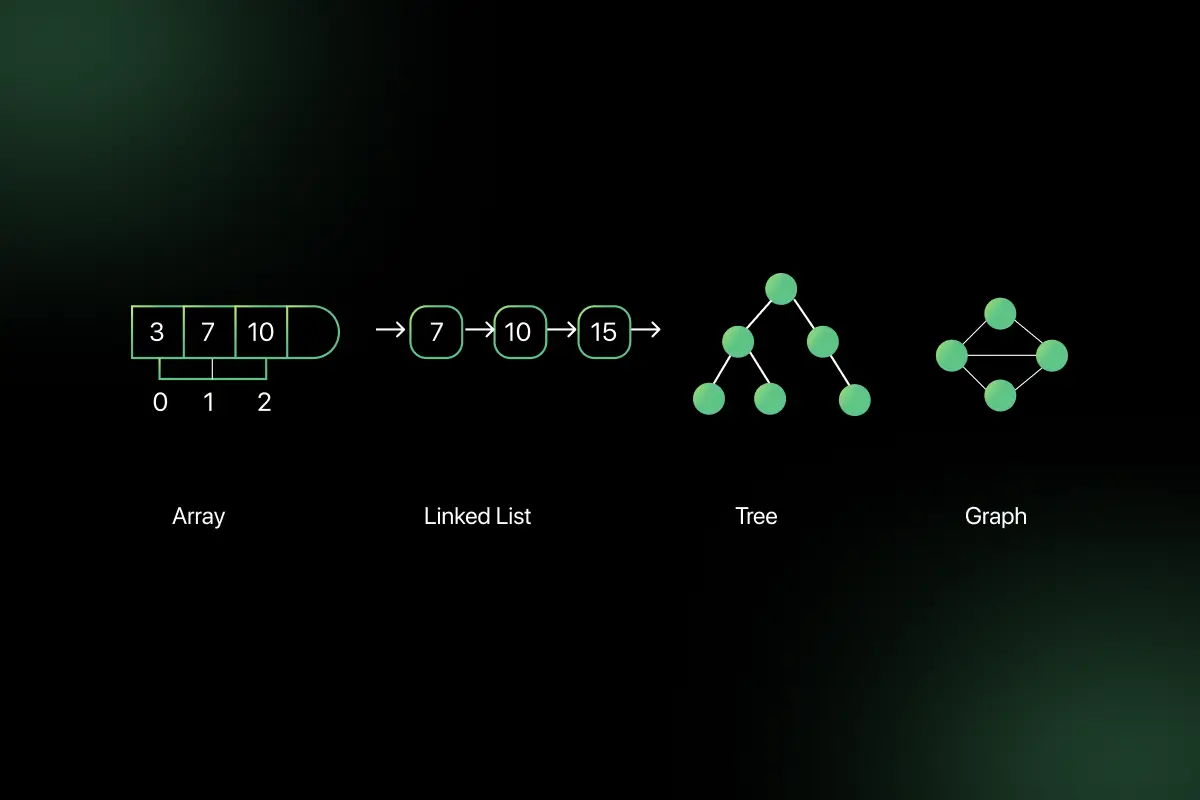
Here are some of the most commonly used data structures in programming and interviews:
- Arrays: Store elements in a fixed size and allow fast access using index.
- Linked Lists: Store data in nodes connected by pointers, useful for dynamic memory.
- Stacks: Follow Last In First Out, used in undo operations and recursion.
- Queues: Follow First In First Out, used in scheduling and task processing.
- Hash Tables: Provide fast search, insert, and delete operations using keys.
- Trees: Organize hierarchical data, widely used in databases and file systems.
- Binary Search Trees: Enable fast searching and sorting of data.
- Heaps and Priority Queues: Used in scheduling, shortest path, and real-time systems.
- Graphs: Represent networks and relationships, such as social media and maps.
Basic Applications of Data Structures and Algorithms
Data Structures and Algorithms are used in many real-world systems to store, process, and retrieve data quickly. Here are some simple and practical applications:
- Search Engines: Search engines like Google use indexing, trees, and hashing to find relevant results from huge datasets within seconds. Algorithms help rank and sort results based on user intent and relevance.
- Social Media Platforms: Platforms such as Instagram and LinkedIn use graphs to manage connections between users. Data structures also help in showing feeds, friend suggestions, and real-time notifications efficiently.
- Navigation and Map Systems: Apps like Google Maps use graph algorithms to find the shortest and fastest routes. These systems process traffic, distance, and travel time to provide accurate directions.
- Banking and Fintech Applications: Banking systems use secure data structures to manage transactions, account details, and fraud detection. Efficient algorithms ensure fast and reliable processing of payments and digital transfers.
- Operating Systems: Operating systems use queues, stacks, and scheduling algorithms to manage tasks, memory, and processes. This ensures that applications run smoothly without delays or system crashes.
- Artificial Intelligence and Machine Learning: AI and ML models rely on efficient data storage and processing. Algorithms help in pattern recognition, data analysis, and decision-making, which are essential for automation and smart applications.
Why Are Data Structures and Algorithms Important to Learn?
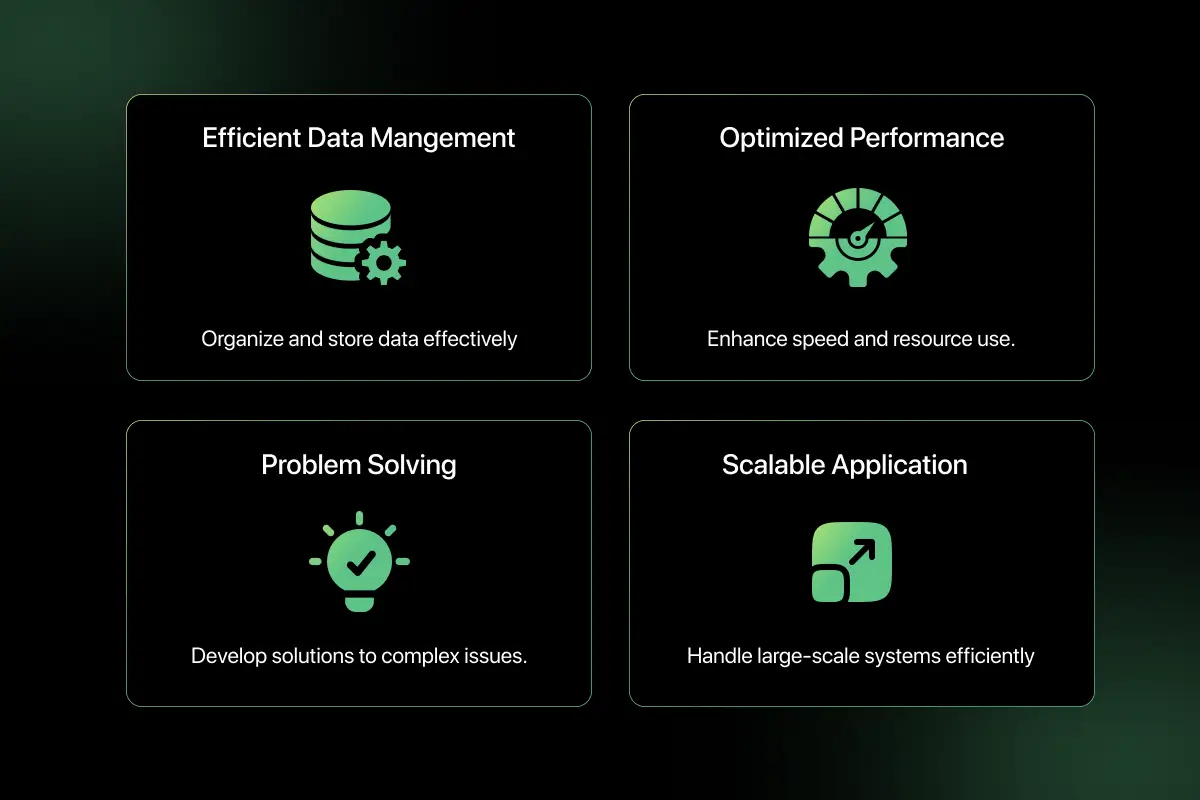
Data Structures and Algorithms form the backbone of efficient programming and scalable system design. They determine how data is stored, accessed, and processed, directly affecting performance and reliability.
Here are a few important reasons to start your DSA preparation quickly:
1. Efficient Data Organization and Memory Management
Efficient programs depend on how well data is stored and managed in memory. Data structures organize data in a structured way, improving access speed and reducing unnecessary memory usage.
Without proper organization, systems become slow and difficult to scale. This is exactly why do we need data structures in programming, to ensure data is arranged in a predictable way that supports faster processing and cleaner logic.
2. Writing Optimized and Scalable Code
Optimized code is about making it work efficiently as the input size grows. Time complexity determines how fast a solution runs, while space complexity defines how much memory it consumes.
The importance of data structures and algorithms becomes clear when building scalable systems. Efficient data handling reduces execution time and ensures that applications can handle larger workloads without performance issues.
3. Building Strong Problem-Solving Skills
Learning DSA trains you to think in a structured and logical way. Instead of jumping directly into code, you begin by analyzing the problem, identifying patterns, and selecting the right approach.
If you ever wonder why should I learn data structures and algorithms, the answer lies in developing a problem-solving mindset that applies to real-world software development challenges.
4. Foundation for Technical Interviews and Placements
For most technical interviews, especially campus placements in India, DSA is a core evaluation area. Recruiters assess how well you understand concepts, apply logic, and write efficient solutions under time constraints.
This is exactly why data structure is important in programming careers, as it directly influences interview performance.
5. Real-World Application in Software Systems
Data Structures and Algorithms are not limited to interview questions; they are deeply integrated into real-world software systems.
Large platforms like search engines and databases use optimized data structures such as trees and hashing to store, search, and retrieve data quickly from massive datasets. This clearly explains why we use data structure in programming applications.

How to Start Learning DSA?
Starting DSA may feel overwhelming at first, but with the right roadmap and consistent practice, anyone can build strong problem-solving skills.
Instead of jumping between random topics, following a structured step-by-step approach helps you learn faster and stay motivated.
Here is a simple 7-step framework to learn and master DSA effectively:
| Step | What to Do | Why It Matters |
| 1. Learn a Programming Language | Choose one language such as C++, Java, or Python and get comfortable with basics like loops, functions, and arrays. | Strong fundamentals make it easier to understand logic and implement DSA concepts. |
| 2. Understand Time and Space Complexity | Learn Big O notation and analyze how fast your solution runs and how much memory it uses. | Helps you write optimized and scalable solutions instead of just working code. |
| 3. Start with Basic Data Structures | Focus on arrays, strings, linked lists, stacks, and queues first. | These form the foundation for solving most beginner and interview problems. |
| 4. Move to Advanced Structures | Learn trees, graphs, heaps, hashing, and tries gradually. | These are commonly asked in product company interviews and real world systems. |
| 5. Practice Problem-Solving Daily | Solve questions regularly to improve logical thinking and pattern recognition. | Consistent practice builds confidence and improves speed in coding rounds. |
| 6. Revise and Analyze Mistakes | Revisit solved problems, understand better approaches, and learn from errors. | This strengthens concepts and prevents repeating the same mistakes. |
| 7. Prepare for Interviews and Real Applications | Practice mock tests, coding rounds, and real scenario problems. | This bridges the gap between theory and real placement preparation. |
If you are looking for a structured and placement-focused learning path, you can practice DSA, mock tests, and company-specific questions on PlacementPreparation.io.
The platform offers guided roadmaps, topic-wise problems, and real interview-level challenges to help you prepare with confidence.
Conclusion
Data Structures and Algorithms form the foundation of efficient and scalable programming. Understanding DSA is essential not only for interviews but also for building reliable real-world systems.
With structured learning and consistent practice, you can strengthen your problem-solving skills and grow confidently as a developer.
FAQs
We need data structures to organize, store, and manage data efficiently. Proper data organization improves performance, reduces memory usage, and enables faster execution of operations in software applications.
No, DSA is not limited to placements. It is essential for writing efficient programs, designing scalable systems, and solving complex real-world software problems beyond interviews.
You may write basic programs without algorithms, but skipping them limits your ability to build optimized, scalable, and high-performance applications required in professional development roles.
DSA helps by enabling efficient searching, sorting, scheduling, caching, and data management in systems like databases, search engines, and large-scale applications handling massive user traffic.
Mastering DSA depends on consistency and practice. With structured learning and regular problem solving, strong proficiency can typically be developed within several months.



Aarthy is a passionate technical writer with diverse experience in web development, Web 3.0, AI, ML, and technical documentation. She has won over six national-level hackathons and blogathons. Additionally, she mentors students across communities, simplifying complex tech concepts for learners.



Aarthy is a passionate technical writer with diverse experience in web development, Web 3.0, AI, ML, and technical documentation. She has won over six national-level hackathons and blogathons. Additionally, she mentors students across communities, simplifying complex tech concepts for learners.
Related Posts

Difference Between Greedy and Dynamic Programming
When solving optimization problems, programmers often face situations where multiple choices are available at every step. Choosing the right approach …


Warning: Undefined variable $post_id in /var/www/wordpress/wp-content/themes/placementpreparation/template-parts/popup-zenlite.php on line 1050
so far feels like...
