Introduction to Recursion
Many programming problems involve repeating the same logic on smaller parts of the data. For example, calculating factorials, traversing trees, or solving maze problems can become complex with loops but are much simpler with recursion.
Recursion in data structure is a problem-solving approach where a function calls itself to break a large problem into smaller and manageable subproblems.
Understanding recursion in DSA is important because it forms the foundation of many algorithms, such as divide and conquer, backtracking, and tree traversals. It is also a frequently tested concept in coding interviews because it evaluates logical thinking and problem breakdown skills.
In this article, let us learn about recursion algorithms, how recursion works, when it should be used, and how it helps in solving complex programming problems efficiently.
What Recursion Means in Problem Solving
Recursion is a problem-solving technique where a function calls itself to solve smaller parts of the same problem. Instead of solving everything at once, recursion reduces the problem step by step until it reaches the simplest version that can be solved directly.
The main idea behind recursion in DSA is breaking a complex task into similar, smaller tasks. This makes many problems easier to understand and implement compared to long iterative logic.
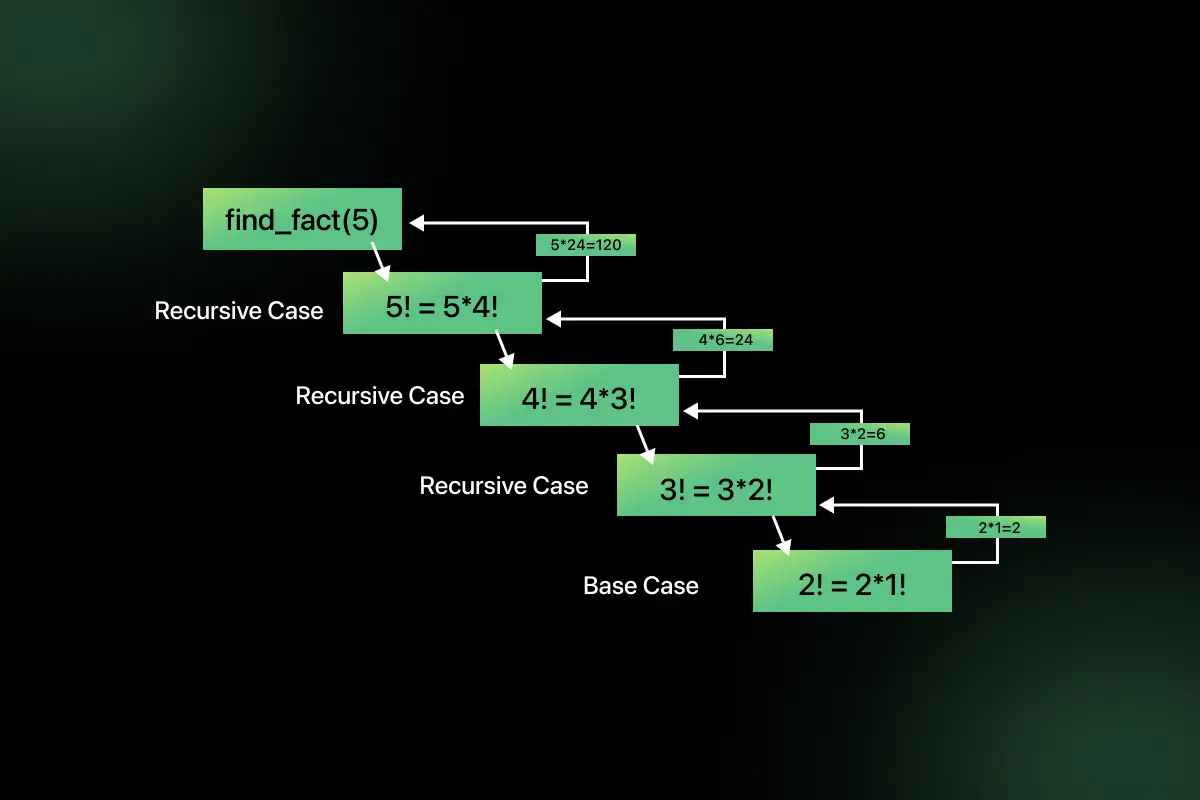
Simple example: Finding the factorial of 5:
5! = 5 × 4!
4! = 4 × 3!
3! = 3 × 2!
2! = 2 × 1
Each step solves a smaller version of the same problem, which shows how recursion works in practice.
Why Recursion is Important in DSA
Helps break complex problems into smaller parts: Recursion allows large problems to be divided into smaller, similar subproblems, making them easier to solve step by step.
- Reduces code complexity: Many problems that require long loops can be written in fewer and cleaner lines using recursion.
- Essential for tree and graph algorithms: Recursion is commonly used in tree traversals (inorder, preorder, postorder) and graph algorithms like DFS.
- Foundation for backtracking algorithms: Problems like N-Queens, Sudoku solver, and maze solving depend on recursive backtracking techniques.
- Used in divide-and-conquer algorithms: Important algorithms like Merge Sort and Quick Sort rely on recursion to divide problems and combine solutions efficiently.
How Recursion Works
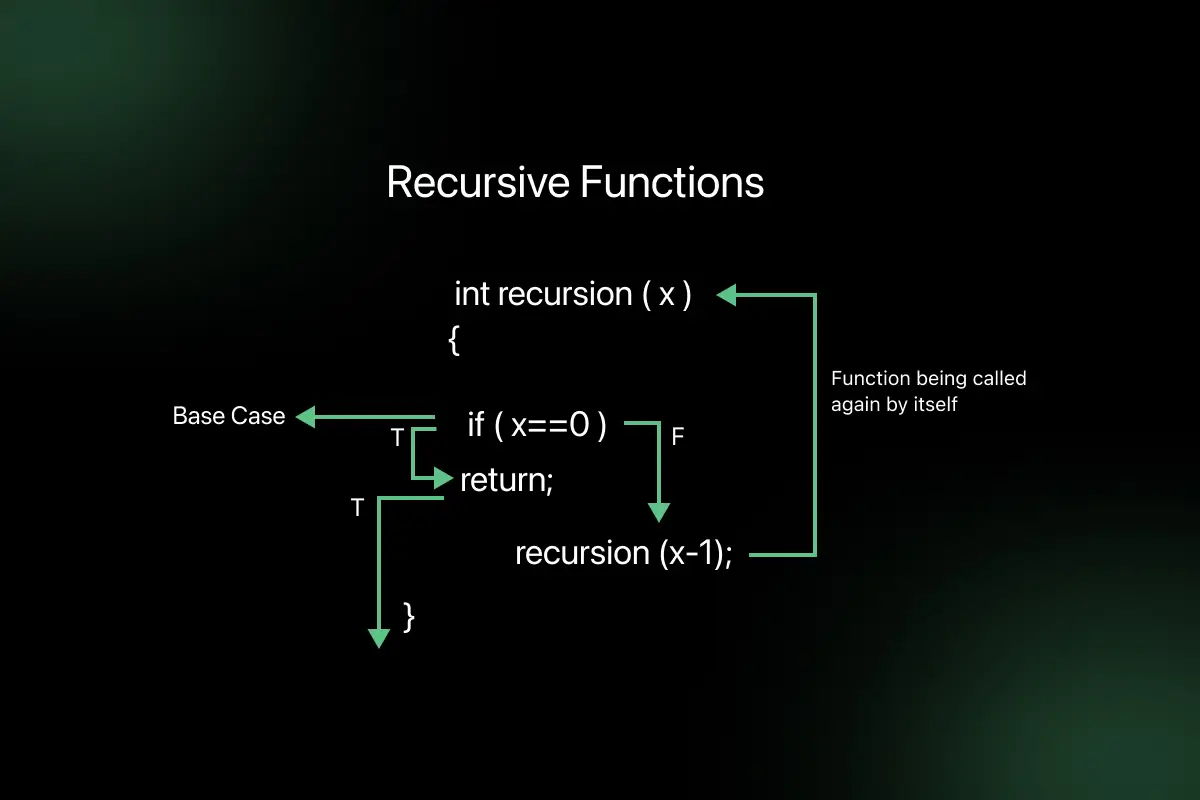
Recursion works by repeatedly calling the same function with smaller inputs until a stopping condition is reached. Every recursive solution mainly depends on two important parts: the base condition and the recursive call.
- Base condition (Stopping condition): This is the condition where the function stops calling itself. Without this, the recursion will continue indefinitely and cause a stack overflow error. For example, in factorial, when n = 1, the function returns 1.
- Recursive call: This is where the function calls itself with a smaller value of the problem. Each call moves the problem closer to the base condition.
- Call stack behavior: Every recursive call is stored in memory (call stack). Once the base condition is reached, the functions start returning results in reverse order.
Problem Example: Factorial Using Recursion
Problem statement: Write a recursive algorithm to find the factorial of a number n. Factorial is defined as:
n! = n × (n-1)!
Base condition: 1! = 1
Code Example (Python)
def factorial(n):
if n == 1: # Base condition
return 1
return n * factorial(n-1) # Recursive call
print(factorial(5))
How it works:
factorial(5) → 5 × factorial(4)
factorial(4) → 4 × factorial(3)
factorial(3) → 3 × factorial(2)
factorial(2) → 2 × factorial(1)
factorial(1) → 1 (base condition reached)
Then values return:
2 × 1 = 2
3 × 2 = 6
4 × 6 = 24
5 × 24 = 120

Recursion vs Iteration
Both recursion and iteration are used to repeat operations, but they differ in how they execute and manage memory.
Recursion solves problems using repeated function calls, while iteration uses loops like for and while. Choosing between them depends on problem complexity and performance needs.
| Factor | Recursion | Iteration |
| Approach | Uses function calling itself | Uses loops |
| Memory usage | Uses call stack memory | Uses less memory |
| Speed | Slight overhead due to function calls | Usually faster |
| Code readability | Cleaner for complex problems | Better for simple repetition |
| Use cases | Tree traversal, DFS, backtracking | Counting, array processing |
| Performance risk | Stack overflow possible | No stack overflow risk |
Real World Applications of Recursion
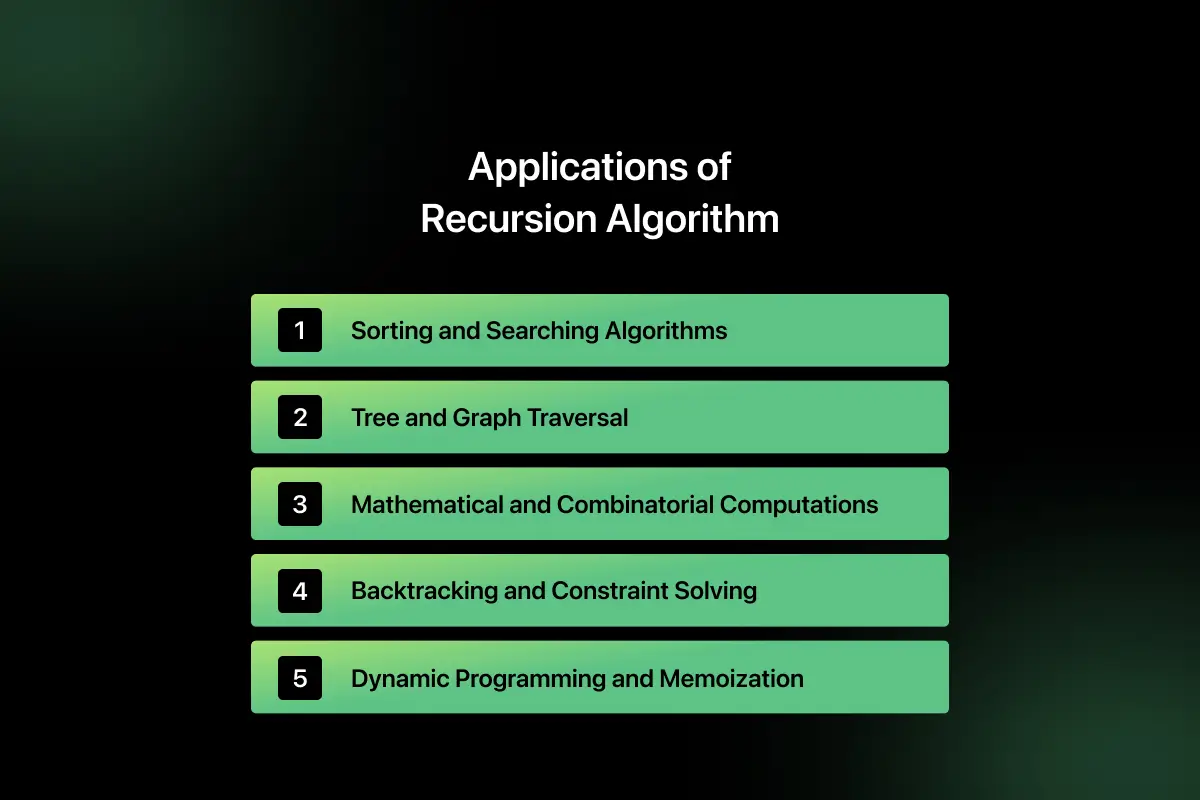
Recursion is widely used in computer science where problems naturally break into smaller similar tasks. Many system level and algorithmic solutions depend on recursive logic.
- Folder navigation systems: File systems are structured like trees. Recursion helps navigate folders and subfolders easily (like how operating systems display directory structures).
- Compiler parsing: Compilers use recursion to analyze nested code structures such as brackets, expressions, and syntax trees.
- Tree traversal algorithms: Operations like inorder, preorder, and postorder traversal of trees are naturally implemented using recursion.
- Search algorithms (DFS): Depth First Search uses recursion to explore nodes deeply before moving to the next branch.
- Backtracking problems: Problems like Sudoku, N-Queens, and maze solving use recursion to try possible solutions and backtrack when needed.
Common Problems Solved Using Recursion
Factorial calculation: Recursion is used because factorial naturally follows a smaller subproblem pattern:
n! = n × (n-1)!, making recursion a direct and clean solution.
- Fibonacci series: Each Fibonacci number depends on the previous two numbers, which makes recursion suitable for expressing this repeated relationship.
- Tower of Hanoi: This classic problem involves solving smaller disk movement problems repeatedly, which fits recursion perfectly.
- Binary tree traversal: Since trees are recursive structures (each node has subtrees), recursion simplifies traversal operations like inorder, preorder, and postorder.
- DFS traversal (Depth First Search): DFS uses recursion to explore nodes deeply before backtracking, making the traversal logic simple and structured.
Advantages and Limitations of Recursion
Advantages
- Cleaner and readable code: Recursion can make complex logic easier to write and understand compared to long iterative solutions.
- Effective for complex problems: Problems like tree traversal, backtracking, and divide and conquer become easier to implement using recursion.
- Natural fit for hierarchical data: Recursive solutions work well for structures like trees, graphs, and nested data.
Limitations
- Risk of stack overflow: If the base condition is missing or too many recursive calls occur, it can cause memory errors.
- Higher memory usage: Each recursive call uses stack memory, which may increase space complexity.
- Sometimes slower than loops: Function call overhead can make recursion slightly slower than iterative solutions in some cases.
Common Mistakes Beginners Make in Recursion
- Missing base condition: Not defining a proper stopping condition causes the function to call itself endlessly, leading to program failure.
- Infinite recursion: If the recursive call does not move toward the base condition, the function keeps executing without termination.
- Stack overflow errors: Too many recursive calls can fill the call stack memory, causing runtime errors, especially with large inputs.
- Incorrect recursive logic: Beginners often write recursive calls that do not correctly reduce the problem size, resulting in wrong outputs.
- Not understanding the call flow: Many errors happen because beginners do not visualize how recursive calls execute and return results step by step.
Interview Questions on Recursion
Recursion is an important topic in coding interviews because it tests how well you can break problems into smaller steps and think logically. Interviewers often ask both conceptual and problem-based questions to check your understanding of recursion in DSA and your ability to analyze recursive algorithms.
- What is recursion? Recursion is a technique where a function calls itself to solve smaller versions of the same problem until a base condition is reached.
- What is the difference between recursion and iteration? Recursion uses function calls and a call stack, while iteration uses loops. Recursion is better for complex structures; iteration is better for simple repetition.
- What is a base condition in recursion? A base condition is the stopping point of recursion that prevents infinite function calls.
- When should recursion be avoided? Recursion should be avoided when memory usage is critical or when an iterative solution is simpler and more efficient.
- What is the time complexity of recursion? It depends on the number of recursive calls. For example, factorial is O(n) while Fibonacci recursion can be O(2ⁿ) without optimization.
Practice tip: To strengthen your understanding, you can practice more recursion MCQ questions and DSA problems that involve recursive thinking patterns.
How to Practice Recursion Effectively
- Start with basic problems: Begin with simple problems like factorial and countdown programs to understand how recursive calls work.
- Solve Fibonacci problems: Practice Fibonacci to understand multiple recursive calls and how recursion grows with input size.
- Practice tree and graph problems: Move to binary tree traversal and DFS problems since these are common recursion-based interview questions.
- Understand the call stack: Trace recursive calls step by step to see how functions are stored and returned from memory.
- Convert recursion to iteration: Try rewriting recursive solutions using loops to clearly understand execution differences.
- Practice MCQs and exercises: Solve recursion MCQs, coding exercises, and topic-wise DSA practice questions to strengthen conceptual understanding.
- Prepare recursion interview questions: Practice common recursion interview questions like backtracking, subset generation, and divide and conquer problems to improve placement preparation.
Final Words
Recursion is a powerful problem-solving technique that helps simplify complex problems by breaking them into smaller and manageable subproblems. It plays an important role in DSA, especially in areas like tree traversal, backtracking, and divide-and-conquer algorithms. Understanding how recursion works also improves logical thinking and is essential for coding interviews
However, mastering recursion requires practice and a clear understanding of base conditions and call flow. By regularly practicing recursive problems, MCQs, and interview questions, you can develop strong problem-solving skills and confidently handle recursion-based questions in technical interviews.
FAQs
Recursion is a technique where a function calls itself to solve smaller instances of a problem.
Recursion is used in tree traversal, DFS, backtracking, divide and conquer, and dynamic programming problems.
A base condition stops recursion and prevents infinite function calls.
Recursion uses function calls while iteration uses loops to repeat operations.
Yes, recursion is frequently asked in interviews because it tests problem decomposition and logical thinking.



Aarthy is a passionate technical writer with diverse experience in web development, Web 3.0, AI, ML, and technical documentation. She has won over six national-level hackathons and blogathons. Additionally, she mentors students across communities, simplifying complex tech concepts for learners.



Aarthy is a passionate technical writer with diverse experience in web development, Web 3.0, AI, ML, and technical documentation. She has won over six national-level hackathons and blogathons. Additionally, she mentors students across communities, simplifying complex tech concepts for learners.
Related Posts
Searching Algorithm in Data Structure
Searching is one of the most fundamental operations in computer science because almost every application involves finding specific data efficiently. …
Warning: Undefined variable $post_id in /var/www/wordpress/wp-content/themes/placementpreparation/template-parts/popup-zenlite.php on line 1050
so far feels like...
