Tail vs Non – Tail Recursion
Recursion is an important concept in DSA, but understanding the different types of recursion is equally important for writing efficient algorithms.
Knowing the difference between tail recursion and non-tail recursion helps developers choose better approaches based on memory usage and performance. This topic is commonly asked in interviews because it tests both recursion fundamentals and optimization knowledge.
Understanding recursion types in DSA also helps improve code efficiency, especially for problems involving large inputs where stack usage matters.
In this article, you will learn what tail-recursive functions and non-tail recursion are, how they differ, when to use each, and how they impact algorithm performance and efficiency.
What Makes a Recursive Function Tail or Non-Tail
A recursive function is classified based on what happens after the recursive call.
- Tail recursion: A function is called tail recursive when the recursive call is the last operation in the function. This means once the function calls itself, no further computation is needed. The result of the recursive call is returned directly.
- Non-tail recursion: A function is non-tail recursive when some operations still need to be performed after the recursive call returns. This means the function has pending work, which increases stack usage.
Key idea:
- If nothing happens after the recursive call → Tail recursion
- If computation continues after the call → Non-tail recursion
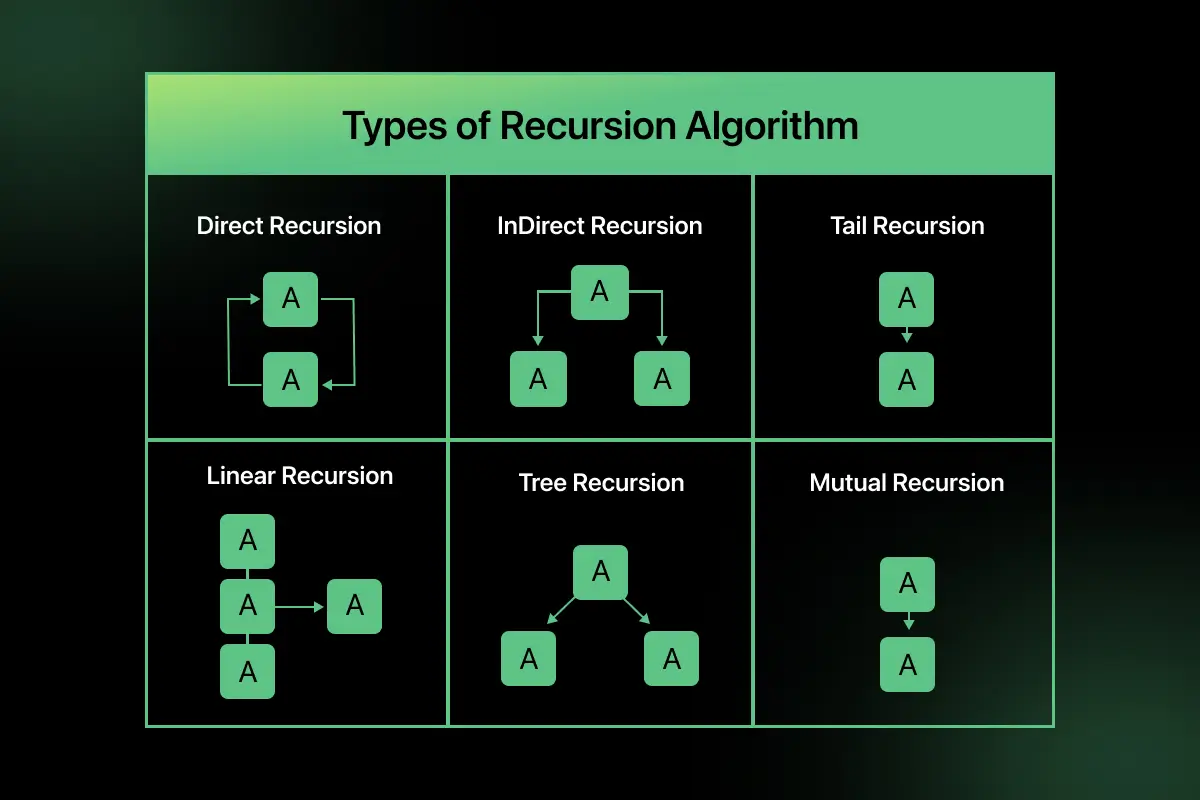
Key Difference Between Tail and Non-Tail Recursion
| Factor | Tail Recursion | Non-Tail Recursion |
| Operation after call | No | Yes |
| Memory usage | Lower | Higher |
| Optimization | Possible | Not possible |
| Performance | Better | Slower |
| Conversion to loop | Easy | Difficult |
How Tail Recursion Works (with Code Example)
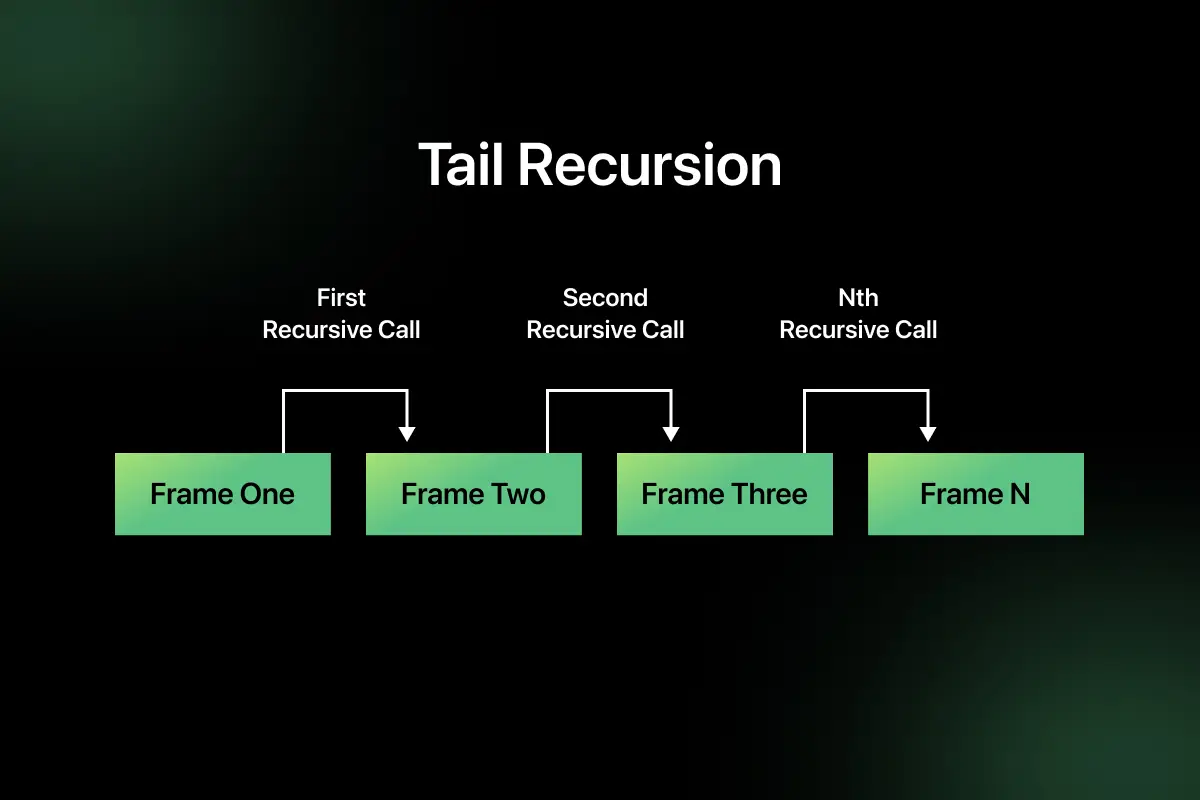
In tail recursion, the recursive call is the last operation performed by the function. This means no computation is left after the function calls itself. Because of this behavior, compilers can optimize tail-recursive functions to reduce memory usage.
Problem Example: Factorial Using Tail Recursion
Idea: Instead of multiplying after the recursive call, we maintain the result using an extra variable (accumulator).
Code Example (Python)
def factorial(n, result=1):
if n == 1: # Base condition
return result
return factorial(n-1, n * result) # Tail recursive call
print(factorial(5))
How it works:
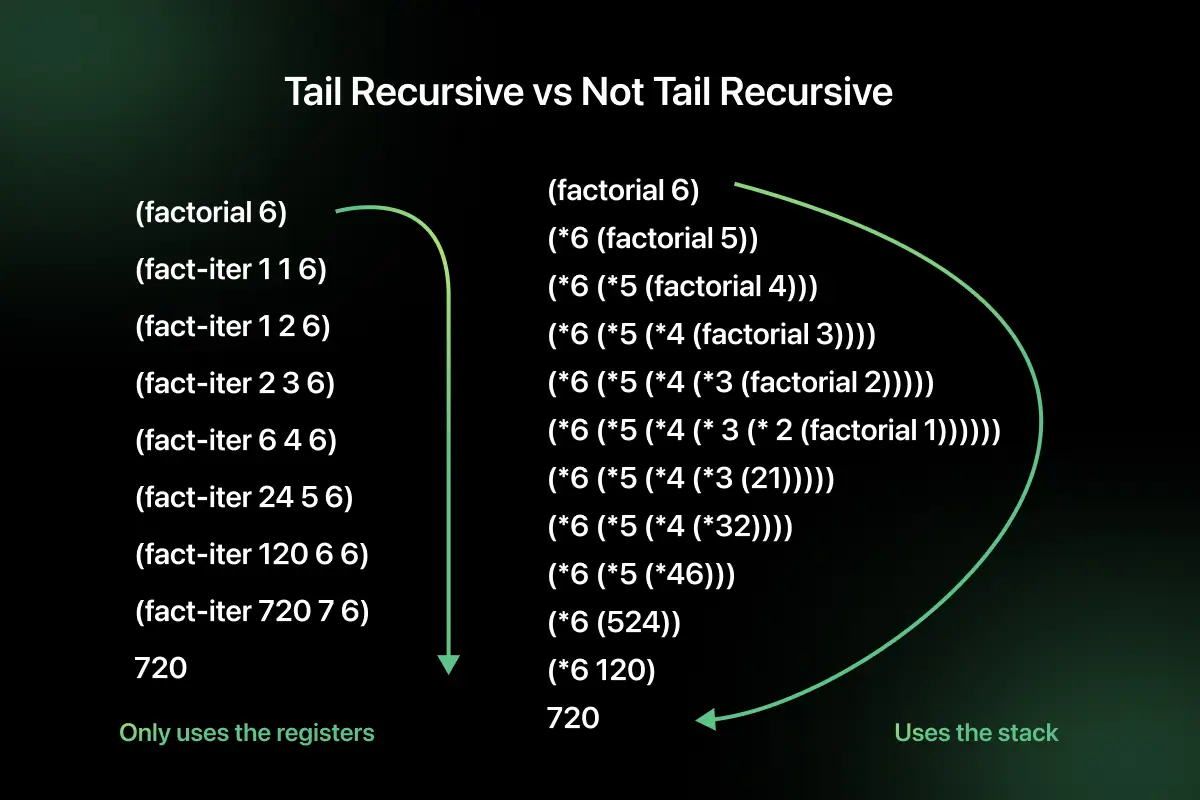
factorial(5,1) → factorial(4,5)
factorial(4,5) → factorial(3,20)
factorial(3,20) → factorial(2,60)
factorial(2,60) → factorial(1,120)
factorial(1,120) → 120
Key point: Since no work is done after the recursive call, this is a tail-recursive function.
How Non-Tail Recursion Works (with Code Example)
In non-tail recursion, the recursive call is not the last operation. After the function calls itself, some computation still needs to be completed. Because of this pending work, each recursive call must remain in the call stack until all computations finish.
Problem Example: Factorial Using Non-Tail Recursion
Idea: The multiplication happens after the recursive call returns, which makes it non-tail recursion.
Code Example (Python)
def factorial(n):
if n == 1: # Base condition
return 1
return n * factorial(n-1) # Work happens after recursive call
print(factorial(5))
How it works:
factorial(5) → 5 × factorial(4)
factorial(4) → 4 × factorial(3)
factorial(3) → 3 × factorial(2)
factorial(2) → 2 × factorial(1)
factorial(1) → 1
Then the results return:
2 × 1 = 2
3 × 2 = 6
4 × 6 = 24
5 × 24 = 120
Key point: Since multiplication happens after the recursive call returns, this is non-tail recursion.
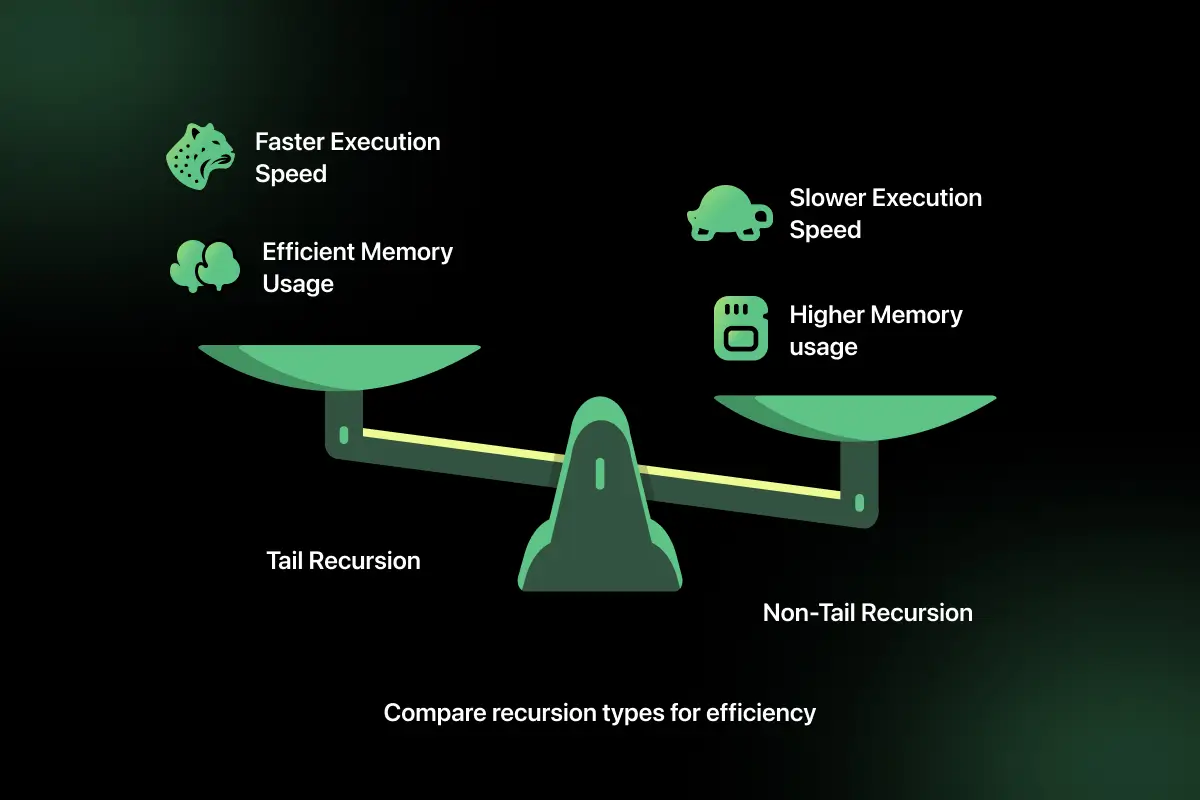
Why Tail Recursion is More Efficient
- Compiler optimization (Tail Call Optimization): Many compilers can optimize tail-recursive functions by reusing the same stack frame instead of creating new ones, reducing memory overhead.
- Uses less stack memory: Since no pending operations remain after the recursive call, fewer function states need to be stored in memory compared to non-tail recursion.
- Better performance for large inputs: Reduced stack usage can improve performance and prevent stack overflow errors when working with large recursive calls.
- Common in functional programming: Languages like Scala and functional programming practices prefer tail recursion because of its optimization benefits and predictable memory usage.
- Easier conversion to iteration: Tail-recursive functions can often be converted into loops, making them more efficient in practical implementations.
Real Use Cases of Tail and Non-Tail Recursion
Tail Recursion Use Cases
- Large calculations: Tail recursion is useful in problems like the factorial of large numbers or mathematical computations where memory efficiency is important.
- Functional programming: Tail recursion is widely used in functional programming to replace loops and improve performance through compiler optimization.
- Data processing tasks: Operations that require repeated transformation of data (like cumulative sums) often use tail recursion.Non-Tail Recursion Use Cases
- Tree traversal: Algorithms like inorder, preorder, and postorder traversal require operations after recursive calls, making them non-tail recursive.
- DFS (Depth First Search): DFS uses non-tail recursion because nodes are processed after exploring deeper branches.
- Divide and conquer algorithms: Algorithms like Merge Sort and Quick Sort use non-tail recursion because they combine results after recursive calls.

How to Convert Non-Tail Recursion to Tail Recursion
Non-tail recursion can often be converted into tail recursion by using an accumulator variable.
An accumulator stores the intermediate result so that no computation is left after the recursive call.
Concept
- Non-tail recursion: Work happens after the recursive call.
- Tail recursion: Store result first → recursive call becomes last step.
Example Conversion
Non-tail recursion (Factorial)
def factorial(n):
if n == 1:
return 1
return n * factorial(n-1)
Here, multiplication happens after recursion, so it is non-tail recursion.
Tail recursion version
def factorial(n, result=1):
if n == 1:
return result
return factorial(n-1, n * result)
Key idea of conversion
- Add accumulator variable
- Move computation before recursive call
- Make recursive call the final step
Result: This reduces stack dependency and improves efficiency in optimized environments.
Common Interview Questions on Tail vs Non-Tail Recursion
Understanding tail recursion vs non-tail recursion is important for technical interviews because it tests your knowledge of recursion behavior, memory usage, and optimization techniques. Interviewers often ask conceptual questions along with small coding problems to check whether you understand how recursion impacts performance.
Common Interview Questions
- What is the difference between tail and non-tail recursion? Tail recursion has the recursive call as the last operation, while non-tail recursion performs additional work after the recursive call returns.
- Why is tail recursion considered faster? Tail recursion can be optimized using Tail Call Optimization, which reduces stack usage and improves memory efficiency.
- What is Tail Call Optimization (TCO)? It is a compiler optimization technique where the current function stack frame is reused for the recursive call instead of creating a new one.
- Can non-tail recursion be converted to tail recursion? Yes, by using an accumulator variable to store intermediate results and making the recursive call the final operation.
Example interview question: Convert a factorial non-tail recursive function into a tail recursive function and explain the difference in memory usage.
Practice tip: Practicing recursion interview questions and recursion optimization problems helps build a strong understanding of recursion efficiency concepts.
Final Words
Understanding the difference between these recursion types helps you write better optimized code and improves your problem-solving approach.
Since this is a commonly tested interview topic, practicing both tail-recursive and non-tail-recursive solutions will help you recognize when to use each approach effectively.
FAQs
Tail recursion is when the recursive call is the last operation in a function with no pending computation afterward.
Non-tail recursion occurs when operations remain after the recursive call returns.
Tail recursion can be optimized to use less memory and reduce stack usage compared to non-tail recursion.
Yes, by using an accumulator variable to store intermediate results before the recursive call.
It is a compiler optimization that reuses stack frames in tail recursion to improve performance.



Aarthy is a passionate technical writer with diverse experience in web development, Web 3.0, AI, ML, and technical documentation. She has won over six national-level hackathons and blogathons. Additionally, she mentors students across communities, simplifying complex tech concepts for learners.



Aarthy is a passionate technical writer with diverse experience in web development, Web 3.0, AI, ML, and technical documentation. She has won over six national-level hackathons and blogathons. Additionally, she mentors students across communities, simplifying complex tech concepts for learners.
Related Posts
Searching Algorithm in Data Structure
Searching is one of the most fundamental operations in computer science because almost every application involves finding specific data efficiently. …
Warning: Undefined variable $post_id in /var/www/wordpress/wp-content/themes/placementpreparation/template-parts/popup-zenlite.php on line 1050
so far feels like...
