Arrays in Data Structure
Arrays are one of the first and most important data structures every programming learner studies. From storing student marks to solving coding interview problems, arrays form the base of problem-solving in Data Structures and Algorithms.
Understanding arrays helps you learn indexing logic, memory management, and algorithm thinking. Many advanced concepts, like sliding window, prefix sum, and dynamic programming, start with array fundamentals.
In this guide, you will learn how arrays work internally, where they are used, how operations work, and how they help in coding interviews.
What is an Array in Data Structure
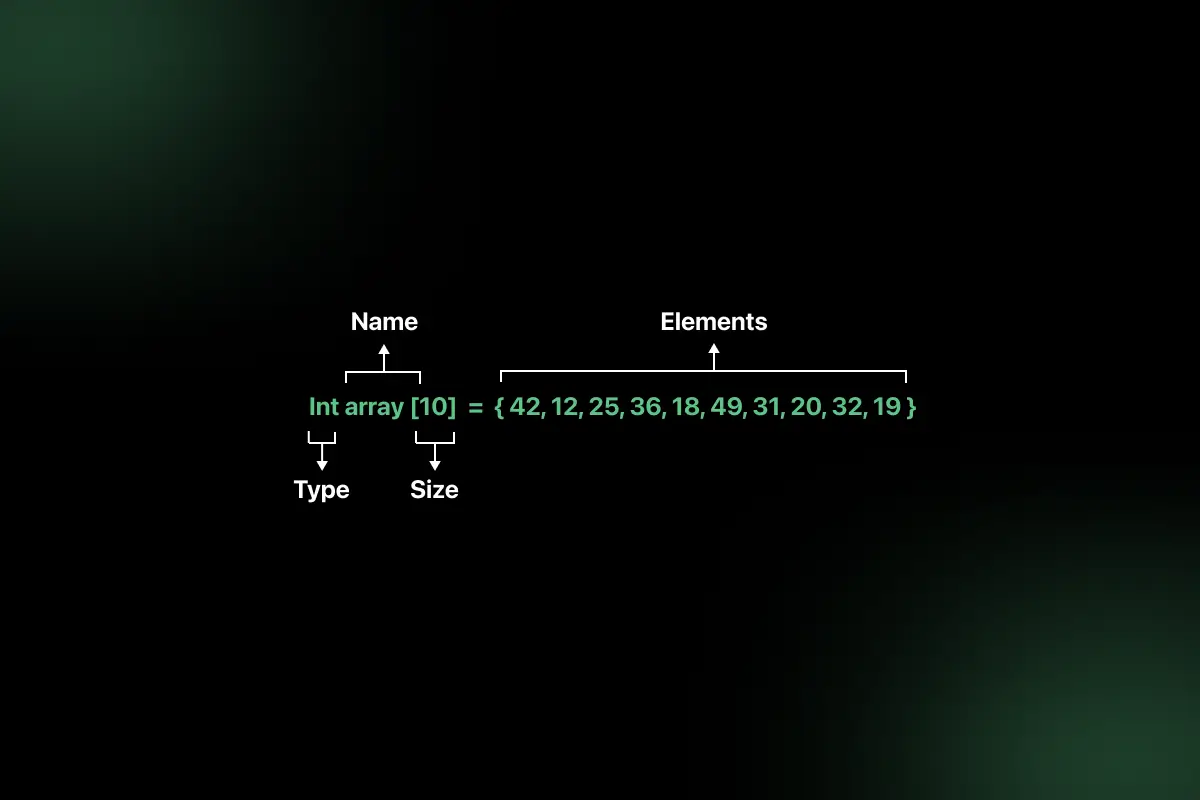
An array is a linear data structure that stores elements of the same data type in contiguous memory locations. Each element is accessed using an index, which allows fast data retrieval.
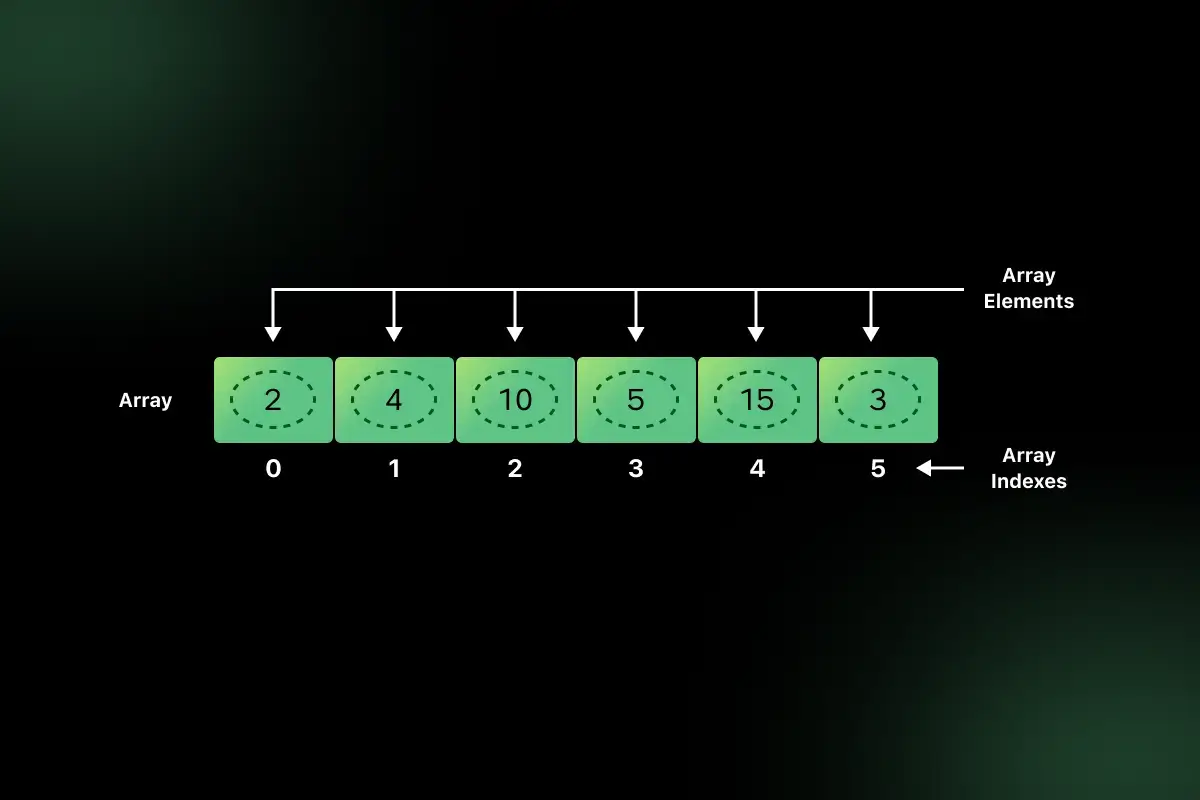
Example:
int arr[5] = {10, 20, 30, 40, 50};
Here:
10 is at index 0
30 is at index 2
50 is at index 4
Key characteristics:
- Fixed size
- Same data type
- Index-based access
- Continuous memory allocation
How Array Memory Representation Works
Arrays store data in continuous memory locations which makes access very fast.
Address calculation formula:
Address = Base Address + (Index × Size of element)
Example:
If base address = 1000
Element size = 4 bytes
Index = 3
Address = 1000 + (3×4) = 1012
This is why array access takes O(1) time.
Types of Arrays in Data Structure
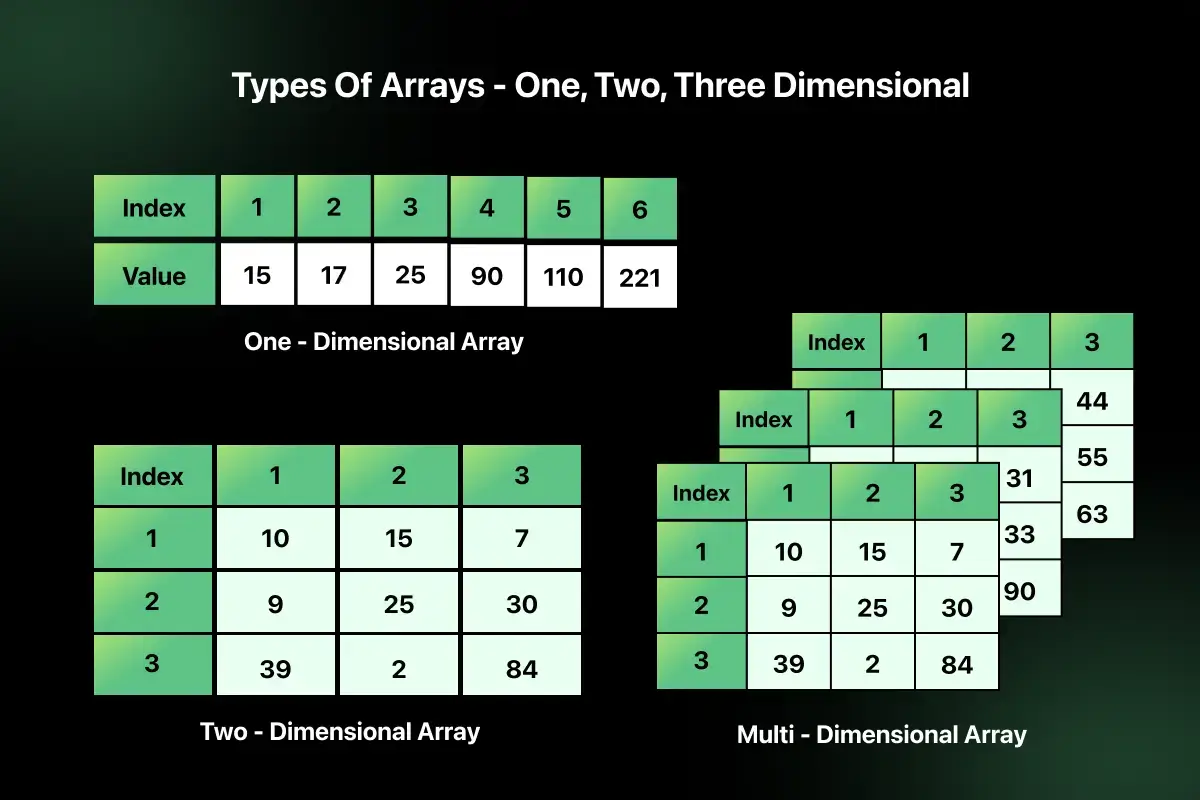
Common array types used in DSA include:
1. One-Dimensional Array
A one-dimensional array stores elements in a single row and is the simplest type of array. Each element is accessed using one index.
int arr[3] = {5,10,15};
2. Two-Dimensional Array
A two-dimensional array stores data in rows and columns, similar to a table or matrix. It uses two indices to access elements.
int matrix[2][2] = {
{1,2},
{3,4}
};
3. Multidimensional Array
Multidimensional arrays are extensions of 2D arrays and are used when data needs more than two dimensions.
Used in:
- Matrix problems
- Image processing
- Game grids
Static Array: Fixed size defined at compile time.
Dynamic Array: Size can grow (example: ArrayList, vectors).
Basic Array Operations with Coding Examples
Arrays support several basic operations that allow you to access and modify data efficiently. These operations form the foundation for many DSA problems.
1. Traversal
Traversal means accessing each element of the array one by one. It is commonly used to display or process array elements.
Example:
for(int i=0;i<5;i++)
{
printf(“%d “, arr[i]);
}
2. Insertion
Insertion means adding or updating an element at a specific index. In arrays, this is usually done by assigning a value to an index.
Example:
arr[2] = 25;
If inserting in between elements, shifting may be required.
3. Deletion
Deletion means removing an element from the array. Since arrays use continuous memory, elements must be shifted to fill the gap.
Example:
for(int i=2;i<4;i++)
{
arr[i] = arr[i+1];
}
4. Searching
Searching means finding whether an element exists in the array. The simplest method is linear search.
Example:
for(int i=0;i<5;i++)
{
if(arr[i]==30)
printf(“Found”);
}
Why Arrays Are Important in DSA Problem Solving
Arrays play a key role in developing strong problem solving skills because most DSA problems start with array concepts. Learning arrays helps you understand how to approach logic-based questions efficiently.
- Builds index-based thinking: Arrays teach how to use positions to access and manipulate data efficiently, which is important for algorithm design.
- Improves pattern recognition: Many common problems, like finding the maximum element, removing duplicates, and array rotation, help develop logical thinking.
- Introduces optimization techniques: Concepts like two pointers, sliding window, and prefix sum start with arrays and help solve problems faster.
- Strengthens complexity understanding: Arrays help you understand time complexity concepts like O(1) access and O(n) traversal, which are important in interviews.
Real World Applications of Arrays
Arrays are widely used in real-world systems where large amounts of similar data need to be stored and accessed efficiently.
- Student record management: Arrays are used to store marks, roll numbers, or attendance data of students in education systems.
- Image processing: Images are stored as 2D arrays where each element represents a pixel value or color information.
- Database storage: Arrays help temporarily store records and query results before processing in database systems.
- Ranking systems: Leaderboards in games or coding platforms use arrays to store and update scores.
Advantages and Limitations of Arrays
Advantages
- Fast data access
- Easy implementation
- Memory efficient
- Useful for algorithms
Limitations
- Fixed size
- Costly insertion
- Memory wastage possible
- Requires continuous memory
Time Complexity of Array Operations
| Operation | Time Complexity |
| Access | O(1) |
| Search | O(n) |
| Insertion | O(n) |
| Deletion | O(n) |
| Traversal | O(n) |
Why Learning Arrays is Important Before Other Data Structures
Arrays form the base of many other data structures, like:
- Stack
- Queue
- Hash tables
- Dynamic programming
- Graph algorithms
Learning arrays improves:
- Logical thinking
- Algorithm understanding
- Interview preparation
- Optimization skills

How to Practice Array Problems for Placements
Start with simple problems:
Beginner:
- Find largest element
- Reverse array
- Sum of elements
Intermediate:
- Remove duplicates
- Move zeros
- Rotate array
Advanced:
- Kadane algorithm
- Two sum problem
- Sliding window maximum
Consistent practice helps build strong DSA fundamentals.
Final Words
Arrays are the most fundamental data structure in programming and form the base of algorithm learning. They help developers understand indexing, memory usage, and problem-solving techniques used in coding interviews.
Mastering arrays makes it easier to learn advanced data structures and improves logical thinking. If you are preparing for placements or technical interviews, arrays should be your starting point before moving to more complex topics.
FAQs
An array is a linear data structure that stores elements of the same type in continuous memory locations and allows access using index positions.
Arrays help build problem solving skills and are used in many coding interview questions and algorithm techniques like sliding window and prefix sum.
Common types include one-dimensional arrays, two-dimensional arrays, multidimensional arrays, static arrays, and dynamic arrays.
Array access takes O(1) time because elements are stored in contiguous memory and accessed using index formulas.
Arrays are used in image processing, databases, storing records, leaderboards, and many algorithm implementations.



Aarthy is a passionate technical writer with diverse experience in web development, Web 3.0, AI, ML, and technical documentation. She has won over six national-level hackathons and blogathons. Additionally, she mentors students across communities, simplifying complex tech concepts for learners.



Aarthy is a passionate technical writer with diverse experience in web development, Web 3.0, AI, ML, and technical documentation. She has won over six national-level hackathons and blogathons. Additionally, she mentors students across communities, simplifying complex tech concepts for learners.
Related Posts
Searching Algorithm in Data Structure
Searching is one of the most fundamental operations in computer science because almost every application involves finding specific data efficiently. …

Warning: Undefined variable $post_id in /var/www/wordpress/wp-content/themes/placementpreparation/template-parts/popup-zenlite.php on line 1050
so far feels like...
