Binary Tree in Data Structure
Binary trees are one of the most important non-linear data structures used to represent hierarchical relationships between data.
While arrays and linked lists store data sequentially, binary trees organize information in a structured hierarchy. Learning binary trees helps you develop recursion skills, understand hierarchical data representation, and master traversal techniques that are frequently tested in coding interviews.
In this guide, you will learn how binary trees work, their types, operations, traversal techniques, real-world applications, and how to practice binary tree problems effectively.
What is a Binary Tree in Data Structure
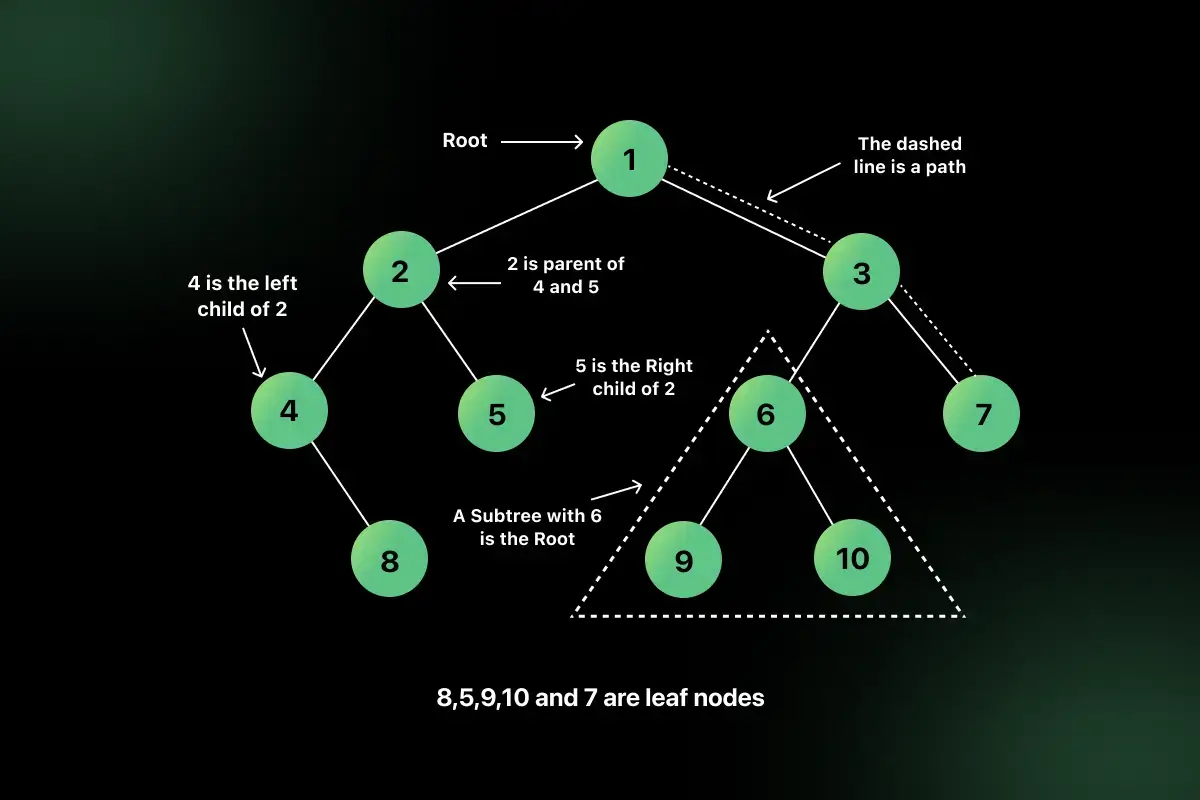
A binary tree is a hierarchical data structure in which each node can have at most two children, known as the left child and the right child. This limitation of two children makes the structure simple to manage while still being powerful enough to solve complex problems.
Each node in a binary tree typically contains three components:
- Data value stored in the node
- Pointer to the left child
- Pointer to the right child
Basic node structure example:
struct Node
{
int data;
struct Node* left;
struct Node* right;
};
Important terminology used in binary trees includes:
- Root node refers to the first node of the tree from which all other nodes originate.
- A parent node is a node that has one or more child nodes connected below it.
- A child node is a node connected below another node.
- A leaf node is a node that does not have any children.
- A subtree is a smaller tree formed from any node and its descendants.
Example structure:
/ \
20 30
/ \
40 50
This hierarchical arrangement makes binary trees suitable for representing structured relationships such as organizational charts or file directories.
How Binary Trees Work Internally
Binary trees work by connecting nodes using pointers, creating a hierarchical structure rather than a linear one. Each node contains references to its left and right children, which allows the structure to branch into multiple paths.
When elements are inserted, they are placed based on the structure rules of the specific tree type.
For example, in a basic binary tree, nodes may be added level by level, while in a Binary Search Tree, they are placed according to value comparisons.
Example insertion flow:
Insert 10 → becomes root node
Insert 20 → becomes left child
Insert 30 → becomes right child
Resulting structure:
10
/ \
20 30
Important structural concepts include:
- The height of a tree refers to the number of edges in the longest path from the root node to a leaf node. This is important when analyzing tree performance.
- The depth of a node refers to the number of edges from the root node to that specific node.
- The level of a node indicates its position in the tree hierarchy, starting from the root at level zero.
Understanding these concepts helps in solving common interview problems such as calculating tree height, finding depth, and performing traversals.

Types of Binary Trees in Data Structure
Binary trees can be categorized based on how nodes are arranged and how balanced the structure is. Understanding these types helps determine performance and use cases.
1. Full Binary Tree
A full binary tree is a tree in which every node has either zero or exactly two children. This means no node has only one child, which keeps the structure well defined.
Example:
10
/ \
20 30
Full binary trees are commonly used in expression trees where operations require two operands.
2. Complete Binary Tree
A complete binary tree is a tree where all levels are filled except possibly the last level, which is filled from left to right.
This type of structure is used in heap data structures because it allows efficient storage using arrays.
3. Perfect Binary Tree
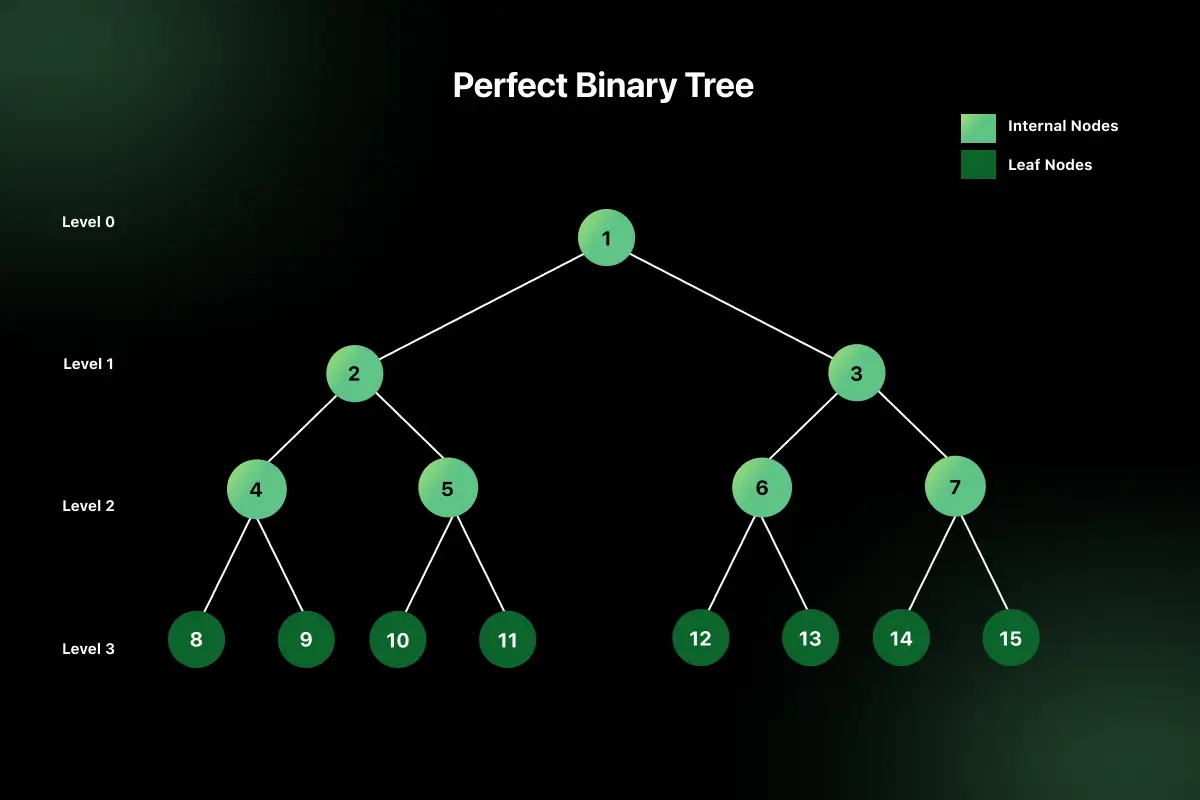
A perfect binary tree is a tree in which all internal nodes have exactly two children and all leaf nodes exist at the same level.
This structure has predictable properties such as:
Number of nodes = 2ⁿ − 1
Perfect binary trees are mostly used in theoretical analysis rather than practical applications.
4. Balanced Binary Tree
A balanced binary tree is a tree where the height difference between left and right subtrees remains small. This ensures operations remain efficient.
Examples include:
- AVL trees
- Red-Black trees
Balanced trees are important because they maintain search efficiency close to O(log n).
5. Skewed Binary Tree
A skewed binary tree is a tree where nodes are arranged in a single direction, either left or right. This makes the structure behave similarly to a linked list.
Example:
10
|
20
|
30
This structure is inefficient because search operations degrade to O(n).
Understanding these types helps developers evaluate tree efficiency and choose appropriate implementations.
Binary Tree Traversal Techniques
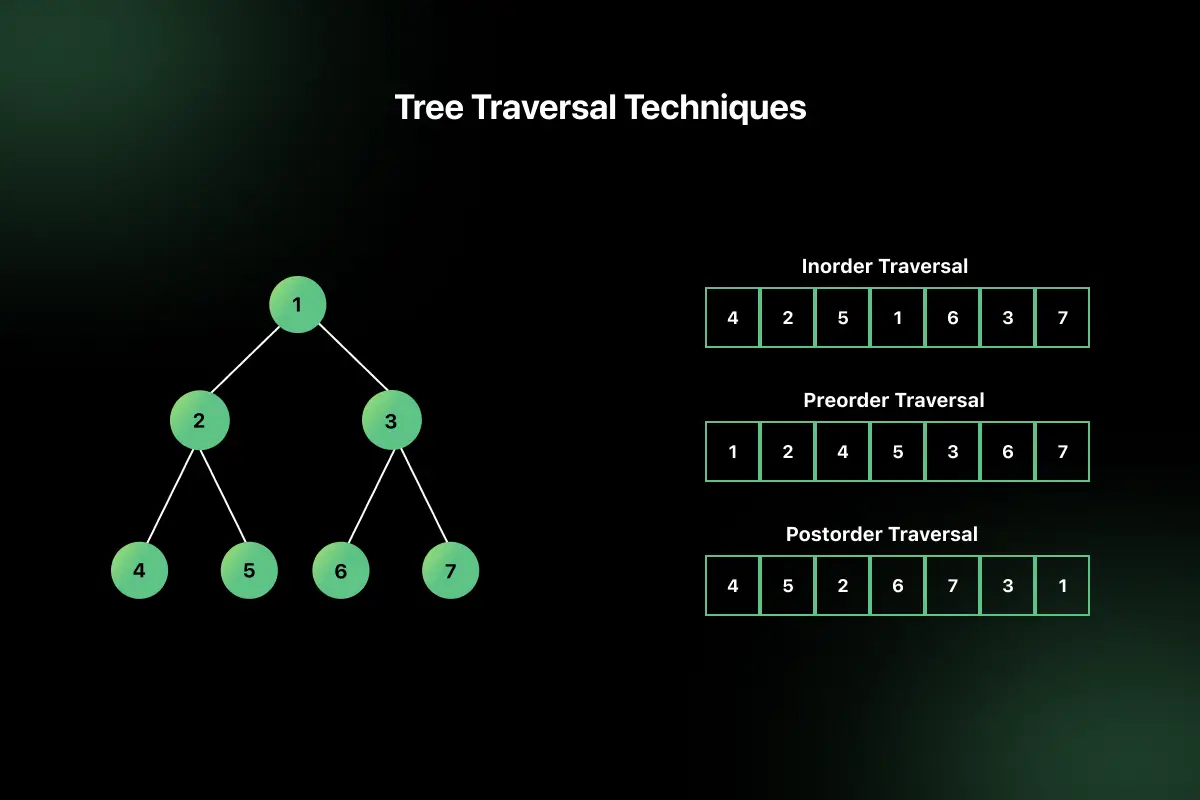
Traversal refers to the process of visiting every node in a binary tree in a specific order. Traversal techniques are extremely important because most tree-based interview problems depend on traversal logic.
1. Inorder Traversal
In inorder traversal, nodes are visited in the order:
Left → Root → Right
This traversal is particularly useful in Binary Search Trees because it produces sorted output.
Example:
void inorder(Node* root)
{
if(root==NULL)
return;
inorder(root->left);
printf(“%d “,root->data);
inorder(root->right);
}
2. Preorder Traversal
In preorder traversal, nodes are visited as:
Root → Left → Right
This method is commonly used when copying trees or creating tree structures.
3. Postorder Traversal
In postorder traversal, nodes are visited as:
Left → Right → Root
This traversal is useful when deleting trees because child nodes must be removed before parent nodes.
4. Level Order Traversal
Level order traversal visits nodes level by level from top to bottom. This traversal uses a queue and forms the basis of Breadth First Search (BFS).
Traversal techniques are essential because they appear in almost every binary tree interview problem.
Basic Binary Tree Operations
Binary trees support several fundamental operations that help manipulate and analyze the structure.
- Insertion involves adding a new node at the correct position while maintaining the structure rules.
- Searching involves checking whether a particular value exists in the tree by traversing nodes.
- Deletion involves removing a node and restructuring the tree to maintain consistency.
- Traversal involves visiting nodes to process or display data.
Example search logic:
if(root==NULL)
return NULL;
if(root->data==value)
return root;
These operations form the basis for more advanced tree algorithms.
Why Binary Trees Are Important in DSA Problem Solving
Binary trees play a major role in improving algorithmic thinking because they introduce hierarchical problem solving and recursive logic.
They help developers:
- Improve recursion skills since most tree problems rely on recursive solutions.
- Understand divide and conquer strategies because tree problems often involve solving subtrees independently.
- Prepare for interviews since common questions include calculating height, counting nodes, and finding the lowest common ancestors.
- Learn advanced structures because Binary Search Trees, heaps, and segment trees all originate from binary tree concepts.
Binary trees also introduce important algorithmic ideas such as Depth First Search (DFS), Breadth First Search (BFS), and tree-based dynamic programming.
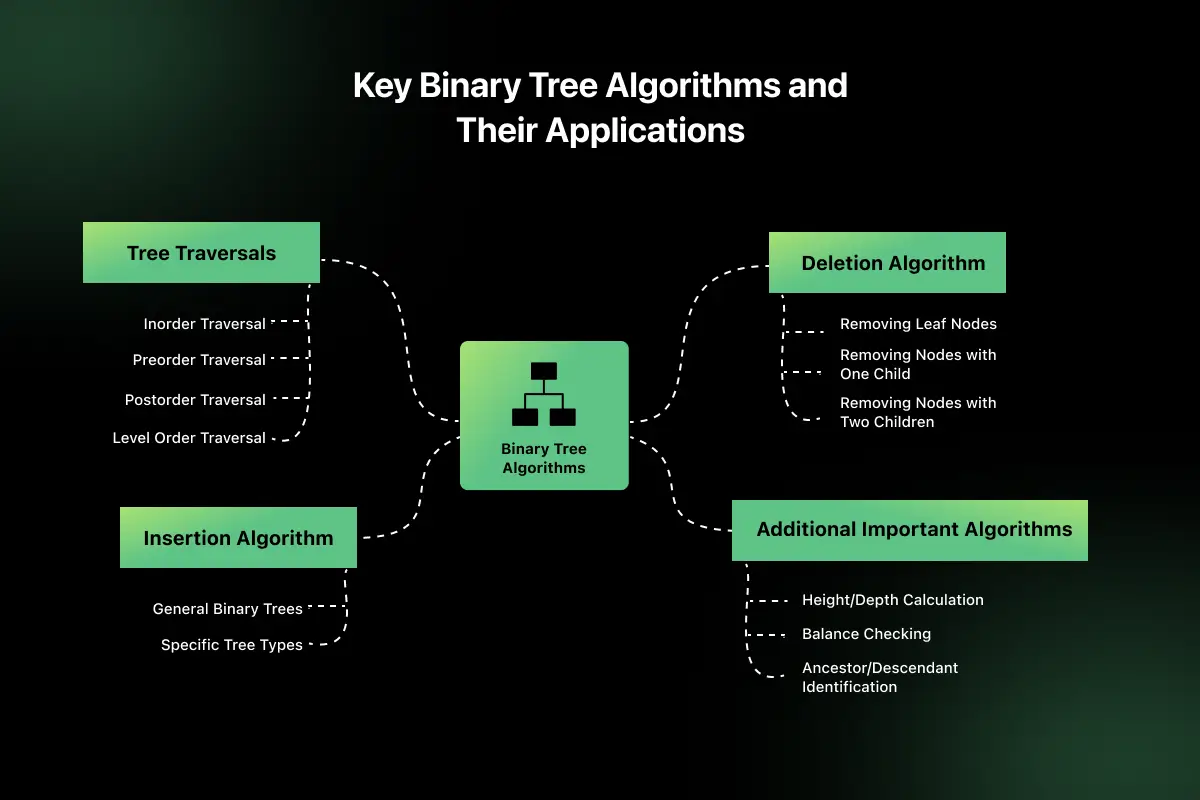
Real World Applications of Binary Trees
Binary trees are widely used in real-world systems that require hierarchical data organization.
Some important applications include:
- File systems: Operating systems organize folders and files using tree-like structures.
- Database indexing: B-tree and B+ tree indexing methods originate from binary tree concepts.
- Expression trees: Compilers use trees to evaluate mathematical expressions.
- Decision trees: Machine learning algorithms use tree structures for classification.
- Routing systems: Network routing algorithms use tree-based decision structures.
For example, the folder structure in a computer acts like a tree where each folder may contain subfolders, forming a hierarchical structure.
Advantages and Limitations of Binary Trees
Advantages
- Represents hierarchical data
- Efficient searching in BST
- Dynamic memory allocation
- Supports recursion-based algorithms
Limitations
- Complex implementation
- Memory overhead due to pointers
- Balancing required for efficiency
- Traversal needed for search
Time Complexity of Binary Tree Operations
|
Operation |
Time Complexity |
|
Search |
O(n) |
|
Insertion |
O(n) |
|
Traversal |
O(n) |
In balanced binary trees, operations improve to O(log n), which is why balanced trees are preferred in real-world applications.
When Should You Use a Binary Tree
Binary trees should be used when data needs to be represented in a hierarchical format or when fast searching and sorting operations are required.
They are especially useful when:
- Data follows a parent-child relationship
- Searching efficiency is important
- Decision-based processing is required
- Sorting operations are needed
Binary trees may not be suitable when:
- Data is purely sequential
- Direct indexing is required
- Memory constraints are strict
Choosing the right data structure is important for building efficient algorithms.
How to Practice Binary Tree Problems for Placements
To master binary trees, it is important to practice problems in increasing difficulty levels.
Start with beginner problems such as tree traversal, node counting, and height calculation. Then move to intermediate problems such as mirror tree, level order traversal, and diameter calculation.
Finally, attempt advanced problems such as the lowest common ancestor, BST validation, and tree serialization.
Regular practice of tree problems improves recursion skills and prepares candidates for technical interviews.
Final Words
Binary trees are a fundamental data structure that helps developers understand hierarchical data representation and recursion based problem solving. They are widely used in databases, compilers, operating systems, and artificial intelligence systems.
Mastering binary trees prepares you for advanced topics such as Binary Search Trees, heaps, and graph algorithms. Developing strong tree fundamentals significantly improves problem-solving ability and coding interview performance.
FAQs
A binary tree is a hierarchical data structure where each node can have at most two children called the left and right child.
Common types include full binary tree, complete binary tree, perfect binary tree, balanced tree, and skewed tree.
Binary trees help implement hierarchical data representation, searching algorithms, and recursive problem-solving.
Tree traversal means visiting all nodes of a tree using methods such as inorder, preorder, postorder, or level order.
Binary trees are used in file systems, database indexing, compilers, AI decision trees, and routing algorithms.



Aarthy is a passionate technical writer with diverse experience in web development, Web 3.0, AI, ML, and technical documentation. She has won over six national-level hackathons and blogathons. Additionally, she mentors students across communities, simplifying complex tech concepts for learners.



Aarthy is a passionate technical writer with diverse experience in web development, Web 3.0, AI, ML, and technical documentation. She has won over six national-level hackathons and blogathons. Additionally, she mentors students across communities, simplifying complex tech concepts for learners.
Related Posts
Searching Algorithm in Data Structure
Searching is one of the most fundamental operations in computer science because almost every application involves finding specific data efficiently. …
Warning: Undefined variable $post_id in /var/www/wordpress/wp-content/themes/placementpreparation/template-parts/popup-zenlite.php on line 1050
so far feels like...
