Data Structure and Algorithm (DSA) – beginner’s Guide

Have you ever wondered what is DSA and why everyone keeps saying it is essential for programming?
Data Structures and Algorithms form the foundation of writing efficient code and are heavily tested in technical interviews.
In this guide, you will clearly understand what DSA is, how it works, and why every beginner should learn it.
What Is a Data Structure in Programming?
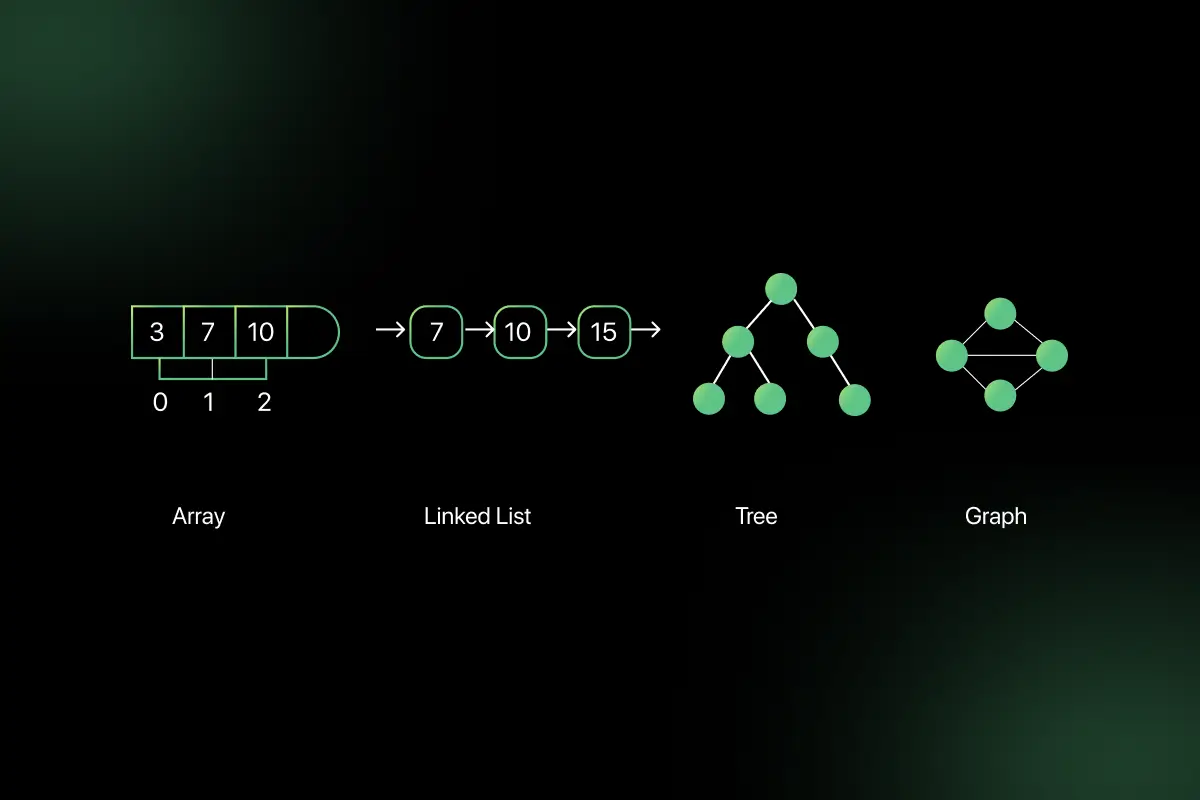
To understand what is a data structure in programming, think of it as a method of organizing and storing data so that it can be used efficiently.
In simple terms, the data structure definition refers to a specific format for arranging data in memory to perform operations like searching, inserting, deleting, or updating smoothly.
Data can be organized in different ways depending on the problem requirement. For example, arrays store elements in a contiguous memory block and allow direct indexing, linked lists connect elements using references, and stacks follow a last-in, first-out order.
Each data structure is designed to support specific operations efficiently, which is why choosing the right one is crucial in programming.
Now, let us look at some real-life problem scenarios that show why data structures are important.
Problem Scenario 1: Managing Product Data in an E-commerce Platform
An online shopping platform needs to store product details, prices, categories, user reviews, and inventory information for lakhs of products.
Challenges without proper data structures:
Challenge 1: How will you store massive product data in an organized and structured manner?
Challenge 2: How will you search, filter, and retrieve specific products quickly when users apply filters and search queries?
Problem Scenario 2: Handling Messages in a Chat Application
A messaging platform must store, retrieve, and display millions of messages for users in real time.
Challenges without proper data structures:
Challenge 1: How will messages be stored so that they appear in the correct order for each user?
Challenge 2: How will older messages be retrieved efficiently without slowing down the system?
Each of these real-world problems involves large data volumes, frequent searching, fast retrieval, and efficient storage. Without proper data structures, systems become slow, unorganized, and unreliable.
What Is an Algorithm?
An algorithm is a step-by-step procedure used to solve a specific problem or perform a task in programming. When learning what is data structure and algorithm, it is important to understand that while data structures organize data, algorithms define the logical steps to process that data efficiently.
In simple terms, an algorithm is a clear sequence of instructions that takes input, processes it, and produces the desired output.
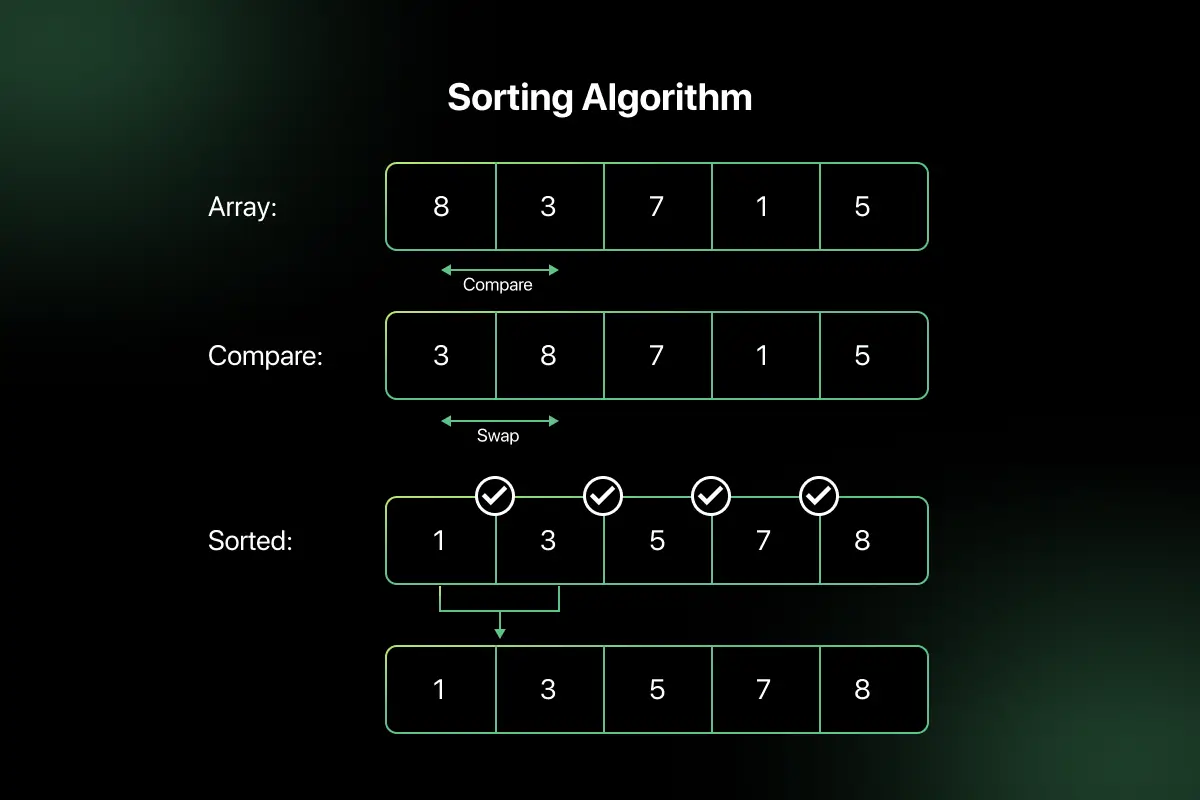
For example, consider sorting numbers in ascending order. A sorting algorithm compares elements one by one and rearranges them until they are in the correct order. Similarly, a searching algorithm checks elements step by step to find a specific value in a list. These structured steps ensure the problem is solved systematically rather than randomly.
How Data Structures and Algorithms Work Together
Data structures and algorithms are designed to complement each other in solving programming problems. The data structure defines how data is stored and organized in memory, while the algorithm determines the steps required to process that data efficiently. A well-chosen data structure allows the algorithm to perform operations faster and with fewer resources.
For example, consider searching for a value in an array.
- The array stores the elements in a sequential format.
- A linear search algorithm checks each element one by one until the target is found, while a binary search algorithm can be used if the array is sorted to reduce the number of comparisons.
- The way the data is stored directly influences how the algorithm works and how efficient the solution becomes.
Common Types of Data Structures You Should Know
As part of a structured data structures study guide, it is important to understand the main categories of data structures and how they differ in organization and usage.
- Linear data structures: Data elements are arranged sequentially, where each element is connected to the next, such as arrays, linked lists, stacks, and queues.
- Non-linear data structures: Data elements are organized hierarchically or in interconnected formats, such as trees and graphs.
- Static vs dynamic structures: Static structures have a fixed size defined at compile time (like arrays), while dynamic structures can grow or shrink during runtime (like linked lists).
Common Types of Algorithms You Should Know
As part of a strong algorithms foundation, it is important to understand the key categories of algorithms and where they are commonly used.
- Searching algorithms: Searching algorithms are used to locate a specific element in a dataset. Linear Search works on unsorted data by checking elements one by one, while Binary Search works on sorted data and reduces the search space efficiently.
- Sorting algorithms: Sorting algorithms arrange data in a specific order to improve organization and search efficiency. Common examples include Bubble Sort, Insertion Sort, Merge Sort, and Quick Sort.
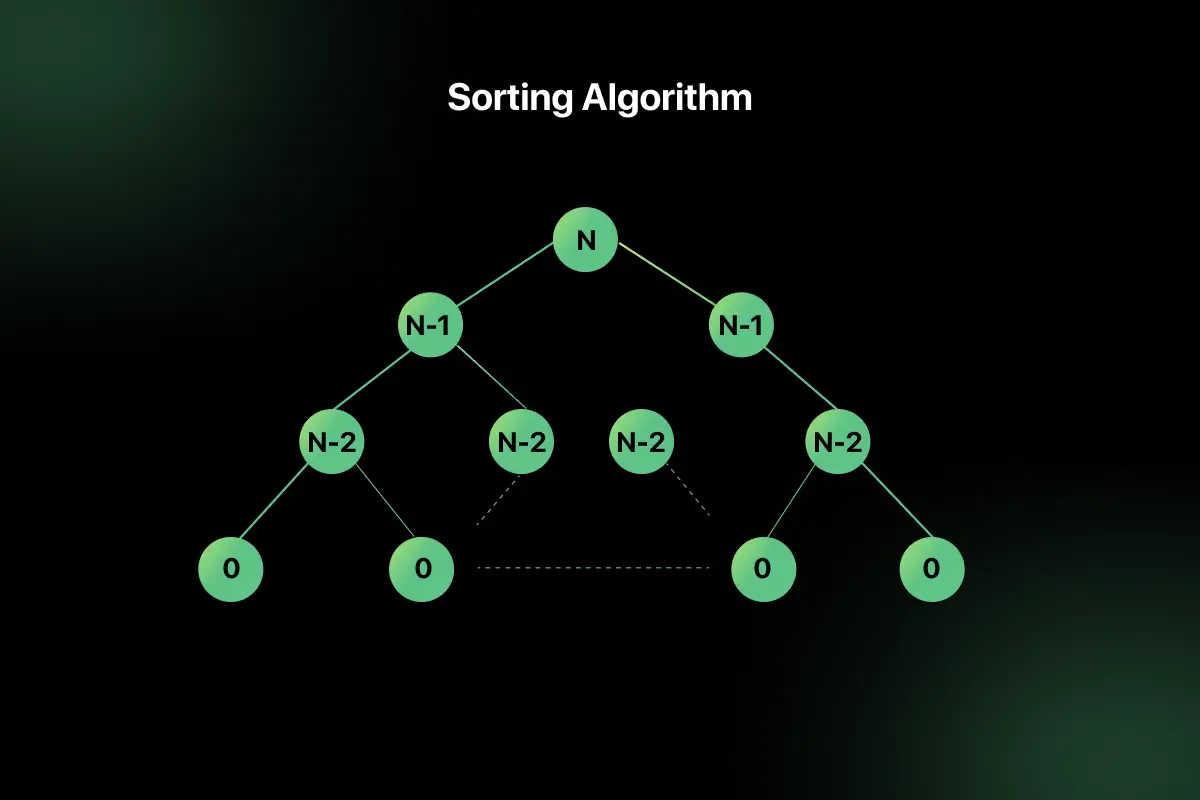
- Recursion: Recursion solves problems by breaking them into smaller subproblems of the same type. It is widely used in tree traversal, divide-and-conquer techniques, and mathematical computations.
- Divide and conquer algorithms: Divide and conquer algorithms split a problem into smaller parts, solve them independently, and combine the results. Merge Sort and Quick Sort follow this approach.
- Greedy algorithms: Greedy algorithms make the best possible choice at each step to reach an optimal solution. They are commonly used in shortest path and scheduling problems.
- Dynamic programming: Dynamic programming optimizes complex problems by storing results of overlapping subproblems. It is useful in optimization and pathfinding problems.
- Graph algorithms: Graph algorithms work on graph data structures to solve traversal and connectivity problems. Breadth First Search, Depth First Search, and Dijkstra’s Algorithm are key examples.
Applications of Data Structures and Algorithms
Below is a key table that summarizes all the DSA concepts with their applications:
| DSA Type | Sub Type/Concepts | Real-World Application |
| Array | Static Array | Used in storing fixed-size data like student marks, daily temperature records, and sensor readings. |
| Dynamic Array | Used in implementing lists, vectors, and dynamic memory structures in applications and software systems. | |
| Linked List | Singly Linked List | Used in music players for playlists and in browsers for navigation history. |
| Doubly Linked List | Used in undo-redo operations in editors and navigation systems in applications. | |
| Circular Linked List | Used in round-robin scheduling and CPU task scheduling systems. | |
| Stack | Simple Stack | Used in function calls, recursion handling, and memory management in compilers. |
| Expression Stack | Used in expression evaluation, syntax parsing, and calculator applications. | |
| Queue | Simple Queue | Used in printer scheduling, ticket booking systems, and request handling. |
| Circular Queue | Used in memory buffering and streaming data processing. | |
| Priority Queue | Used in job scheduling, task prioritization, and operating system process management. | |
| Tree | Binary Tree | Used in hierarchical data storage such as file systems and directory structures. |
| Binary Search Tree (BST) | Used in fast searching and sorting operations in databases. | |
| Heap | Used in priority-based systems like job schedulers and memory allocation. | |
| Trie | Used in autocomplete systems, dictionaries, and search engines. | |
| Graph | Directed Graph | Used in workflow systems, dependency management, and task scheduling. |
| Undirected Graph | Used in social networks and relationship mapping. | |
| Weighted Graph | Used in GPS systems, routing algorithms, and shortest path calculations. | |
| Hashing | Hash Table | Used in password storage, caching systems, and fast data lookup operations. |
| Searching Algorithms | Linear Search | Used in small datasets and simple search operations. |
| Sorting Algorithms | Binary Search | Used in sorted data systems, databases, and efficient lookup systems. |
| Quick Sort | Used in large-scale data processing and database sorting systems. | |
| Merge Sort | Used in external sorting and distributed systems. | |
| Recursion | Recursive Functions | Used in tree traversal, divide-and-conquer algorithms, and problem decomposition. |
| Dynamic Programming | Memoization | Used in optimization problems like route planning and resource allocation. |
| Greedy Algorithms | Optimization Algorithms | Used in scheduling systems, resource distribution, and network routing. |
| Backtracking | Search Problems | Used in puzzles, AI problem solving, and pathfinding systems. |
Key Concepts Every Programmer Must Understand
Understanding data structures and algorithms is also about understanding the core concepts that define how programs perform, scale, and behave in real-world systems.
These concepts help programmers write efficient code, optimize performance, and design systems that can handle real-world data and workloads effectively.
- Time Complexity: Time complexity explains how the execution time of an algorithm increases as the size of the input data grows, which helps in comparing the efficiency of different algorithms.
- Space Complexity: Space complexity describes how much memory an algorithm uses based on input size, which is important for designing memory-efficient applications.
- Big-O Notation: Big-O notation is used to represent the worst-case performance of an algorithm in terms of time and space, making it easier to compare algorithms.
- Best Case, Average Case, and Worst Case Analysis: These cases describe how an algorithm performs under different conditions, helping developers understand its reliability and efficiency in real-world usage.
- Recursion: Recursion is a technique where a function calls itself to solve smaller parts of a problem, which is commonly used in tree structures and divide-and-conquer algorithms.
- Iteration: Iteration uses loops to repeat a set of instructions and is often used as an alternative to recursion for better performance and memory control.
- Memory Management: Memory management involves how programs allocate, use, and release memory during execution to prevent memory leaks and performance issues.
- Brute Force Approach: A brute force approach solves problems by trying all possible solutions, which is simple but often inefficient for large datasets.
- Optimization: Optimization focuses on improving performance by reducing time complexity, space usage, or both.

Why Is DSA Important for Beginners?
- Improves logical thinking: Learning what is DSA helps beginners develop structured thinking and break complex problems into manageable steps.
- Required for placements: Most technical interviews test core DSA concepts, making it essential for campus and off-campus job opportunities.
- Helps write efficient code: Understanding data structures and algorithms allows you to optimize time and space complexity in your solutions.
- Used in real-world applications: DSA concepts are applied in search engines, databases, scheduling systems, and many software systems.
Quick Guide: How to Start Learning DSA
If you are just beginning, this data structures and algorithms quick guide will help you build a strong and structured foundation.
- Learn one data structure at a time: Focus on understanding how it works, its operations, and typical use cases before moving to the next topic.
- Practice problems regularly: Apply concepts by solving questions to strengthen logic and improve implementation skills.
- Understand time and space complexity: Analyze how your solution performs as the input size grows to build efficient coding habits.
- Revise concepts consistently: Revisit previously learned topics to improve recall and deepen understanding.
Final Thoughts
DSA is not about memorizing solutions but about developing a structured problem-solving mindset. A strong foundation in core concepts makes advanced topics easier to understand and apply.
With consistent practice and clarity in basics, beginners can confidently build their programming skills step by step.
FAQs
DSA stands for Data Structures and Algorithms. In simple terms, it is a way of organizing data and defining step-by-step methods to solve programming problems efficiently.
DSA is important because it helps you write optimized and efficient code. It improves problem-solving skills and is a key requirement in technical interviews and real-world software development.
DSA can feel challenging at first, especially when learning new concepts. However, with consistent practice and a clear understanding of the basics, beginners can gradually build confidence and improve.
Data structures are mainly classified into linear and non-linear types. Linear structures include arrays and linked lists, while non-linear structures include trees and graphs.
The time required depends on your background and practice consistency. With regular study and problem-solving, beginners can build a solid foundation in a few months.



Aarthy is a passionate technical writer with diverse experience in web development, Web 3.0, AI, ML, and technical documentation. She has won over six national-level hackathons and blogathons. Additionally, she mentors students across communities, simplifying complex tech concepts for learners.



Aarthy is a passionate technical writer with diverse experience in web development, Web 3.0, AI, ML, and technical documentation. She has won over six national-level hackathons and blogathons. Additionally, she mentors students across communities, simplifying complex tech concepts for learners.
Related Posts
Importance of Data Structures and Algorithms (DSA)
Why is everyone constantly talking about DSA, and why is it considered so important for programming? Many beginners focus only on …


Warning: Undefined variable $post_id in /var/www/wordpress/wp-content/themes/placementpreparation/template-parts/popup-zenlite.php on line 1050
so far feels like...
