How to Revise DSA Before Interviews
Have you ever walked into a technical interview and suddenly blanked out on problems you already studied?
Before interviews, data structures revision is far more important than learning new topics, because interviews test clarity and recall, not coverage.
This article will help you revise data structures and algorithms in a structured and stress-free way so you can recall concepts quickly and solve problems with confidence during interviews.
Understand What Interviewers Expect From DSA
Interviewers do not expect you to know every DSA problem or advanced algorithm. Instead, they look for strong clarity in basics and a structured approach to solving problems, even if the final solution is not perfect.
- Problem-solving approach: How you break down the problem and decide the steps to solve it
- Time and space complexity explanation: Your ability to analyze and explain the efficiency of your solution
- Ability to optimize solutions: Improving a basic solution into a better one when prompted
- Clear communication of logic: Explaining your thought process clearly while writing or discussing code
Make a Data Structures and Algorithms Quick Revision Plan (7–14 Days Before Interview)
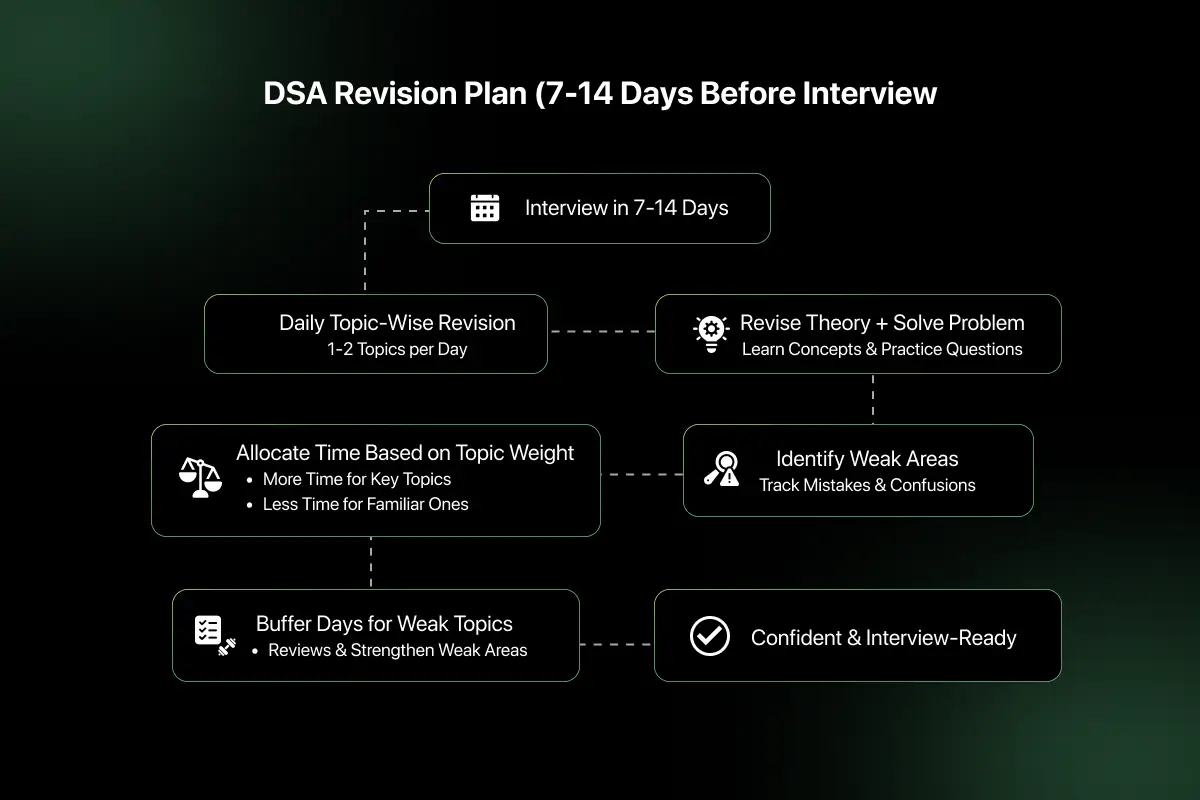
A focused DSA revision plan is essential before interviews because random practice often leads to confusion and incomplete coverage. With limited time, a structured plan helps you revise important topics systematically, strengthen weak areas, and build confidence without unnecessary stress.
- Daily topic-wise revision: Assign one or two DSA topics per day so you can revise concepts and practice related problems without rushing.
- Balanced mix of theory and problems: Spend time revisiting core concepts, then immediately apply them by solving a few representative problems.
- Time allocation per topic: Give more time to high-weight topics like arrays, trees, and recursion, and less time to familiar ones.
- Keeping buffer days for weak areas: Reserve a few days to revisit topics you struggle with and fix mistakes identified during revision.
Revise Core DSA Topics in Priority Order
For data structures quick revision, follow the topics below in order:
- Arrays and Strings: Focus on traversal, indexing, common patterns, and edge case handling, as these are frequently asked in interviews.
- Linked Lists: Revise pointer manipulation, basic operations, and common problems like reversal and cycle detection.
- Stacks and Queues: Understand their applications in expression evaluation, recursion simulation, and problem-solving patterns.
- Recursion and Backtracking: Practice base cases, recursive flow, and problems involving combinations, permutations, and decision trees.
- Trees and Binary Trees: Focus on traversals, height, depth, and basic tree-based problem-solving logic.
- Binary Search and Sorting: Revise binary search variations and commonly used sorting techniques with their time complexities.
- Hashing: Understand how hash tables work and practice problems involving frequency counting and fast lookups.
- Basic Graph concepts: Revise graph representations, BFS, DFS, and simple connectivity-based problems.
- Dynamic Programming (important patterns only): Focus on identifying overlapping subproblems and revising common DP patterns rather than memorizing solutions.
Practice regularly with PlacementPreparation.io DSA exercises to reinforce concepts, identify weak areas, and build interview-ready problem-solving confidence.
Focus on Problem-Solving Patterns, Not Just Questions
During interviews, problems are often new, even if the underlying logic is familiar. That is why focusing on problem-solving patterns is more effective than memorizing specific solutions. Once you recognize a pattern, you can quickly adapt it to different problems and explain your approach clearly.
- Sliding window: Useful for problems involving subarrays or substrings where you need to optimize range-based calculations.
- Two pointers: Helps reduce time complexity by processing elements from both ends or maintaining relative positions efficiently.
- Recursion and divide-and-conquer: Breaks complex problems into smaller subproblems, making logic easier to manage and explain.
- Stack-based problems: Common in expression evaluation, next greater element, and matching patterns, especially where order matters.
- Tree traversal patterns: Understanding preorder, inorder, postorder, and level-order helps solve most tree-based questions.
- DP patterns (include/exclude, tabulation): Focus on recognizing overlapping subproblems and building solutions step by step instead of memorizing formulas.
Revise Time and Space Complexity Properly
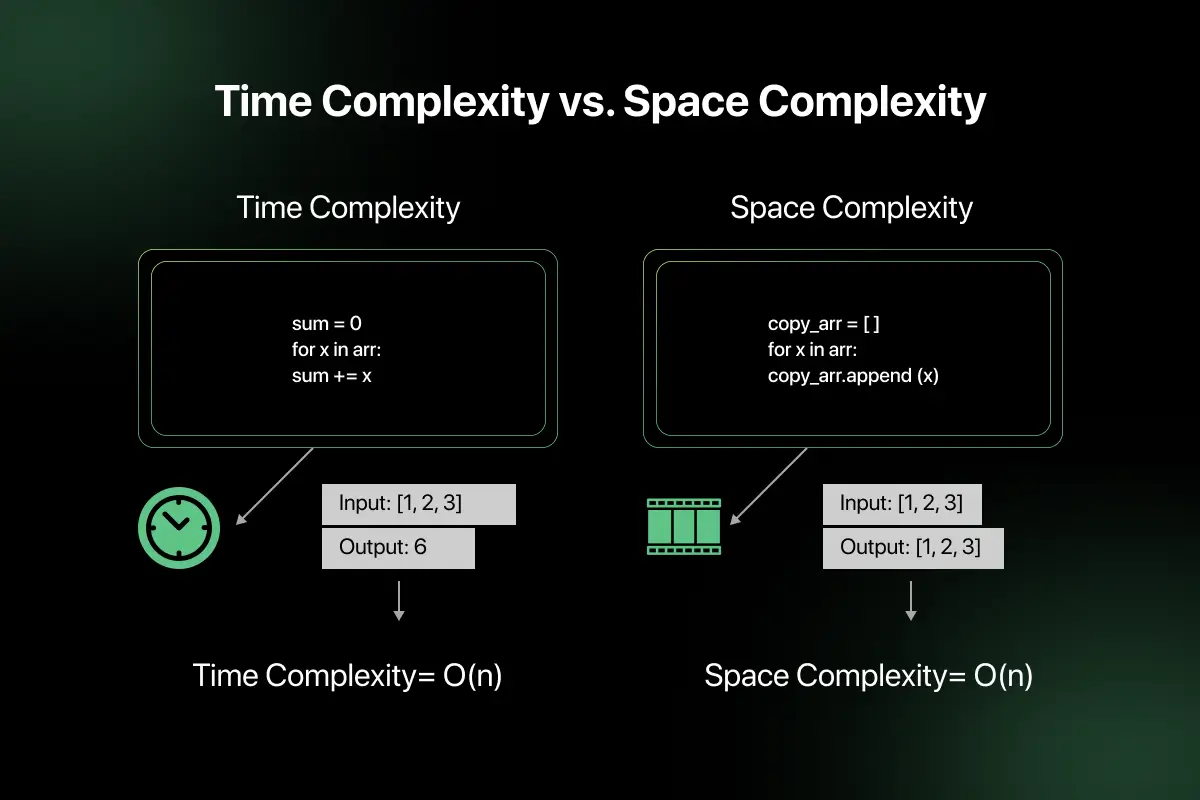
Many candidates fail DSA interviews even after writing a correct solution because they cannot clearly explain its time and space complexity. Interviewers want to know whether you understand how your code behaves as input size grows, not just whether it works.
- Best, average, and worst-case complexity: Know when each case applies and which one interviewers usually focus on.
- Common complexities to remember: Be comfortable with O(1), O(log n), O(n), O(n log n), and O(n²) for standard operations.
- Explaining complexity verbally in interviews: Practice describing complexity in simple terms while relating it directly to your code logic.
Practice Explaining Your Code Out Loud
In technical interviews, solving the problem silently is not enough. Interviewers evaluate how clearly you can communicate your thought process while writing code. Explaining your approach step by step shows that you understand the problem, can structure your logic, and can work collaboratively in real-world engineering situations.
Practicing this habit improves confidence and reduces hesitation during interviews. When you explain your logic out loud, you naturally think more clearly, identify mistakes early, and stay aligned with interview expectations. It also helps you simulate real interview conditions, making you more comfortable and prepared on the actual interview day.
Solve Interview-Level Problems, Not Too Easy or Too Hard
During DSA revision, solving problems that are either too easy or too advanced does not prepare you effectively for interviews.
Beginner problems may boost confidence but do not test problem-solving depth, while very hard problems can waste time and increase stress.
The goal is data structures revision for interview to improve your ability to think under conditions.
- Focus on medium-level problems: Medium-level questions best represent real interview scenarios, requiring both logic and optimization without excessive complexity.
- Problems asked in past interviews: Practicing previously asked interview questions helps you understand common patterns and expectations.
- Company-pattern-based questions: Revising questions aligned with specific company patterns prepares you for the type of problems you are likely to face.

Revise Common Mistakes and Edge Cases
- Off-by-one errors: Mistakes in loop boundaries or index handling often lead to incorrect results even when the logic is correct.
- Not handling empty inputs: Failing to consider empty arrays, strings, or null values can cause runtime errors.
- Missing base cases: In recursion, missing or incorrect base cases can lead to infinite calls and crashes.
- Ignoring constraints: Not using input constraints may result in inefficient solutions that fail for large inputs.
- Wrong assumptions about input size: Assuming small input sizes can lead to solutions that do not scale during interviews.
Quick Revision Tips for the Last 2–3 Days
Here are a few tips for data structures quick revision:
- Revise notes and patterns, not new topics: Focus on strengthening what you already know instead of learning unfamiliar concepts at the last minute.
- Re-solve previously attempted questions: Go through problems you have already solved to reinforce patterns and improve recall speed.
- Review the mistakes list: Revisit common errors you made during practice to avoid repeating them in interviews.
- Light practice, avoid burnout: Do short and focused practice sessions to stay sharp without exhausting yourself.
Final Thoughts
Revising DSA before interviews is less about solving hundreds of new problems and more about building confidence and clarity in what you already know.
Focusing on quality practice helps you recognize patterns, explain solutions clearly, and avoid common mistakes.
With consistent and structured revision, you can approach interviews calmly and perform better in problem-solving rounds.
FAQs
Seven to fourteen days are usually enough to revise DSA if you follow a focused and structured revision plan.
You should revise important and frequently asked DSA topics first, then cover the remaining topics if time permits.
Solving previous interview questions is helpful, but you should also revise core concepts and problem-solving patterns.
Practicing five to ten quality problems daily is enough if you focus on understanding logic and patterns.
You can revise DSA in one week by focusing on core topics, common patterns, and previously practiced problems.



Aarthy is a passionate technical writer with diverse experience in web development, Web 3.0, AI, ML, and technical documentation. She has won over six national-level hackathons and blogathons. Additionally, she mentors students across communities, simplifying complex tech concepts for learners.



Aarthy is a passionate technical writer with diverse experience in web development, Web 3.0, AI, ML, and technical documentation. She has won over six national-level hackathons and blogathons. Additionally, she mentors students across communities, simplifying complex tech concepts for learners.
Related Posts

Importance of Data Structures and Algorithms (DSA)
Why is everyone constantly talking about DSA, and why is it considered so important for programming? Many beginners focus only on …
Warning: Undefined variable $post_id in /var/www/wordpress/wp-content/themes/placementpreparation/template-parts/popup-zenlite.php on line 1050
so far feels like...
