Which Programming Language Is Best for DSA? – Guide
Ever wondered which language is best for DSA and why everyone gives a different answer?
Choosing the right programming language can directly affect how quickly you understand concepts, write solutions, and gain confidence while practicing data structures and algorithms.
In this article, you will learn how to choose the best programming language for DSA based on your learning goals and placement needs.
Clear the Basics: DSA Is Not a Programming Language
Many beginners often ask, is data structure a programming language, which leads to unnecessary confusion. Data structures and algorithms are problem-solving concepts that define how data is organized and how operations are performed on it. They are independent of any programming language and focus purely on logic, efficiency, and approach.
Programming languages are simply tools used to implement these concepts in code. Whether you use C, C++, Java, or Python, the same DSA principles apply across all DSA languages.
Once you understand the core idea behind a data structure or algorithm, you can implement it in any language with minimal adjustment, making the concept far more important than the syntax itself.
What Makes a Programming Language Suitable for DSA
The programming language you choose plays a key role in how easily you learn DSA concepts and apply them during interviews.
A language with clear syntax and good tooling helps you focus on problem-solving rather than struggling with errors, debugging, or complex syntax. It also affects how confidently you can explain your approach in technical interviews.
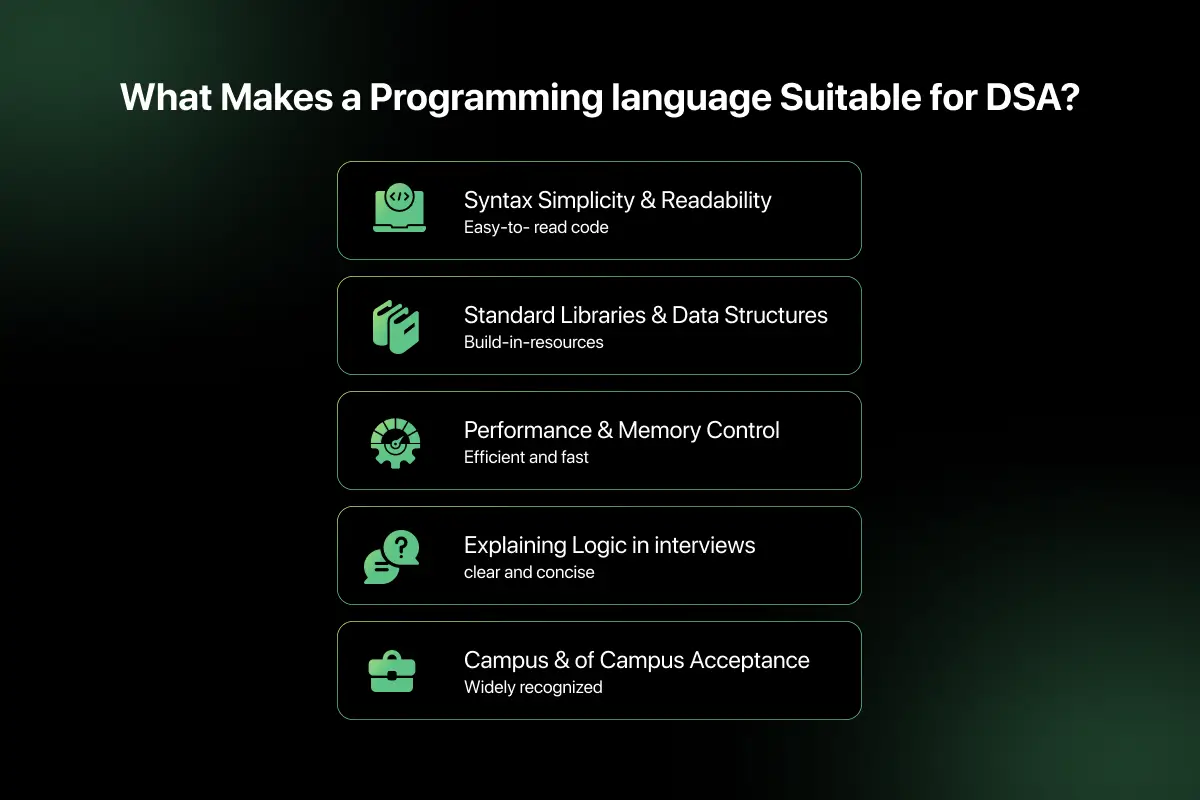
- Syntax simplicity and readability: Clean and intuitive syntax allows you to concentrate on logic instead of language-specific details.
- Standard libraries and built-in data structures: Strong library support reduces boilerplate code and speeds up problem-solving.
- Performance and memory control: Some languages offer better control over memory and execution, which is useful for optimization-related questions.
- Ease of explaining logic in interviews: A language that lets you express ideas clearly helps interviewers understand your thought process.
- Acceptance in campus and off-campus placements: Widely accepted languages give you flexibility across different companies and interview formats.
Most Common Programming Languages Used for DSA in India
Students in India use different languages for DSA based on college curriculum, placement trends, and ease of learning. There is no single best language for data structures and algorithms, but some languages are more commonly preferred due to their interview relevance and learning support.
- C: Often taught in first-year engineering courses, C helps students understand memory management and low-level implementation of data structures.
- C++: Widely used for DSA because of its performance, STL support, and popularity in product company interviews.
- Java: Preferred by many students due to its structured syntax, strong OOP concepts, and frequent use in service and product companies.
- Python: Chosen by beginners as the best language to learn data structures and algorithms because of its simple syntax and faster problem-solving ability.
- JavaScript: Briefly used by web-focused students to practice DSA, though it is less common in core placement interviews compared to other languages.

How to Choose the Right Language Based on Your Goal
Understanding which language is best for data structures becomes easier when you align your language choice with the type of roles and companies you are preparing for.
- Beginners who want faster learning: Python is often preferred because its simple syntax allows you to focus on logic rather than language complexity.
- Students targeting service companies: Java or C is commonly sufficient, as these companies focus on fundamentals and clarity of approach.
- Students targeting product companies: C++ or Java is usually recommended due to better performance control and wider acceptance in technical interviews.
- College-mandated language: If your college already teaches a specific language, sticking to it helps avoid confusion and builds confidence.
- Web-focused learners who still need DSA: JavaScript can be used to practice DSA concepts while continuing preparation for web development roles.
Comparison Table: Which Programming Language Should You Choose for DSA?
| Language | Best for | Learning Difficulty | Performance | Interview Friendliness | When to Choose |
| C | Understanding low-level concepts | Medium | High | Moderate | When you want strong fundamentals in memory and pointers |
| C++ | Competitive coding and product roles | High | Very High | High | When targeting product companies or performance-critical roles |
| Java | Structured DSA and OOP-based learning | Medium | High | Very High | When preparing for service and product company interviews |
| Python | Beginners and fast problem-solving | Low | Moderate | High | When you want quick learning and clear logic expression |
| JavaScript | Web developers practicing DSA | Medium | Moderate | Moderate | When DSA is needed alongside frontend or full-stack preparation |
Final Words
For most students, Python or Java is a strong starting point for learning DSA because they balance readability, structure, and interview relevance.
More important than the language itself is staying consistent and not frequently switching between languages.
Strong logic, problem-solving ability, and clear explanation matter far more in interviews than the specific programming language you use.
FAQs
Python is best for DSA beginners because its simple syntax helps focus on logic, problem-solving, and understanding core data structure concepts without language complexity.
C++ is not mandatory for DSA, but it is preferred in some product companies due to performance and STL support.
Yes, many students in India learn DSA using Python and get placed by demonstrating strong logic and problem-solving skills.
Switching languages frequently is not recommended, as it slows learning; mastering DSA in one language is more effective.
Companies usually prefer Java, C++, or Python, focusing more on your approach and problem-solving clarity than the language itself.


Aarthy is a passionate technical writer with diverse experience in web development, Web 3.0, AI, ML, and technical documentation. She has won over six national-level hackathons and blogathons. Additionally, she mentors students across communities, simplifying complex tech concepts for learners.



Aarthy is a passionate technical writer with diverse experience in web development, Web 3.0, AI, ML, and technical documentation. She has won over six national-level hackathons and blogathons. Additionally, she mentors students across communities, simplifying complex tech concepts for learners.
Related Posts
Importance of Data Structures and Algorithms (DSA)
Why is everyone constantly talking about DSA, and why is it considered so important for programming? Many beginners focus only on …

Warning: Undefined variable $post_id in /var/www/wordpress/wp-content/themes/placementpreparation/template-parts/popup-zenlite.php on line 1050
so far feels like...
