16 MBTI Personality Types Explained with Career Choices
Think about the people around you.
You’ve probably noticed the planner in your group who always has a checklist. The idea machine that jumps from one thought to another.
The silent observer who speaks less but always makes sense when they do. Or the people-pleaser who keeps everyone together, even at the cost of their own comfort.
Now ask yourself the question most people ignore:
Is there a real connection between your personality and the career you choose, or is career success just about skills and luck?
The 16 personality types model helps explain how people think, communicate, and choose careers.
This guide breaks down all 16 personality type profiles using concepts from the 16 personality types test, making it easier to understand the 16 personality types and how they affect real-life choices.
What Are the 16 Personality Types? (Complete Explanation)
The 16 personality types framework, or MBTI framework, is widely discussed in psychology and organizational behavior research.
While it is not designed to predict success, it is often used to understand work preferences, communication styles, and career alignment.
The 16 personality types model is based on how individuals prefer to:
- Focus their energy
- Process information
- Make decisions
- Organize their work and life
Rather than labeling people as “good” or “bad,” the framework explains natural preferences, patterns that influence how someone performs in different environments.
Many people encounter this model through the 16 personality types test, which categorizes individuals into one of 16 profiles based on four key dimensions.
Many people first discover their personality type by taking a reliable assessment. If you’re unsure about your type, you can start with a trusted 16 personality types test or explore career-focused insights using the TypeFinder career assessment.
How the 16 Personality Types Test Works?
The 16 personality types test evaluates preferences across four dimensions:
- Introversion (I) vs Extraversion (E): Where you draw energy from
- Sensing (S) vs Intuition (N): How you process information
- Thinking (T) vs Feeling (F): How you make decisions
- Judging (J) vs Perceiving (P): How you structure work and life
Each combination results in one of all 16 personality type profiles, such as INTJ, ENFP, ISTJ, and so on.
While no test can define a person completely, this framework is widely used in career counseling, organizational psychology, and leadership development because of its practical insights.
Why Personality Matters When Choosing a Career?
Research in career psychology suggests that personality-job fit plays a major role in long-term satisfaction, performance, and burnout prevention.
Personality and Technical Roles
Technical roles often require:
- Deep focus
- Logical thinking
- Comfort with complexity
- Independent problem-solving
However, not all technical roles are the same. For example, a backend developer, data scientist, and DevOps engineer demand different work styles and stress tolerance levels.
Personality and Non-Technical Roles
Non-technical roles typically emphasize:
- Communication
- Decision-making
- Collaboration
- Leadership and influence
Sales, operations, HR, marketing, and product roles all require different interpersonal and cognitive strengths.
When personality and role expectations clash, people often experience:
- Burnout
- Reduced performance
- Frequent job changes
- Low career satisfaction
Understanding your personality is the first step. The next step is preparing for roles that actually match your strengths.
For technical and non-technical career readiness, structured preparation matters just as much as alignment. Check out the placement preparation roadmap for a structured approach.

The Four Dimensions Behind All 16 Personality Types
1. Introversion vs Extraversion
- Introverts often excel in focused, independent work
- Extraverts often thrive in collaborative, people-facing roles
Technical fit: Backend development, data analysis vs solutions engineering
Non-technical fit: Research roles vs sales or people management
2. Sensing vs Intuition
- Sensing types prefer facts, details, and proven methods
- Intuitive types prefer concepts, patterns, and future possibilities
Technical fit: QA, system administration vs AI, product architecture
Non-technical fit: Operations vs strategy and innovation roles
3. Thinking vs Feeling
- Thinking types prioritize logic and objective outcomes
- Feeling types prioritize impact on people and values
Technical fit: Engineering, cybersecurity vs UX and research
Non-technical fit: Consulting vs HR and people operations
4. Judging vs Perceiving
- Judging types prefer structure and planning
- Perceiving types prefer flexibility and adaptability
Technical fit: Infrastructure, QA vs DevOps, and rapid prototyping
Non-technical fit: Project management vs growth and experimentation roles
All 16 Personality Types Explained (With Career Fit)
Below is a structured breakdown of all 16 personality type profiles with purely technical and non-technical career options.
1. Analyst Personality Types
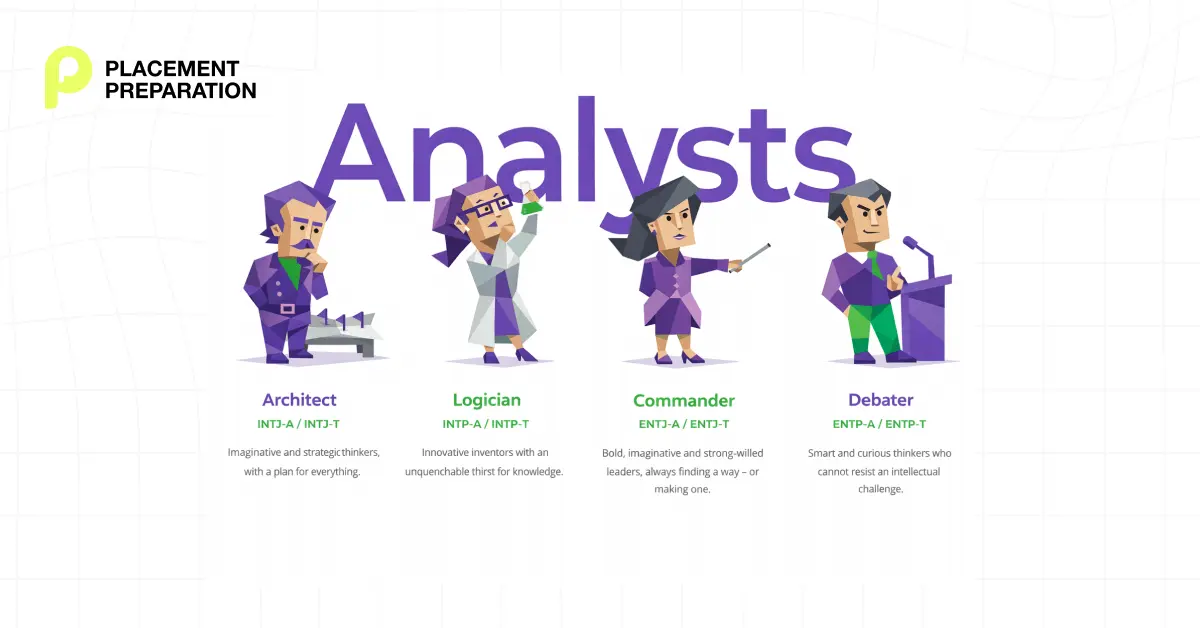
INTJ – The Architect
- Best Technical Careers: Software Engineer, Data Scientist, Systems Architect
- Best Non-Technical Careers: Product Strategist, Business Analyst
- Careers to Avoid: Highly reactive, interruption-heavy roles
INTP – The Thinker
- Best Technical Careers: AI Engineer, Research Scientist, Backend Developer
- Best Non-Technical Careers: Technical Consultant, Policy Analyst
- Careers to Avoid: Rigid, highly bureaucratic environments
ENTJ – The Commander
- Best Technical Careers: Engineering Manager, Cloud Architect
- Best Non-Technical Careers: Operations Manager, Strategy Consultant
- Careers to Avoid: Roles with limited authority or impact
ENTP – The Visionary
- Best Technical Careers: Solutions Engineer, Startup Technologist
- Best Non-Technical Careers: Product Manager, Growth Strategist
- Careers to Avoid: Highly repetitive work
Analyst personality types often excel in structured problem-solving roles. However, success in these careers depends on consistent preparation and strong fundamentals.
Check out the blog on ‘10 Websites on Technical Interview Preparation’ to have consistent practice.
2. Diplomat Personality Types
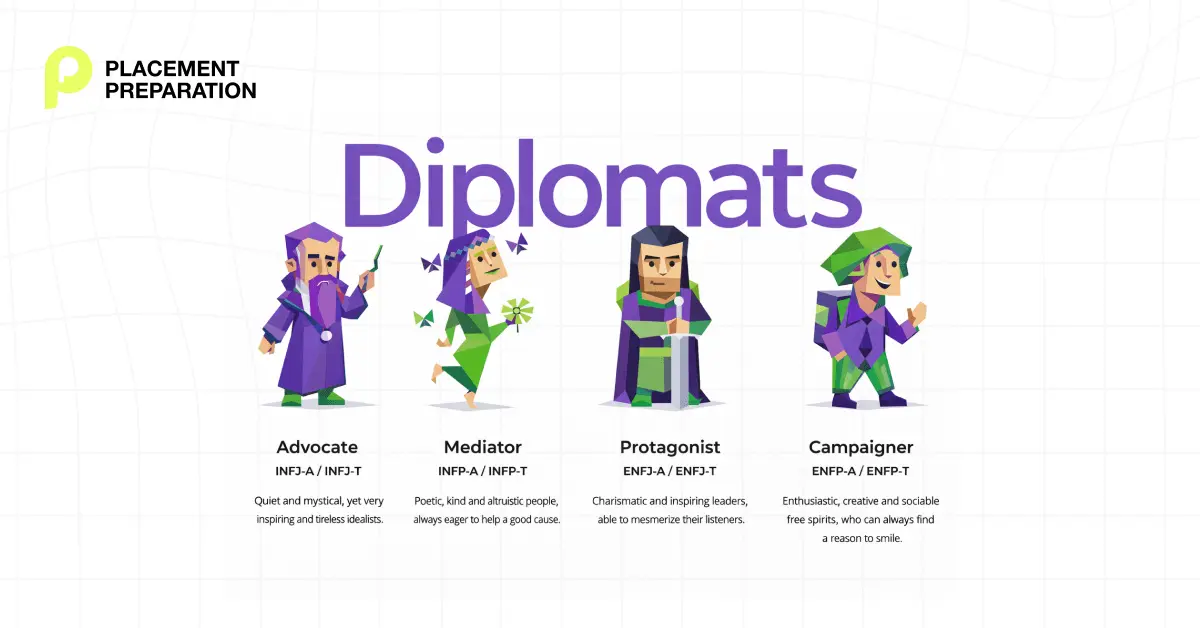
INFJ – The Advocate
- Best Technical Careers: UX Researcher, Data Analyst
- Best Non-Technical Careers: HR Strategist, Organizational Consultant
INFP – The Mediator
- Best Technical Careers: Frontend Developer, Content Technologist
- Best Non-Technical Careers: Content Strategist, Learning Designer
ENFJ – The Protagonist
- Best Technical Careers: Technical Trainer, Customer Success Engineer
- Best Non-Technical Careers: People Manager, Leadership Coach
ENFP – The Campaigner
- Best Technical Careers: UX Designer, No-Code Developer
- Best Non-Technical Careers: Brand Strategist, Community Manager
Diplomatic personalities perform best in people-centric roles, where communication and emotional intelligence are critical for success during placements.
To improve, check out the guide on ‘Most common interview questions and answers’.
3. Sentinel Personality Types
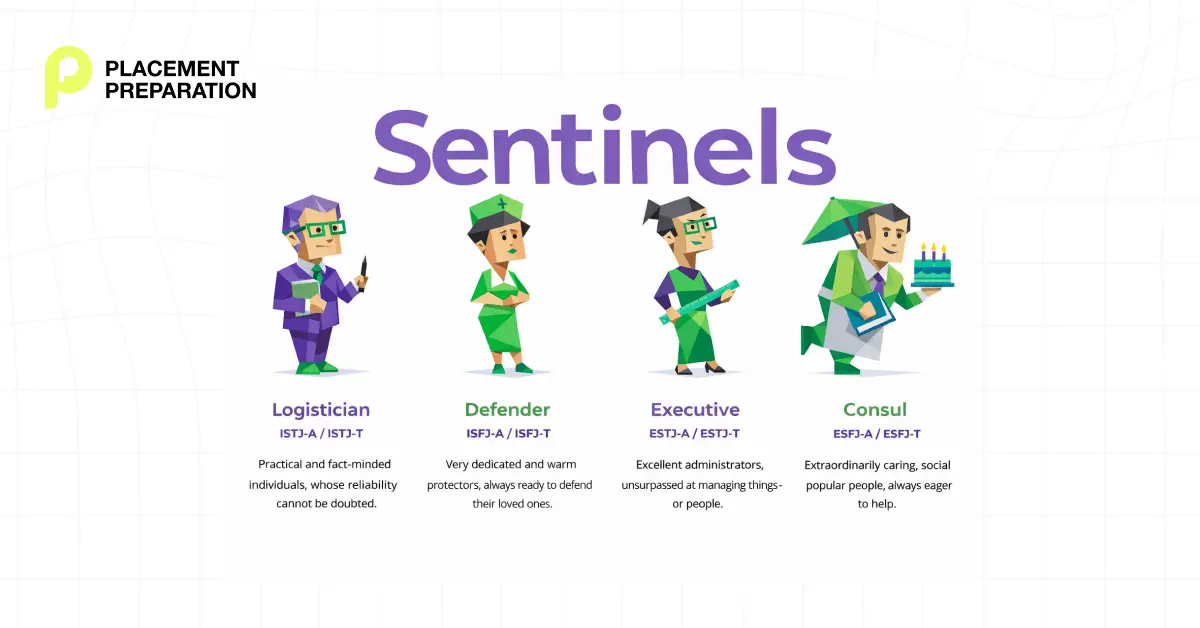
ISTJ – The Logistician
- Best Technical Careers: QA Engineer, Cybersecurity Analyst
- Best Non-Technical Careers: Compliance Manager, Operations Lead
ISFJ – The Defender
- Best Technical Careers: Systems Administrator, Support Engineer
- Best Non-Technical Careers: HR Operations, Process Manager
ESTJ – The Executive
- Best Technical Careers: IT Program Manager, Infrastructure Manager
- Best Non-Technical Careers: Business Operations Manager
ESFJ – The Consul
- Best Technical Careers: CRM Administrator, Tech Support Lead
- Best Non-Technical Careers: Client Relationship Manager
4. Explorer Personality Types
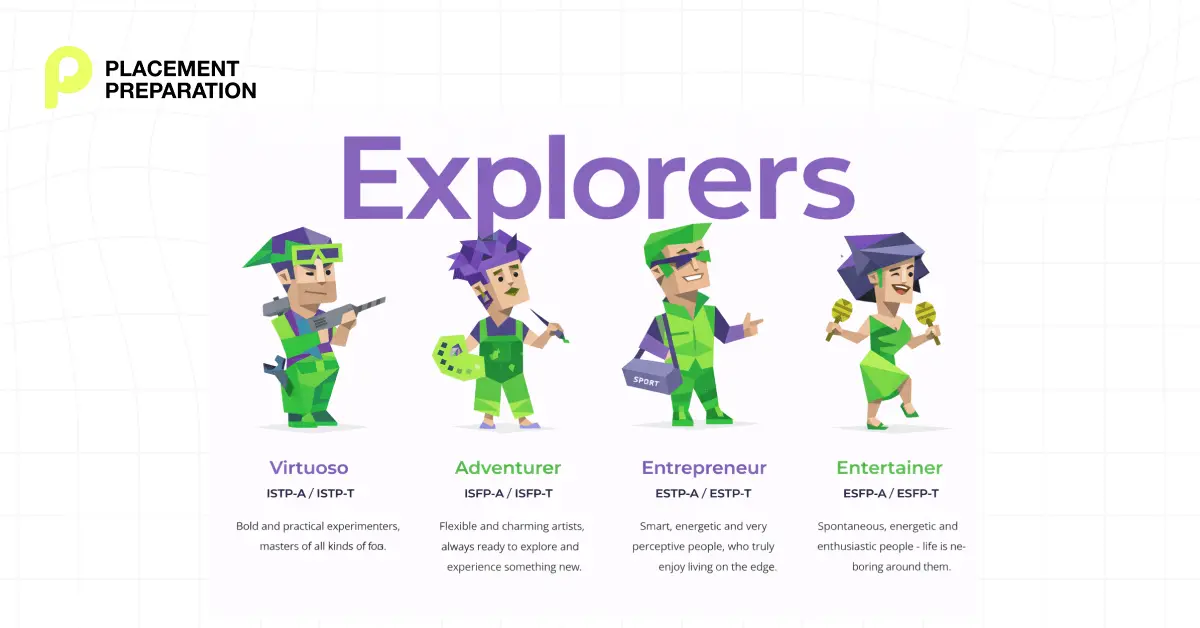
ISTP – The Virtuoso
- Best Technical Careers: DevOps Engineer, Hardware Engineer
- Best Non-Technical Careers: Technical Operations Specialist
ISFP – The Adventurer
- Best Technical Careers: UI Developer, Creative Technologist
- Best Non-Technical Careers: Design Coordinator
ESTP – The Entrepreneur
- Best Technical Careers: Solutions Architect, Sales Engineer
- Best Non-Technical Careers: Business Development Manager
ESFP – The Entertainer
- Best Technical Careers: Media Technologist, AR/VR Specialist
- Best Non-Technical Careers: Marketing Manager, Event Strategist
Not sure which IT role suits you best? See Career Choices & Roadmaps with learning paths, required skills, salary, and salary comparisons, and enroll wisely.
Best Technical Careers by Personality Traits
- Introverted & Analytical: Backend Developer, Data Scientist
- Action-Oriented & Adaptive: DevOps Engineer, Systems Engineer
- Creative & Technical: UX Engineer, Creative Technologist
Best Non-Technical Careers by Personality Traits
- People-Focused: HR Manager, Customer Success Manager
- Leadership-Oriented: Operations Manager, Program Manager
- Strategic Thinkers: Product Manager, Business Strategist
Common Myths About the 16 Personality Types
Can Your Personality Type Change?
- Your core preferences remain stable, but behavior adapts with experience and environment.
Are Some Personality Types Better Than Others?
- No. Each type excels in different conditions and roles.
Do Technical Careers Require Only Introverts?
- No. Many technical roles benefit from strong communication and leadership skills.
How to Use the 16 Personality Types Test for Career Planning?
- Identify your dominant traits
- Map them to technical or non-technical roles
- Combine personality insights with skills and interests
- Build a long-term career roadmap instead of chasing short-term trends
- Used correctly, personality insights reduce career trial-and-error.
Final Words
Understanding the 16 personality types is not about limiting your options; it’s about making smarter choices. When personality, skills, and career paths align, work feels more natural, growth becomes sustainable, and long-term success is easier to achieve.
Exploring technical roles, non-technical careers, or planning a transition, personality awareness can serve as a powerful foundation for building a fulfilling career.
Frequently Asked Questions About the 16 Personality Types
1. What are the 16 personality types?
The 16 personality types are part of the MBTI (Myers-Briggs Type Indicator) framework. They describe how people think, make decisions, gain energy, and work.
Each personality type is formed by combining four preferences, creating all 16 personality type profiles, such as INTJ, ENFP, and ISTJ.
2. What is the 16 Personality Types Test?
The 16 personality types test is a self-assessment that identifies your MBTI personality based on preferences like introversion vs extraversion and thinking vs feeling.
It helps people understand their work style, communication approach, and career suitability. The test does not measure intelligence or talent.
3. Which personality types are best suited for technical careers?
Personality types like INTJ, INTP, ISTJ, and ISTP often perform well in technical roles because they prefer logic, focus, and problem-solving. However, success in technical careers depends on skill development and interest, not personality alone.
4. Which personality types are better for non-technical roles?
Personality types such as ENFJ, ESFJ, ENFP, and ENTJ often thrive in non-technical roles that involve leadership, communication, and collaboration. These roles benefit from strong interpersonal skills and emotional intelligence, which these personalities naturally prefer.
5. Can the 16 personality types help in choosing a career?
Yes. The 16 personality types help identify work environments and roles that align with your natural preferences. While they should not be the only factor, they reduce career mismatch and burnout by guiding people toward roles that fit their thinking and working style.
6. Are some of the 16 personality types more successful than others?
No. There is no “best” personality type. Success depends on alignment between personality, skills, and career choice. Every personality type can succeed in both technical and non-technical careers when placed in the right environment.
7. Can your personality type change over time?
Core personality preferences usually remain stable, but behavior and skills can adapt with experience.
Your results from the 16 personality types test may shift slightly due to life stages or work demands, but your natural tendencies often stay consistent.
8. Should you choose a career only based on personality type?
No. Personality should guide, not decide, your career. The best outcomes come from combining personality insights with skills, education, interests, and long-term goals. Personality helps narrow options, not restrict them.



Hi, I’m Hashmithaa. I believe in the power of words to connect and guide. As a content writer, I craft stories and insights that are relatable, practical, and designed to help readers learn, evolve, and navigate the online world.



Hi, I’m Hashmithaa. I believe in the power of words to connect and guide. As a content writer, I craft stories and insights that are relatable, practical, and designed to help readers learn, evolve, and navigate the online world.
Related Posts

Top 10 Apache Spark Project Ideas for Beginners in 2026
Apache Spark becomes much easier to understand when you stop learning individual commands and start building complete projects. A practical …


Warning: Undefined variable $post_id in /var/www/wordpress/wp-content/themes/placementpreparation/template-parts/popup-zenlite.php on line 1050
so far feels like...
