Strings in Data Structure

Strings are one of the most commonly used data structures in programming because most real-world applications deal with text processing. From searching in Google to validating passwords and processing user input, strings are everywhere.
Learning strings helps you understand character manipulation, pattern matching, and important interview problem-solving techniques. Many coding interview questions are directly based on string operations.
In this guide, you will learn how strings work, their operations, coding examples, and why they are important in DSA.
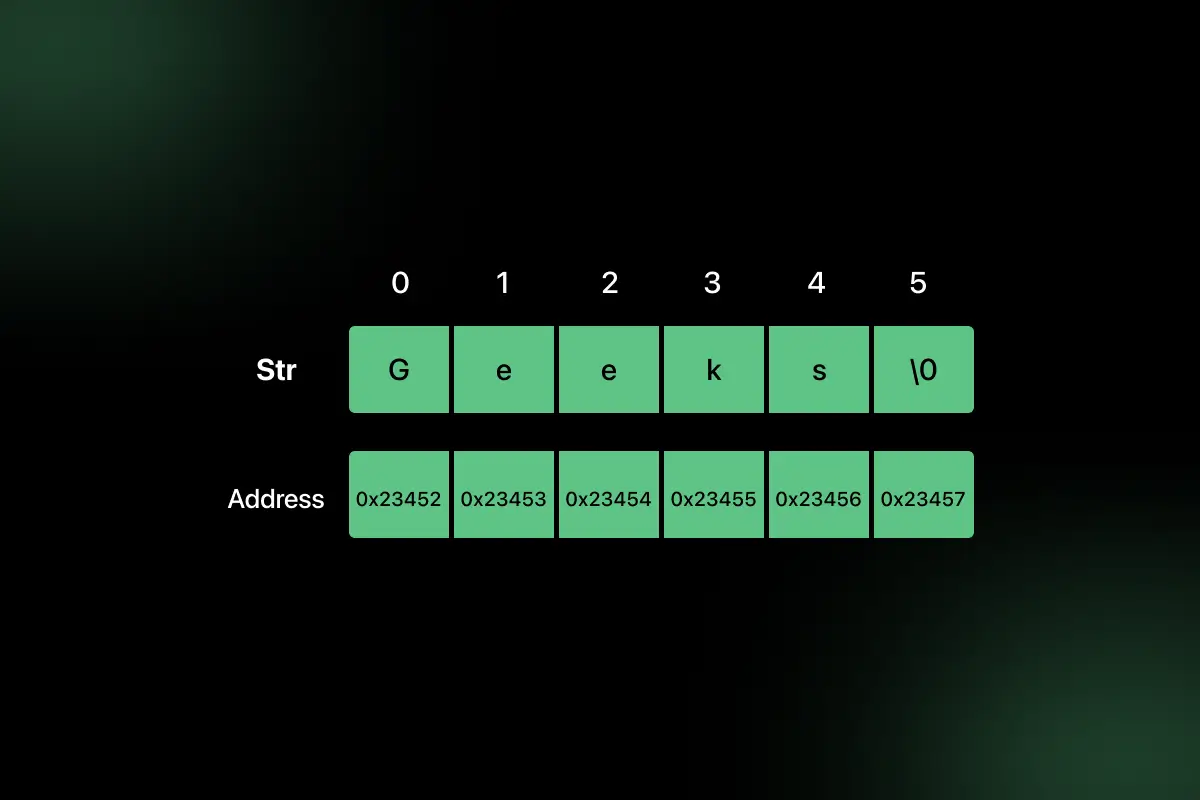
What is a String in Data Structure
A string is a sequence of characters stored in contiguous memory locations and usually terminated by a special character like null (\0) in some languages like C.
Example:
char str[] = “HELLO”;
Here:
H is at index 0
E is at index 1
O is at index 4
Key characteristics:
- Collection of characters
- Index-based access
- Immutable in some languages
- Used for text processing
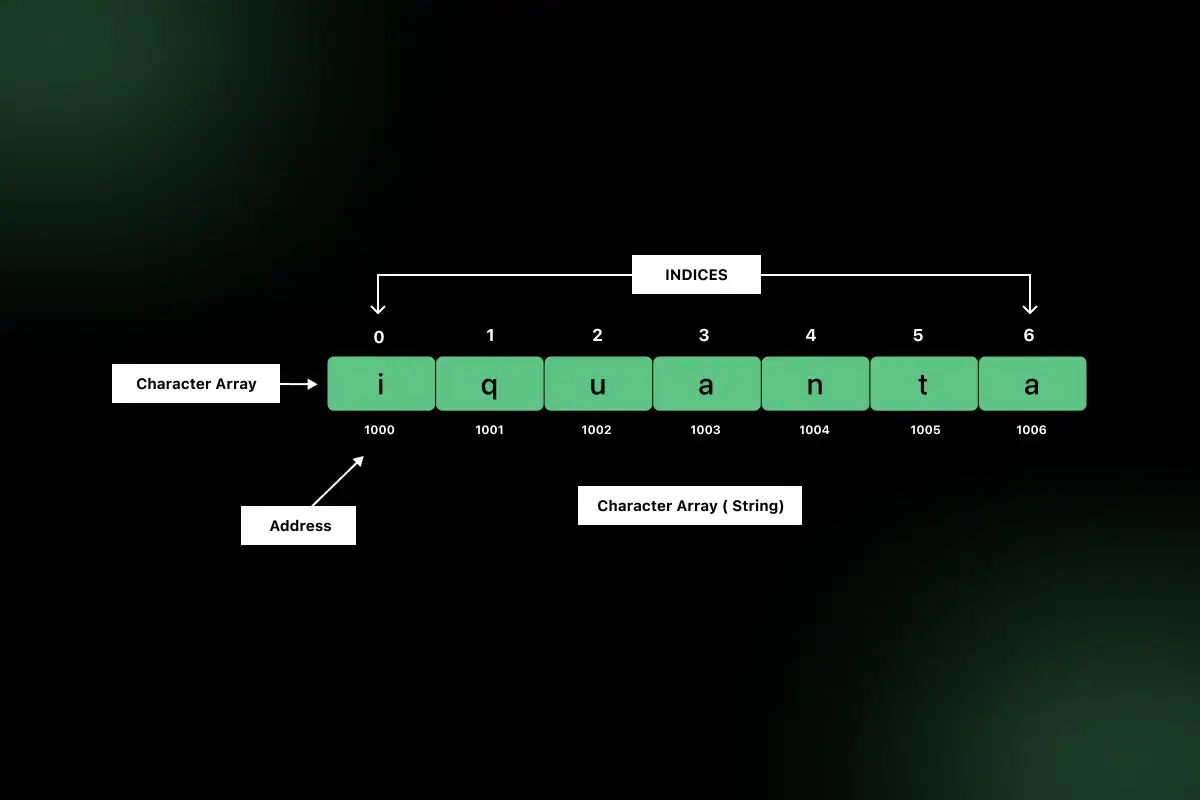
How Strings are Stored in Memory
Strings are stored as arrays of characters.
Example:
char str[] = “CODE”;
Memory representation:
C → 1000
O → 1001
D → 1002
E → 1003
\0 → 1004
This is why string access takes constant time using indexing.

Basic String Operations with Coding Examples
Strings support several basic operations that help in processing and manipulating text data. These operations are commonly used in programming and coding interview problems.
1. Traversal
Traversal means accessing each character of the string one by one.
Example:
for(int i=0; str[i] != ‘\0’; i++)
{
printf(“%c”, str[i]);
}
2. Finding Length
The length operation returns the number of characters in a string.
Example:
strlen(str);
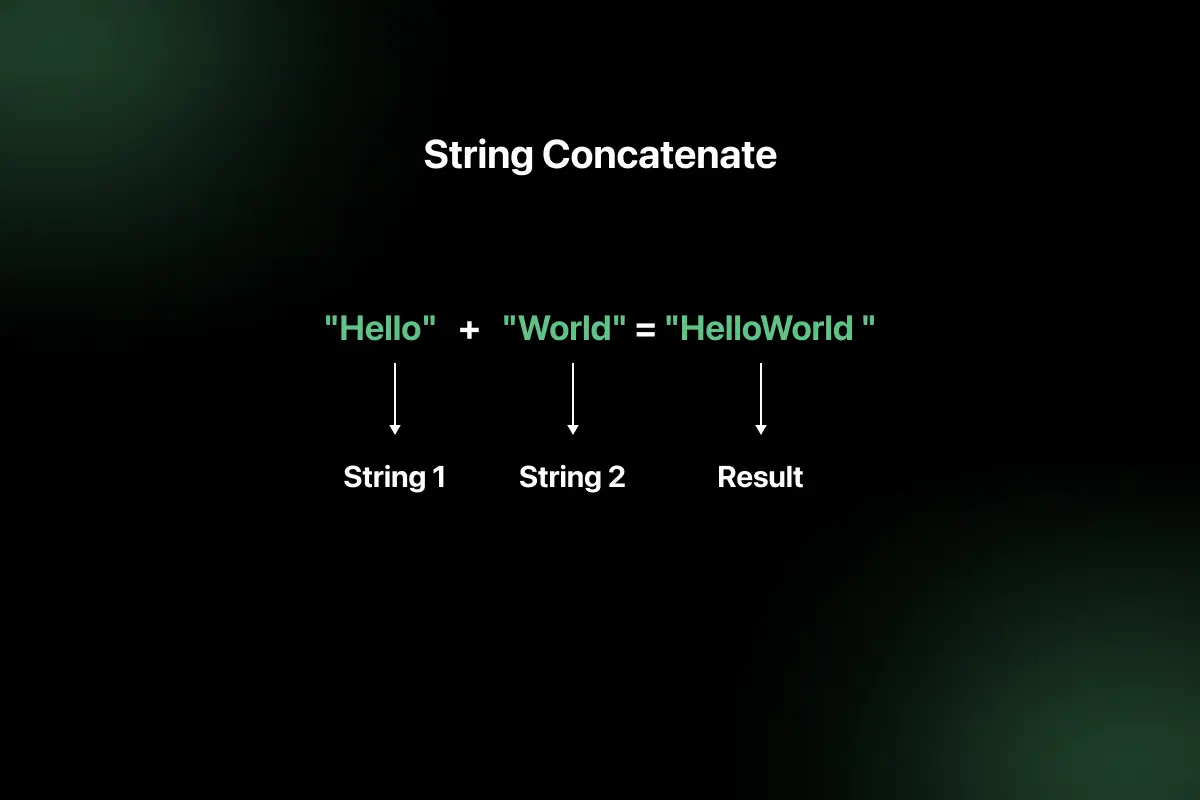
3. Concatenation
Concatenation means joining two strings together.
Example:
strcat(str1,str2);
4. Comparison
Comparison checks whether two strings are equal or different.
Example:
strcmp(str1,str2);
5. Copy
Copy operation duplicates one string into another.
Example:
strcpy(str2,str1);
Why Strings Are Important in DSA Problem Solving
Strings are important in DSA because many coding problems involve text processing and character manipulation.
- Improves pattern recognition: String problems like palindrome and anagram checks help develop logical thinking.
- Builds character manipulation skills: Operations like reversing a string or counting characters improve programming fundamentals.
- Introduces important techniques: Concepts like sliding window and hashing are first learned through string problems.
- Common in coding interviews: Problems such as the longest substring, reverse string, and character frequency are frequently asked.
Real World Applications of Strings
Strings are essential in applications where text data needs to be processed or validated.
- Search engines: User search queries are processed as strings to find relevant results.
- Authentication systems: Password validation and username checks depend on string comparison.
- Communication platforms: Chat applications and email systems process messages as strings.
- Bioinformatics: DNA sequences are analyzed using string algorithms in scientific applications.
Advantages and Limitations of Strings
Advantages
- Easy text handling
- Fast character access
- Useful in pattern problems
- Supports built-in functions
Limitations
- Immutable in some languages
- Memory overhead possible
- Expensive modifications
- Case sensitivity issues
Time Complexity of Common String Operations
| Operation | Time Complexity |
| Access | O(1) |
| Traversal | O(n) |
| Search | O(n) |
| Concatenation | O(n) |
| Comparison | O(n) |
How to Practice String Problems for Placements
Beginner:
- Reverse string
- Count characters
- Remove spaces
Intermediate:
- Check palindrome
- Check anagram
- First non-repeating character
Advanced:
- Longest substring without repeating characters
- Rabin-Karp concept
- KMP basics
Regular practice builds strong string-handling skills.
Final Words
Strings are a fundamental data structure used in almost every programming application involving text processing. They help developers build strong problem-solving skills and are frequently asked in coding interviews.
Understanding string operations, memory behavior, and common patterns makes it easier to solve complex DSA problems.
If you are preparing for technical interviews, mastering strings is an essential step in your learning journey.
FAQs
A string is a sequence of characters stored in memory and used to represent text in programming and data structure applications.
Strings help solve pattern matching and text processing problems which are commonly asked in coding interviews.
Common operations include traversal, concatenation, comparison, searching, and finding string length.
String search usually takes O(n) time depending on the length of the string.
Strings are used in search engines, chat systems, password validation, and text processing applications.



Aarthy is a passionate technical writer with diverse experience in web development, Web 3.0, AI, ML, and technical documentation. She has won over six national-level hackathons and blogathons. Additionally, she mentors students across communities, simplifying complex tech concepts for learners.



Aarthy is a passionate technical writer with diverse experience in web development, Web 3.0, AI, ML, and technical documentation. She has won over six national-level hackathons and blogathons. Additionally, she mentors students across communities, simplifying complex tech concepts for learners.
Related Posts
Searching Algorithm in Data Structure
Searching is one of the most fundamental operations in computer science because almost every application involves finding specific data efficiently. …

Warning: Undefined variable $post_id in /var/www/wordpress/wp-content/themes/placementpreparation/template-parts/popup-zenlite.php on line 1050
so far feels like...
