SAP Architecture Explained
Large enterprises manage complex business processes such as finance, sales, supply chain, and human resources. To ensure smooth operations, these processes must be integrated within a single unified system.
SAP provides enterprise resource planning solutions that connect different business functions through centralized data management. It helps organizations streamline workflows and maintain real-time visibility across departments.
SAP architecture defines how the presentation layer, application layer, and database layer interact to process business transactions efficiently. It ensures structured communication between users and backend systems.
In this guide, you will understand SAP architecture components, working model, deployment types, and real world enterprise use cases clearly and practically.
What is SAP Architecture?
SAP architecture is a structured enterprise software framework that defines how SAP systems process, manage, and store business data across integrated modules.
- Enterprise Software Architecture: It is designed for large organizations to handle core business functions such as finance, human resources, sales, and supply chain within a centralized system.
- Three-Tier Structure: SAP architecture follows a three-tier model consisting of the presentation layer, the application layer, and the database layer. Each layer has a specific role in processing business transactions.
- Client-Server Based Model: SAP operates on a client-server model where users interact through a frontend interface, and backend servers handle logic and data management.
- Supports Business Modules Integration: SAP architecture integrates multiple business modules so that data flows seamlessly between departments, ensuring consistency and real-time updates.
Components of SAP Architecture
SAP architecture consists of multiple components that work together to process enterprise business transactions efficiently.
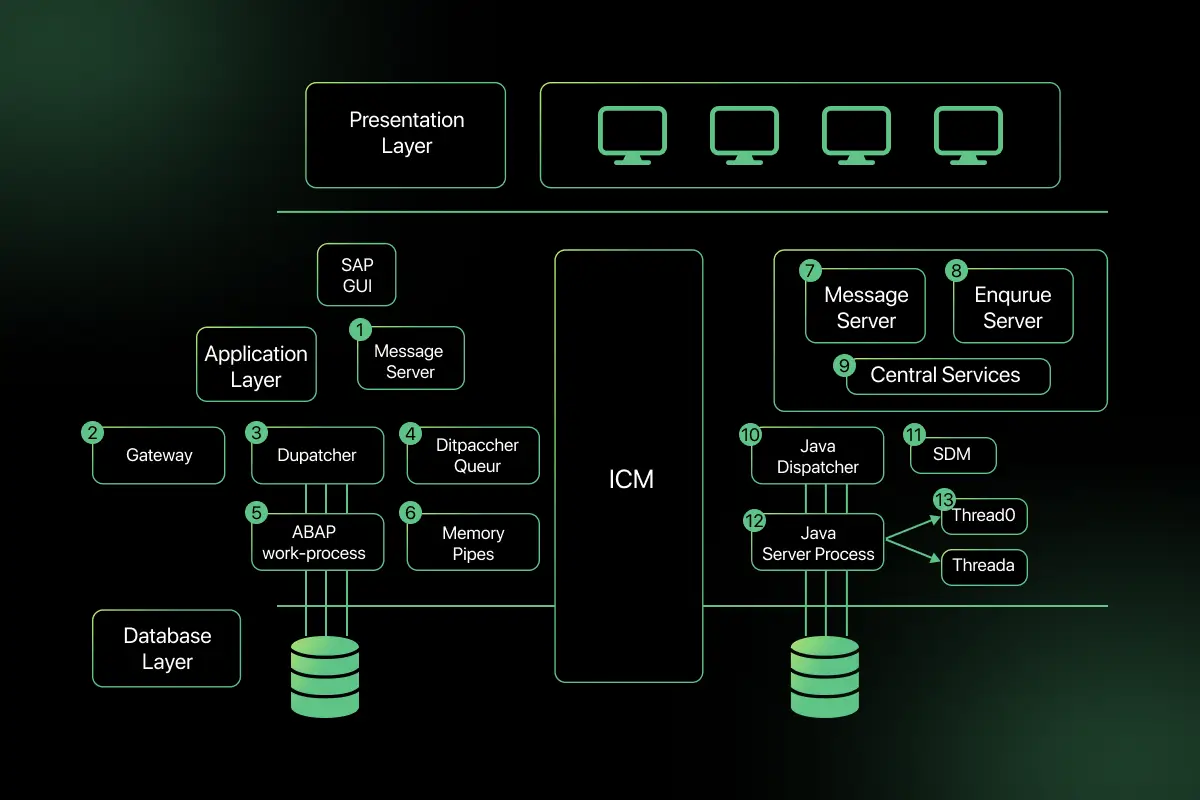
- SAP GUI or Frontend: SAP GUI is the user interface through which users access the SAP system. It allows employees to enter data, execute transactions, and interact with different business modules.
- Application Server: The application server processes business logic and executes SAP programs. It handles transaction processing, data validation, and communication between the frontend and the database.
- Message Server: The message server manages communication between multiple application servers in a distributed SAP system. It balances user requests and ensures proper load distribution.
- Enqueue Server: The enqueue server manages data locking mechanisms. It prevents multiple users from modifying the same data simultaneously, ensuring data consistency.
- Database Server: The database server stores all enterprise data, including transactional and master data. It retrieves and updates information based on requests from the application layer.
SAP Architecture Diagram and Working Flow
Learning SAP architecture involves understanding how different system layers and modules interact to manage enterprise data, applications, and business processes.
Scenario: A user creates a sales order in the SAP system.
- User enters data in SAP GUI: The user inputs customer details, product information, and quantity through the SAP GUI interface. The request is forwarded to the application layer.
- Request sent to application server: The application server receives the request and begins processing the transaction according to defined business rules.
- Business logic processed: The system validates customer information, checks product availability, calculates pricing, and applies relevant rules and configurations.
- Data stored in database: After successful validation, the sales order data is stored in the database layer. Transaction records and related entries are updated accordingly.
- Response returned: Once processing is complete, the system sends a confirmation response back to the SAP GUI, displaying the sales order number and status to the user.
SAP Three-Tier Architecture Explained
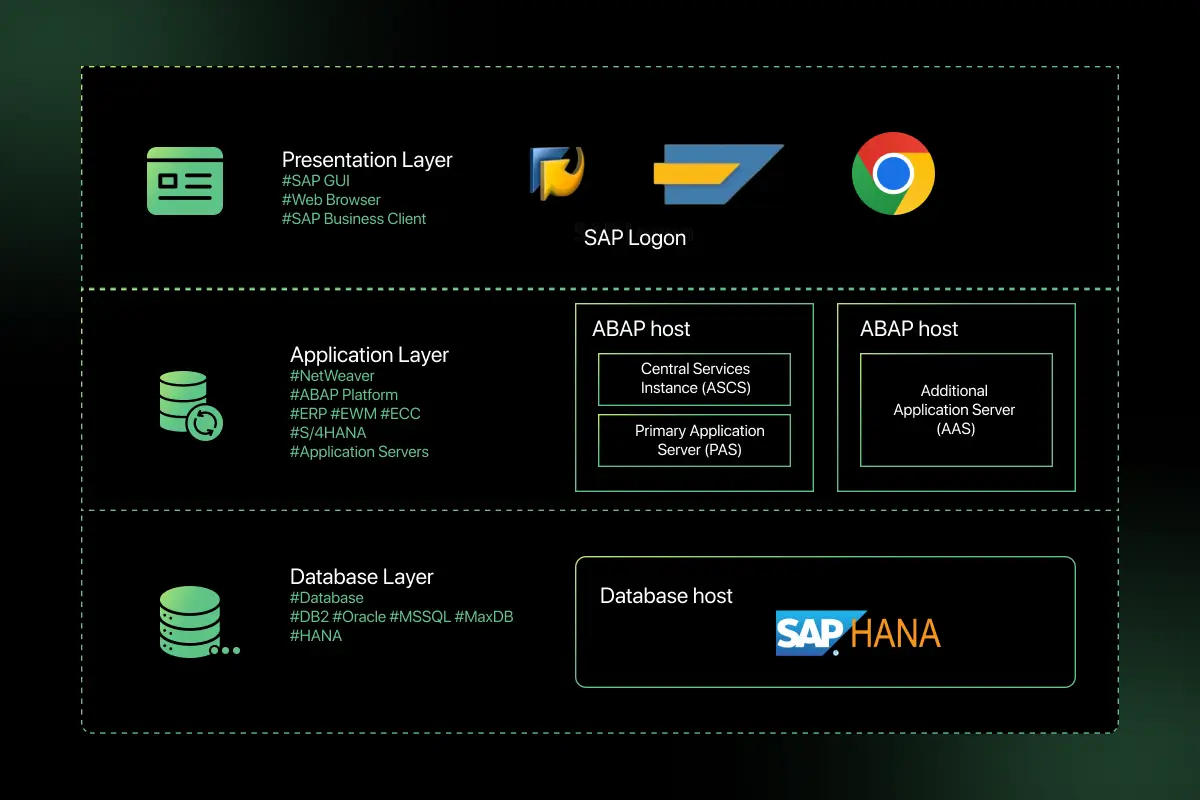
SAP architecture follows a three-tier model that separates user interaction, business logic, and data storage. This separation improves scalability, performance, and maintainability in enterprise systems.
1. Presentation Tier
The presentation tier is the user interface layer. It includes SAP GUI or web-based interfaces where users enter data and execute transactions. This layer collects input and displays output, but does not process business logic.
2. Application Tier
The application tier contains the core business logic of SAP. It processes transactions, applies business rules, performs validations, and manages communication between the presentation and database tiers.
3. Database Tier
The database tier stores all business data, including transactional records and master data. It retrieves and updates information in response to instructions from the application tier.
When a user acts as the presentation tier, the request is sent to the application tier for processing. The application tier applies business logic and interacts with the database tier to store or retrieve data. Once the operation is complete, the response is sent back to the presentation tier for display.
SAP Deployment Models
SAP architecture can be deployed in different environments based on organizational needs, infrastructure strategy, and scalability requirements.
On-Premise SAP
In on-premises deployment, SAP systems are installed and managed within the organization’s own data centers. The company controls hardware, security, and maintenance directly.
SAP on Cloud
In cloud deployment, SAP applications are hosted on cloud infrastructure. The cloud provider manages servers and infrastructure, while the organization focuses on application usage and configuration.
Hybrid SAP Architecture
Hybrid deployment combines on premise and cloud environments. Organizations may keep critical data in local systems while using cloud resources for scalability and flexibility.
SAP ECC vs SAP S 4HANA Architecture
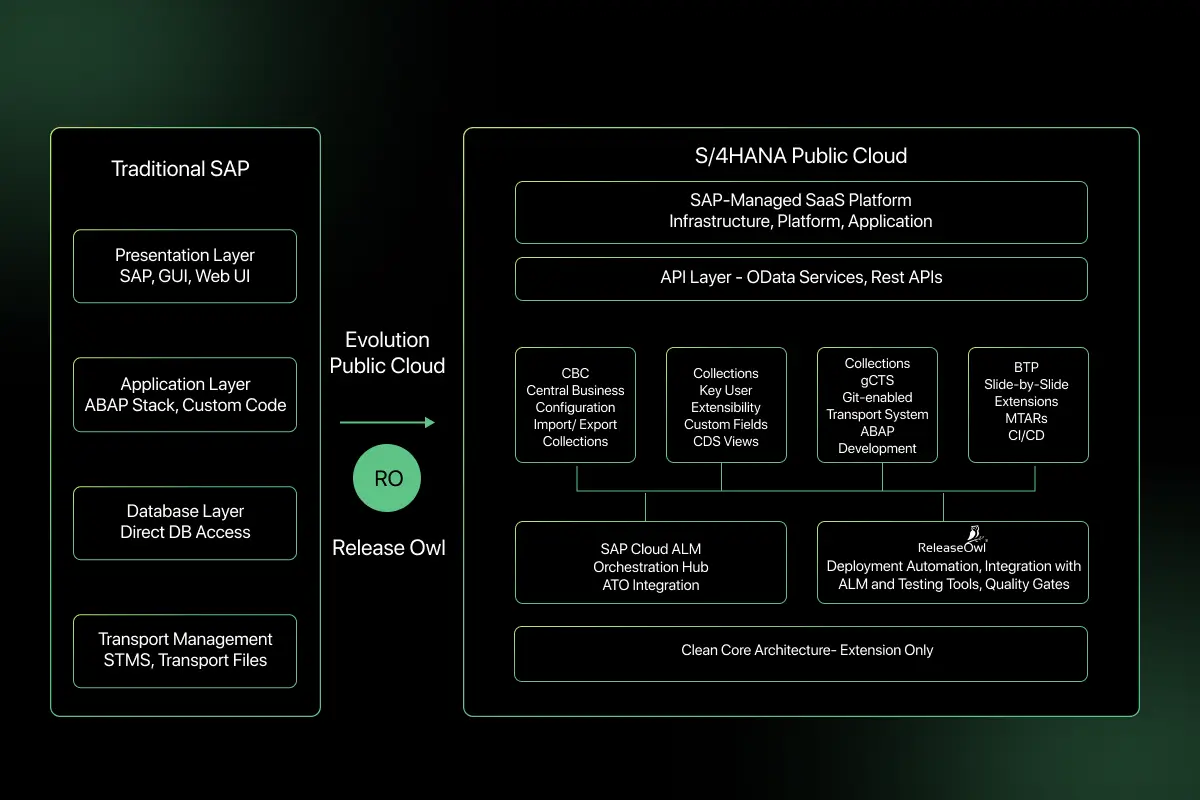
Understanding the architectural differences between SAP ECC and SAP S 4HANA helps organizations choose the right enterprise solution based on performance and business needs.
| Factor | SAP ECC | SAP S 4HANA |
| Database | Supports multiple databases such as Oracle and SQL Server | Designed exclusively for SAP HANA in-memory database |
| Performance | Slower due to disk-based data processing | High performance with real-time in-memory processing |
| Data Model | Complex data tables with aggregate and index tables | Simplified data model with reduced tables and real-time analytics |
| Deployment | Primarily on premise with limited cloud options | Supports on-premises, cloud, and hybrid deployments |
| Architecture Type | Traditional three-tier architecture | Optimized three tier architecture with in-memory computing |
| Use Case | Legacy enterprise systems with stable operations | Modern enterprises requiring real time insights and digital transformation |
Advantages and Challenges of SAP Architecture
SAP architecture provides structured enterprise management, but it also involves implementation and operational complexity.
Advantages
- Centralized data management – All business processes operate on a unified database, ensuring consistent and accurate enterprise-wide data.
- Real-time processing – Transactions and reports are processed instantly, providing up-to-date insights for decision-making.
- Business process integration – Different modules such as finance, sales, and supply chain are connected, enabling seamless data flow across departments.
- Scalability – SAP systems can scale to support growing enterprise operations and increasing transaction volumes.
Challenges and Limitations
- High implementation cost – Deploying SAP requires significant investment in infrastructure, licensing, and consulting services.
- Complex configuration – Setting up modules and aligning them with business processes can be technically demanding.
- Customization difficulty – Extensive customization may increase maintenance complexity and upgrade challenges.
- Skilled resource requirement – Managing and maintaining SAP systems requires trained professionals with specialized expertise.

Real World Use Cases
SAP architecture is widely used in large enterprises where integrated business process management is essential.
Manufacturing companies: Manufacturers use SAP to manage production planning, inventory control, procurement, and quality management within a centralized system.
Retail businesses: Retail organizations use SAP to handle sales, billing, inventory tracking, and customer data across multiple stores and regions.
Financial institutions: Banks and financial firms rely on SAP for accounting, reporting, compliance management, and secure transaction processing.
Supply chain management: SAP supports end-to-end supply chain operations, including logistics, warehouse management, procurement, and vendor coordination.
Important Concepts to Remember
- Three-tier architecture
- SAP modules
- Application server role
- Message server function
- SAP HANA
If you want to test your understanding of enterprise system concepts, try solving MCQ questions that cover system layers, application servers, and enterprise resource planning fundamentals.
These SAP interview questions for practice help reinforce concepts commonly asked in enterprise software and ERP-related technical interviews.
Final Words
SAP architecture follows a structured three-tier model integrating presentation, application, and database layers. It enables centralized enterprise management with real-time processing. Proper configuration ensures scalability and performance.
Explore More Architecture Blogs
- Database Management System
- Microservices
- Web Application
- REST API and API Gateway
- Distributed Systems
- OSI Security Model
- Cloud Computing
- Docker
- Kubernetes
- SQL Server
- Spring Boot
- Data Warehouse
- Java
- Linux
- Angular
- Selenium
FAQs
SAP architecture is a structured enterprise system design that integrates presentation, application, and database layers to manage business processes and centralized data efficiently.
SAP architecture consists of three main layers: presentation layer, application layer, and database layer, each responsible for user interaction, business logic, and data storage.
The SAP application server processes business logic, validates transactions, executes workflows, and communicates between the presentation layer and the database layer.
SAP ECC uses traditional databases, while SAP S 4HANA runs on the in-memory HANA database, offering faster processing and a simplified data model.
Yes, SAP architecture typically follows a three-tier model that separates the user interface, business logic, and data storage for better scalability and performance.
SAP is used in manufacturing, retail, finance, healthcare, and supply chain management to integrate and automate core business operations.



Aarthy is a passionate technical writer with diverse experience in web development, Web 3.0, AI, ML, and technical documentation. She has won over six national-level hackathons and blogathons. Additionally, she mentors students across communities, simplifying complex tech concepts for learners.



Aarthy is a passionate technical writer with diverse experience in web development, Web 3.0, AI, ML, and technical documentation. She has won over six national-level hackathons and blogathons. Additionally, she mentors students across communities, simplifying complex tech concepts for learners.
Related Posts
Difference between Main memory and Secondary memory
Have you ever noticed that unsaved work disappears after a power failure, while your documents, photos, and applications remain available …
Warning: Undefined variable $post_id in /var/www/wordpress/wp-content/themes/placementpreparation/template-parts/popup-zenlite.php on line 1050
so far feels like...
