Microservices Architecture Explained

Many applications initially start as monolithic systems where all features are built and deployed as a single unit. This approach works well in the early stages but becomes difficult to manage as the user base and feature set grow.
As traffic increases, scaling a monolithic application becomes complex because even small changes require redeploying the entire system. Performance bottlenecks and maintenance challenges begin to appear.
Microservices architecture addresses this problem by breaking an application into small, independent services that can be developed, deployed, and scaled separately.
In this guide, you will understand what microservices architecture is, how it works, its key components, comparison with monolithic architecture, and real-world use cases.
What is Microservices Architecture?
Microservices architecture is a software design approach where an application is built as a collection of small, independent services that work together to deliver complete functionality.
In a microservices-based architecture, the application is divided into multiple services, and each service is responsible for a single business function. These services run independently and communicate with each other through APIs.
This approach improves flexibility in microservice system design by allowing teams to develop, deploy, and scale services separately without affecting the entire system.
Simple Example
Consider an online shopping application designed using a microservices architecture:
- User service handles registration, login, and profile management
- Product service manages product listings and inventory
- Payment service processes transactions and payment validation
Each service operates independently but communicates through APIs to complete a user request.
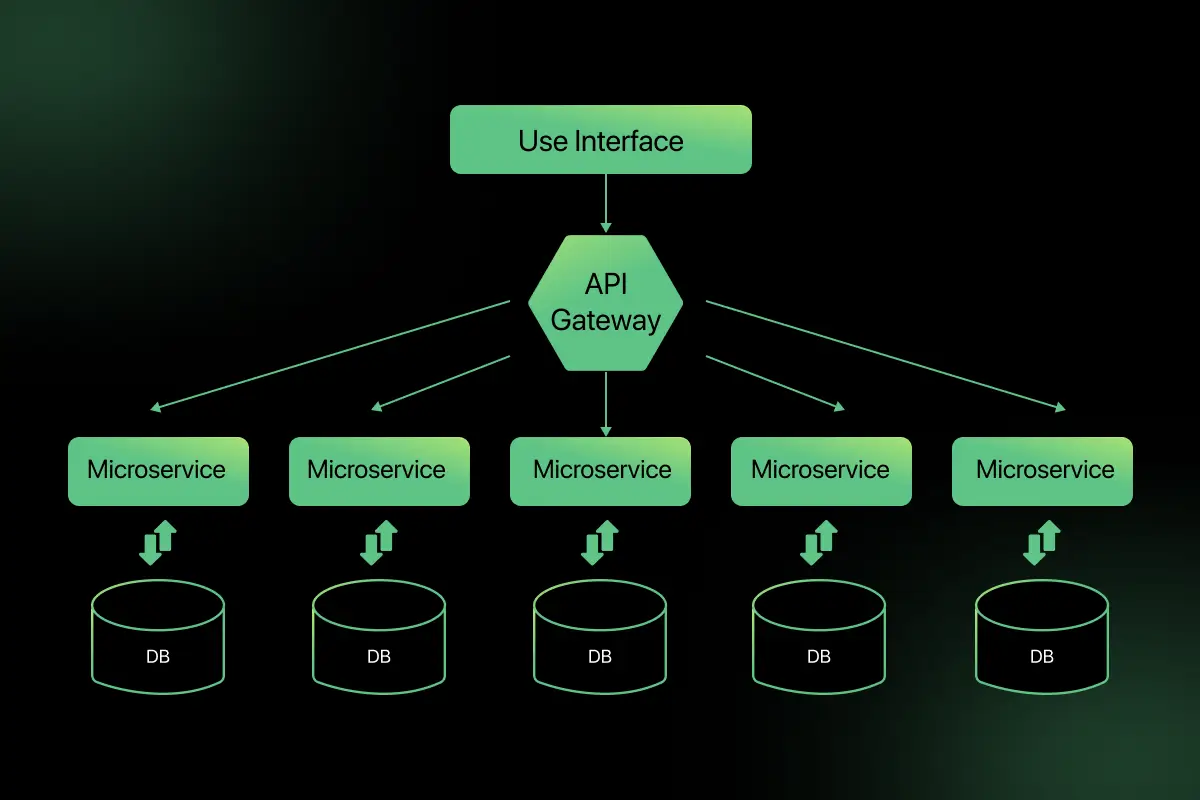
Why Do We Need Microservices Architecture?
Large applications become difficult to maintain, scale, and deploy when built as a single unit.
As the system grows, even small updates can impact the entire application, leading to slower releases and higher risk.
Key Reasons:
- Independent deployment – Each service can be updated without redeploying the entire system.
- Better scalability – Services can be scaled individually based on demand.
- Fault isolation – Failure in one service does not bring down the whole application.
- Faster development cycles – Teams can work on different services simultaneously.
- Technology flexibility – Different services can use different technologies or frameworks.
Core Components of Microservices Architecture
A microservices architecture project consists of several key components that work together to build scalable and independent services.
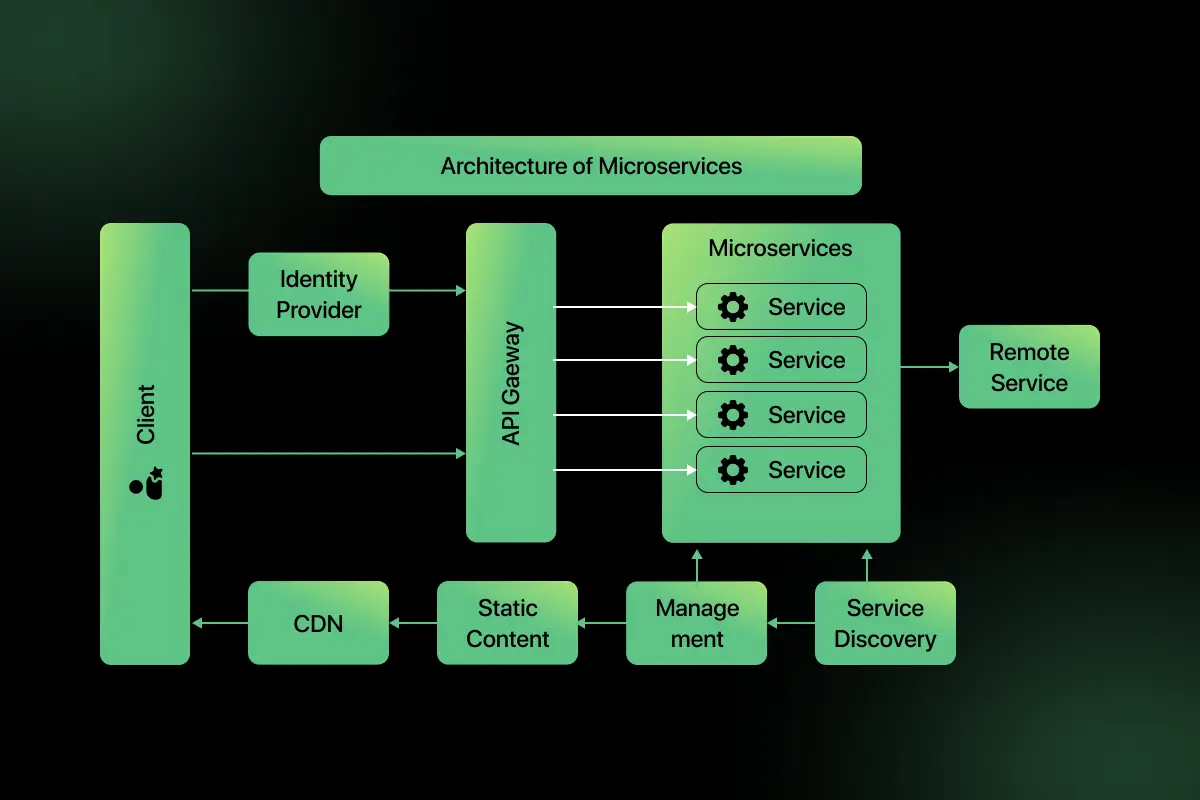
Service
A service is a small independent business unit that performs a specific function. Each service runs separately, can be deployed independently, and focuses on a single responsibility, such as user management or payment processing.
API Gateway
The API Gateway acts as the single entry point for all client requests. It routes incoming requests to the appropriate service, handles authentication, and manages request aggregation when multiple services are involved.
Service Registry and Discovery
In a microservices environment, services may scale dynamically. Service registry and discovery help services locate and communicate with each other automatically without hardcoding network locations.
Database per Service
Each microservice manages its own database to maintain independence. This prevents tight coupling between services and allows each service to choose the most suitable database technology.
Communication Mechanism
Microservices communicate using standard protocols and messaging systems.
- REST APIs are commonly used for synchronous communication between services.
- Messaging queues are used for asynchronous communication, enabling reliable data exchange without direct service dependency.
How Microservices Architecture Works Step by Step
Learning the fundamentals of microservices architecture involves understanding how independent services communicate and scale in distributed systems.
Scenario
A user selects a product and clicks Place Order.
Step-by-Step Flow
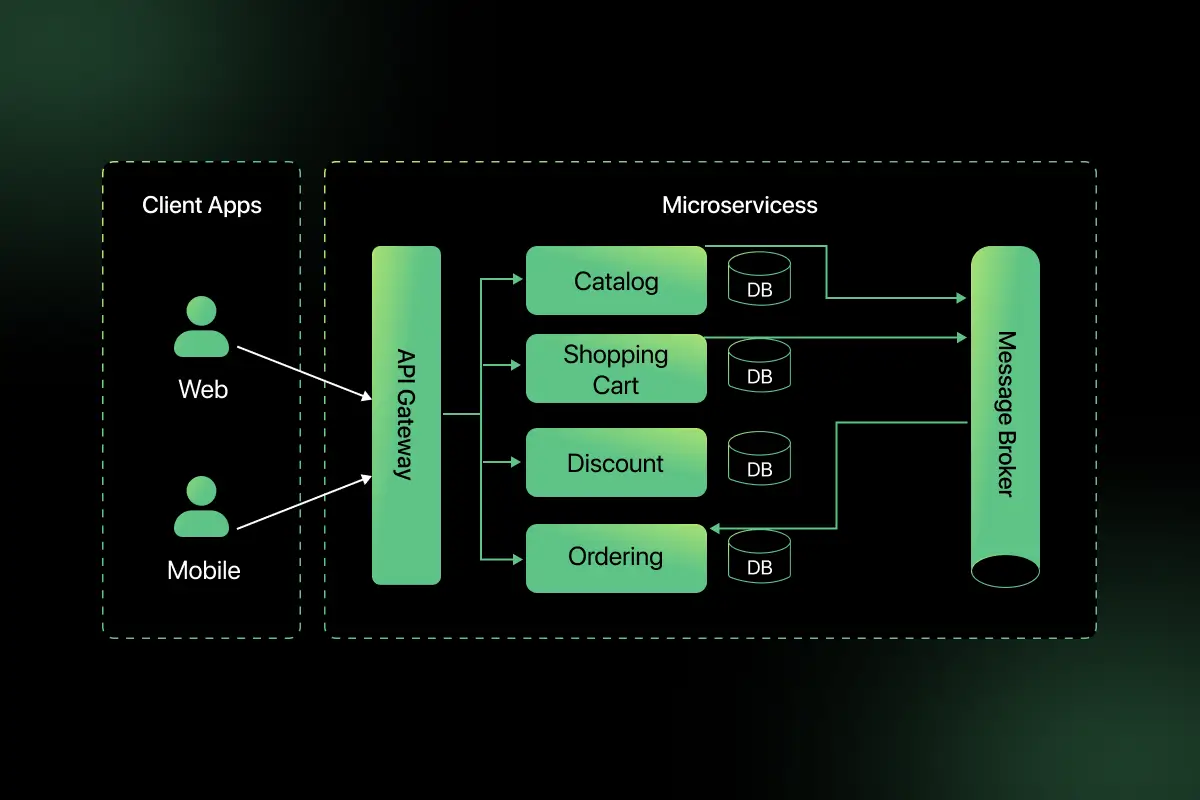
- Request goes to API Gateway: The app sends the order request to the API Gateway, which acts as the entry point and routes the request to the correct service.
- Order service processes the request: The Order service creates a new order, checks basic details, and triggers the next actions required to complete the purchase.
- Payment service validates the transaction: The Payment service confirms payment status and returns success or failure based on the payment response.
- Inventory service updates stock: After payment success, the Inventory service reduces stock count and confirms product availability for shipping.
- Response returned to the user: The Order service finalizes the order status and a success response is sent back through the API Gateway to the user interface.
Microservices Architecture Patterns
Microservices architecture relies on specific design patterns to manage communication, reliability, and distributed transactions effectively.
API Gateway Pattern
The API Gateway acts as a single entry point for all client requests. It handles routing, authentication, rate limiting, and request aggregation before forwarding traffic to the appropriate service.
Circuit Breaker Pattern
The Circuit Breaker pattern prevents cascading failures. If a service becomes unavailable, the circuit temporarily stops requests to that service, allowing the system to remain stable and recover gracefully.
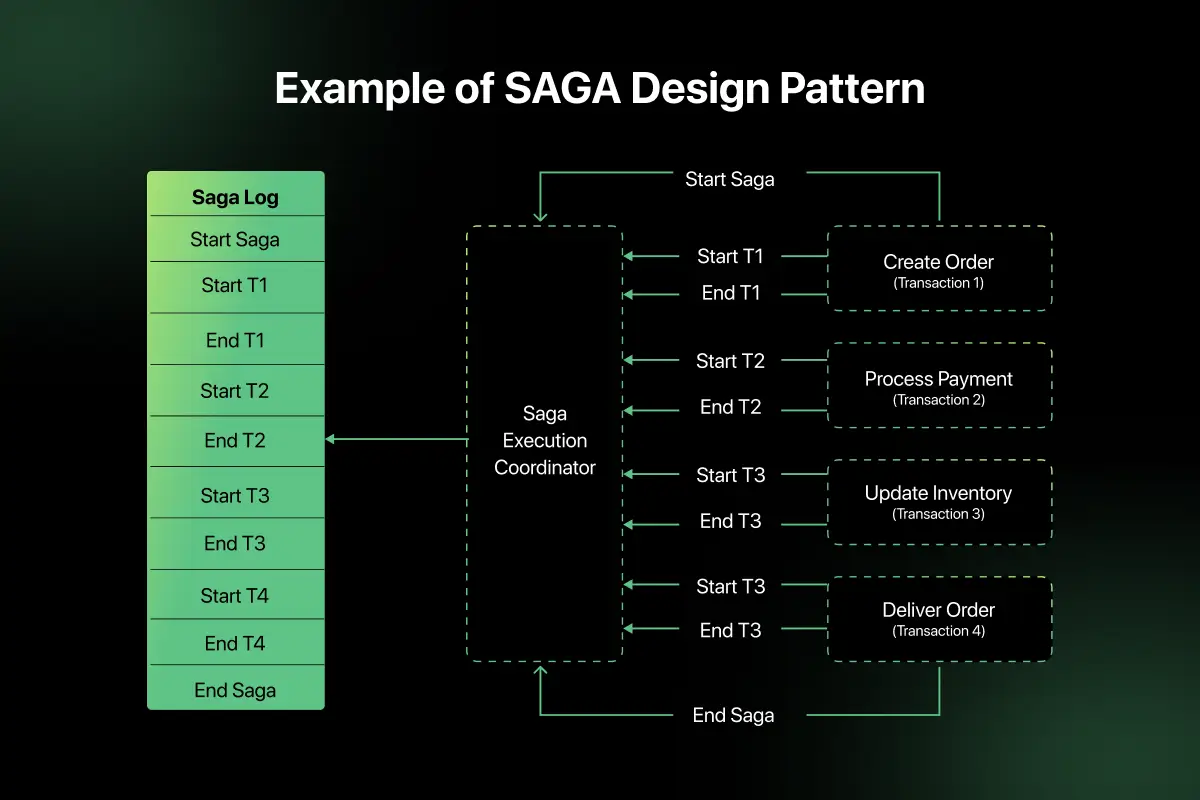
Saga Pattern
The Saga pattern manages distributed transactions across multiple services. Instead of a single database transaction, each service performs its own local transaction and triggers the next step, with compensating actions if a failure occurs.
Event Driven Architecture
In event-driven architecture, services communicate through events rather than direct calls. When one service completes an action, it publishes an event that other services can listen to and respond accordingly, improving scalability and loose coupling.
Microservices vs Monolithic Architecture
Understanding the difference between monolithic and microservice architectures is important for system design decisions.
The table below compares both models based on key technical factors.
| Factor | Monolithic Architecture | Microservices Architecture |
| Structure | The entire application is built as a single unified codebase | The application is divided into small, independent services |
| Scalability | The entire system must be scaled together | Individual services can be scaled independently |
| Deployment | Any update requires redeploying the whole application | Each service can be deployed separately |
| Fault Isolation | Failure in one module can impact the entire system | Failure in one service does not directly affect others |
| Development Speed | Slower as team size grows due to code dependencies | Faster as teams can work independently on different services |
| Complexity | Simpler to develop initially | Higher operational and infrastructure complexity |
Advantages of Microservices Architecture
- Independent scaling – Each service can be scaled based on its own demand without affecting other parts of the system.
- Faster releases – Services can be developed, tested, and deployed independently, enabling quicker feature updates.
- Improved resilience – Failure in one service does not bring down the entire application, improving overall system stability.
- Team autonomy – Different teams can manage and deploy their own services without dependency on a single large codebase.
- Technology diversity – Each service can use the most suitable programming language, framework, or database based on its requirements.
Challenges and Limitations
While microservices architecture offers flexibility and scalability, it also introduces operational challenges that must be managed carefully.
- Increased complexity – Managing multiple services, deployments, and communication channels adds architectural and operational complexity.
- Network latency – Since services communicate over the network, delays can occur compared to in-process calls in monolithic systems.
- Data consistency challenges – Maintaining consistency across multiple service databases is difficult, especially in distributed transactions.
- DevOps dependency – Continuous integration, containerization, and automated deployment pipelines are essential, increasing infrastructure requirements.
- Monitoring difficulty – Tracking performance, logs, and failures across many services requires centralized monitoring and observability tools.
Real World Use Cases
Microservices architecture is commonly used in large-scale applications where scalability, flexibility, and reliability are critical.
E-commerce platforms
Online shopping systems handle user accounts, product catalogs, payments, orders, and delivery tracking. Microservices allow each function to scale independently during high traffic events like sales.
OTT platforms
Streaming platforms manage content delivery, user subscriptions, recommendations, and playback services separately. This improves performance and allows continuous feature updates without affecting the entire system.
Banking apps
Banking systems require strong security, transaction management, and fault isolation. Microservices help separate services such as authentication, payments, account management, and notifications for better control and reliability.
Ride-sharing apps
Ride booking, driver management, payment processing, and location tracking operate as independent services. This enables real-time scaling and ensures that failure in one component does not impact the entire application.
Important Concepts to Remember
- Difference between monolithic and microservice architecture
- Role of API Gateway in request routing
- Database per service principle
- Service communication patterns in distributed systems
- When to choose a microservices architecture
- Trade-off between scalability and operational complexity
If you want to test your understanding of microservices architecture concepts, try solving MCQ questions on Operating Systems that cover service communication, scalability patterns, and distributed application fundamentals.
Also, System Design interview questions for practice help reinforce concepts commonly asked in backend development and architecture interview discussions.

Final Words
Microservices architecture divides applications into small, independent services that can be developed and scaled separately.
It improves scalability, flexibility, and fault isolation in large systems. However, it also introduces additional complexity that requires proper design and management.
Frequently Asked Questions:
1. What is microservices architecture?
Microservices architecture is a design approach where an application is built as a collection of small, independent services. Each service focuses on a specific business function and communicates with others through APIs.
2. How is microservices different from monolithic architecture?
In monolithic architecture, the entire application is built as a single unit. In a microservices architecture, the application is divided into independent services that can be developed, deployed, and scaled separately.
3. Why do companies move to microservices?
Companies move to microservices to improve scalability, enable faster feature releases, reduce system failures, and allow teams to work independently on different parts of the application.
4. What is API Gateway in microservices?
API Gateway acts as a single entry point for all client requests. It routes traffic to the correct service, handles authentication, and manages request aggregation across multiple services.
5. Does each microservice have its own database?
Yes, in most microservices architectures, each service manages its own database. This ensures independence, reduces coupling, and allows services to scale or evolve without affecting others.
6. Is microservices suitable for small applications?
Microservices may not be ideal for small applications because they introduce infrastructure and operational complexity. Monolithic architecture is often simpler and more cost-effective for smaller systems.
7. What are common challenges in microservices architecture?
Common challenges include increased system complexity, network latency, data consistency issues, deployment overhead, and the need for advanced monitoring and DevOps practices.
Explore More Architecture Blogs



Aarthy is a passionate technical writer with diverse experience in web development, Web 3.0, AI, ML, and technical documentation. She has won over six national-level hackathons and blogathons. Additionally, she mentors students across communities, simplifying complex tech concepts for learners.



Aarthy is a passionate technical writer with diverse experience in web development, Web 3.0, AI, ML, and technical documentation. She has won over six national-level hackathons and blogathons. Additionally, she mentors students across communities, simplifying complex tech concepts for learners.
Related Posts

JDBC Architecture Explained
Have you ever wondered how a Java application connects to a database to store or retrieve data? This interaction happens …


Warning: Undefined variable $post_id in /var/www/wordpress/wp-content/themes/placementpreparation/template-parts/popup-zenlite.php on line 1050
so far feels like...
