REST API & API Gateway Architecture Explained
APIs power almost every modern web and mobile application. Whether it is a shopping app, a banking platform, or a streaming service, communication between the frontend and backend occurs through APIs.
REST API architecture defines how services expose resources using standard HTTP methods. It provides a structured and scalable way for clients and servers to communicate.
As systems grow and multiple services are introduced, managing direct communication becomes complex. API Gateway architecture solves this by acting as a centralized entry point that routes, secures, and monitors requests in distributed systems.
In this guide, you will clearly understand how REST API and API Gateway architectures work, how they differ, and where each is used in real-world applications.
REST API Architecture
This section explains what REST API architecture is, how it is structured, and the core principles that define communication between clients and servers.
What is REST API Architecture?
REST API architecture is a design approach where applications communicate through HTTP-based APIs that expose resources in a structured and standardized way.
It follows the principles of Representational State Transfer to enable scalable and efficient communication.
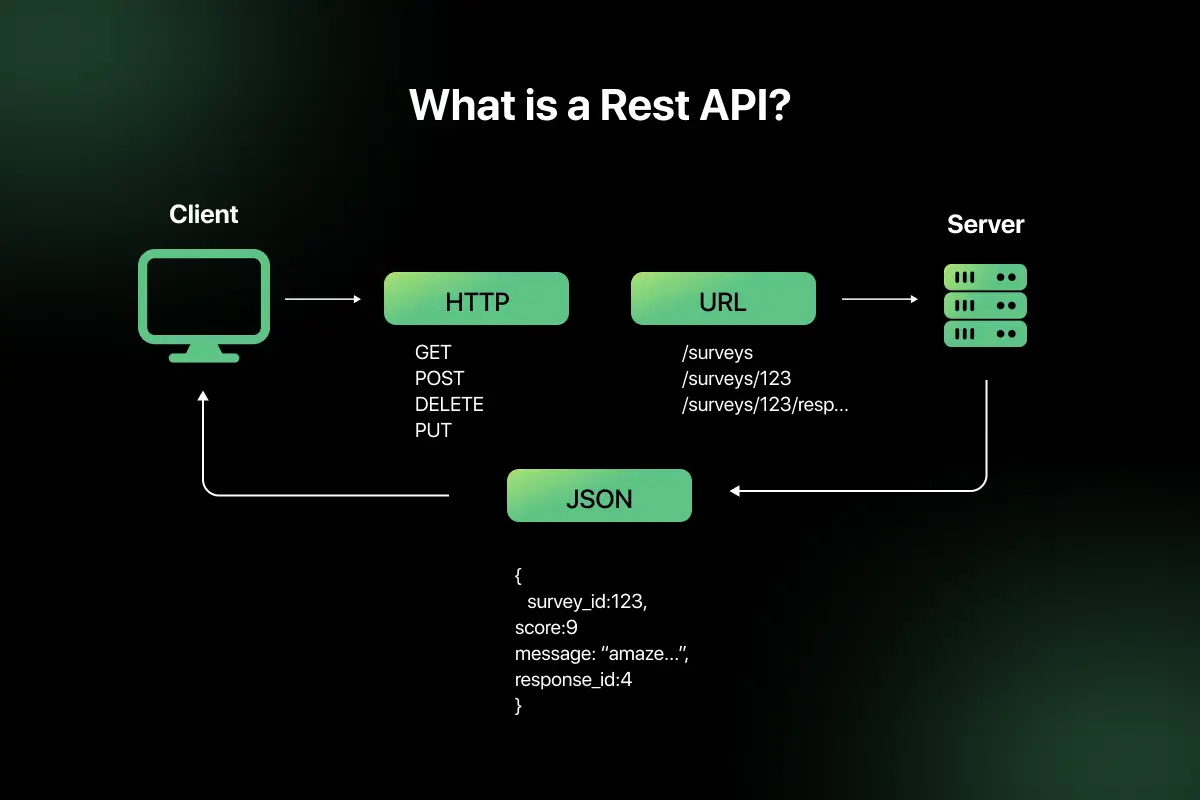
- Client-Server Model: REST API architecture separates the client and server. The client handles the user interface, while the server manages data processing and storage. This separation improves flexibility and independent development.
- Stateless Communication: Each request from the client must contain all necessary information. The server does not store session state between requests, which improves scalability and reliability.
- Resource-Based Endpoints: In REST API architecture, everything is treated as a resource. Resources are identified using URLs such as /users, /orders, or /products.
- HTTP Methods: REST APIs use standard HTTP methods to perform operations
Core Principles of REST API Architecture
REST API architecture follows a set of core principles that ensure scalability, simplicity, and structured communication between clients and servers.
- Statelessness: Each request from the client must contain all the information required to process it. The server does not store session data between requests, which improves scalability and simplifies server design.
- Uniform Interface: REST APIs follow consistent rules for communication. Standard HTTP methods, clear resource URLs, and predictable response formats make integration easier across different systems.
- Client Server Separation: The client and server operate independently. The client manages the user interface, while the server handles data processing and storage. This separation allows both sides to evolve without affecting each other.
- Resource Identification: All data is treated as a resource and is identified using clear and meaningful URLs. For example, /users/101 represents a specific user resource.
- Cacheability: Responses from the server can be marked as cacheable. This allows clients or intermediate systems to reuse responses, reducing server load and improving performance.
REST API Architecture Diagram and Working Flow
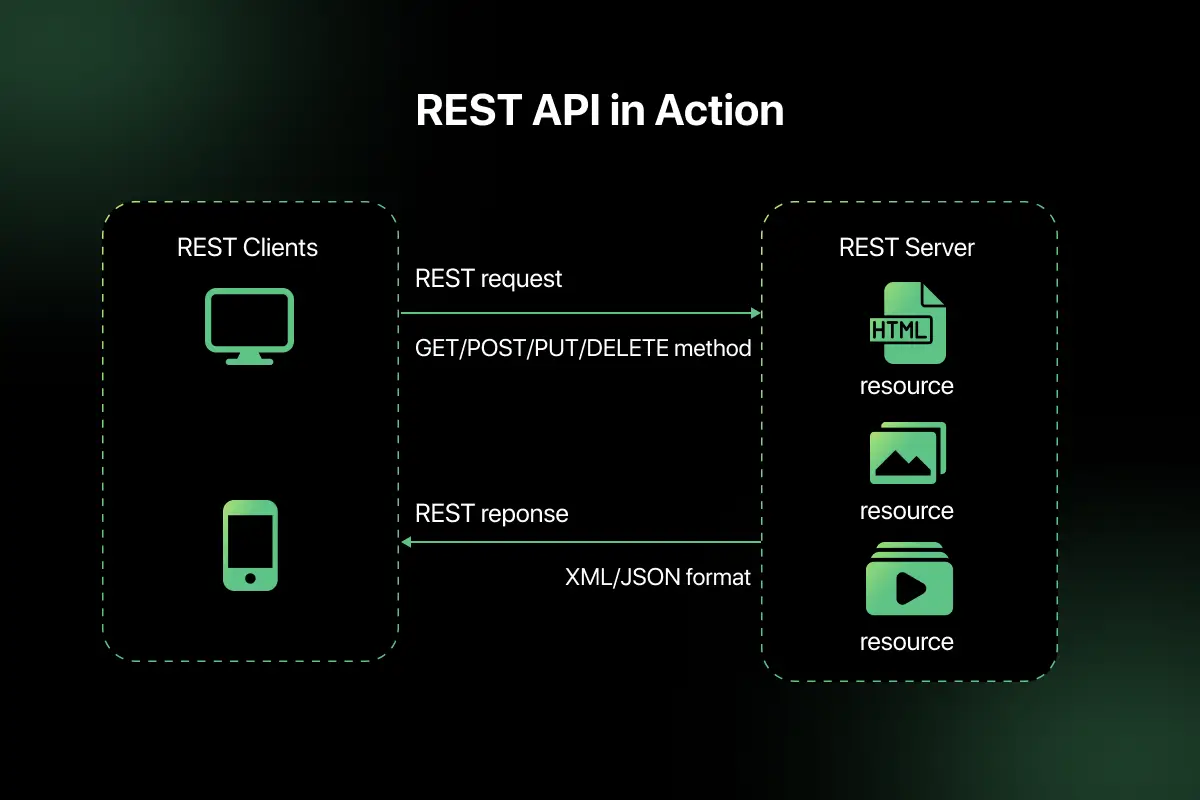
Learning how REST APIs work involves understanding how client requests interact with servers through structured endpoints and API gateway management.
Scenario: A user opens an e-commerce application and requests to view the product list.
Step-by-Step Flow
- Client sends request: The frontend application sends a GET request to the server, for example,/products.
- Server processes request: The server receives the request, validates it, and determines the required operation.
- Database queried: The server interacts with the database to fetch the product information.
- JSON response returned: The server sends the requested data back to the client in JSON format, which is then displayed to the user.
This working flow shows how REST API architecture enables structured and stateless communication between client and server.
Advantages and Limitations of REST API Architecture
REST API architecture is widely adopted because of its simplicity and flexibility, but it also has certain limitations that should be considered.
Advantages
- Simple – Uses standard HTTP methods and clear URL structures, making it easy to understand and implement.
- Scalable – Stateless communication allows servers to handle large numbers of requests efficiently.
- Language independent – Clients and servers can be built using different programming languages as long as they follow HTTP standards.
Limitations
- Over-fetching – Clients may receive more data than required because endpoints return fixed response structures.
- No centralized control – When multiple services expose APIs directly, managing security and routing becomes complex.
- Direct backend exposure – Backend services may be directly accessible, increasing security risks in larger systems.

API Gateway Architecture
As applications grow and multiple backend services are introduced, direct communication between clients and services becomes difficult to manage.
API Gateway architecture provides a structured way to control and simplify this communication.
What is API Gateway Architecture?
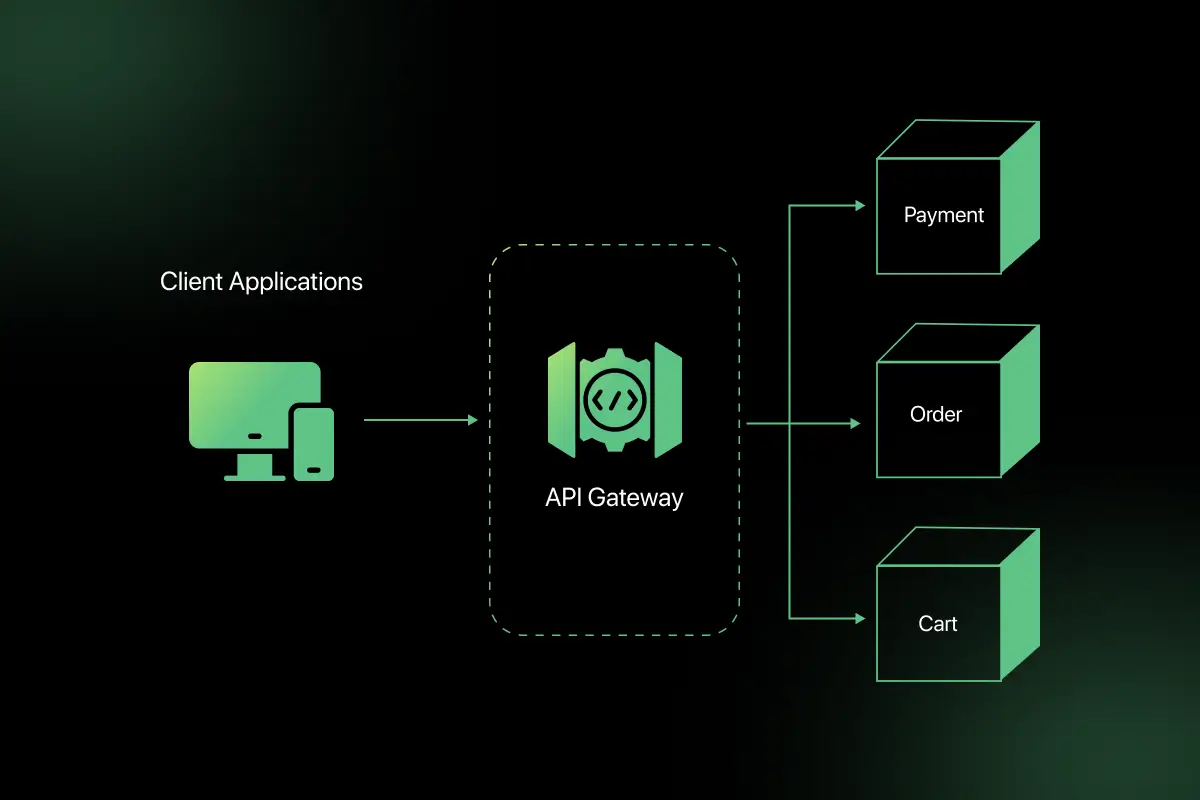
API Gateway architecture is a design pattern where a centralized gateway acts as an intermediary between clients and backend services. It manages incoming requests and forwards them to the appropriate service.
- Single Entry Point: The API Gateway serves as the single access point for all client requests. Instead of calling multiple backend services directly, the client communicates only with the gateway.
- Request Routing: The gateway analyzes each request and routes it to the correct backend service. It can also aggregate responses from multiple services before sending the final result to the client.
- Used in Microservice Systems: API Gateway architecture is commonly used in microservice systems where many independent services exist.
It simplifies client interaction, enhances security, and centralizes control across distributed services.
API Gateway Architecture Diagram and Working Flow
Scenario: A user places an order in an e-commerce application built using microservices.
Step-by-Step Flow
- Request hits API Gateway: The client sends the order request, which first reaches the API Gateway instead of directly contacting backend services.
- Gateway authenticates: The gateway verifies user credentials, checks authorization rules, and ensures the request is valid before forwarding it.
- Gateway routes request: Based on the request type, the gateway routes it to the appropriate backend service, such as the Order service or Payment service.
- Backend responds: The backend service processes the request and sends the response back to the API Gateway.
- Gateway returns response: The API Gateway forwards the final response to the client, sometimes combining responses from multiple services if required.
This working flow shows how API Gateway architecture centralizes security, routing, and communication in distributed systems.
API Gateway Architecture Patterns
API Gateway architecture uses specific patterns to manage routing, security, and reliability in distributed systems.
- Backend for Frontend: In this pattern, separate gateways are created for different client types, such as web and mobile. Each gateway is optimized for the specific needs of that client, reducing unnecessary data transfer and improving performance.
- API Aggregation: The gateway combines responses from multiple backend services into a single response. This reduces the number of client requests and simplifies frontend logic.
- Circuit Breaker Integration: The gateway can integrate a circuit breaker mechanism to prevent repeated calls to failing services. If a service becomes unavailable, the gateway temporarily blocks requests to protect the system from cascading failures.
- Rate Limiting: Rate limiting controls how many requests a client can make within a specific time period. This prevents system overload, protects against abuse, and ensures fair usage across users.
Challenges and Limitations of API Gateway
While API Gateway architecture simplifies communication and improves control, it also introduces certain operational challenges.
- Single Point of Failure Risk: Since all client requests pass through the gateway, any failure in the gateway can disrupt the entire system. Proper load balancing and redundancy are required to avoid downtime.
- Added Latency: The gateway adds an extra network hop between the client and backend services. This can slightly increase response time, especially in high-traffic systems.
- Infrastructure Overhead: Managing an API Gateway requires additional configuration, monitoring, and scaling. It increases infrastructure complexity compared to direct REST API communication in smaller systems.
REST API vs API Gateway Architecture
Understanding REST API architecture and API Gateway architecture is important for designing scalable and secure systems.
| Factor | REST API Architecture | API Gateway Architecture |
| Purpose | Defines how services expose and manage resources using HTTP | Manages and controls how client requests reach backend services |
| Role | Enables communication between client and server | Acts as an intermediary between clients and multiple backend services |
| Security Responsibility | Security must be handled individually by each service | Centralizes authentication, authorization, and rate limiting |
| Scalability | Scales at the service level | Helps manage and route traffic efficiently across multiple services |
| Complexity | Simple to implement for small systems | Adds architectural and infrastructure complexity |
| When to Use | Suitable for single service or small applications | Suitable for distributed systems and microservices environments |
Important Concepts to Remember
- Difference between REST API and API Gateway
- Stateless communication
- Role of API Gateway in microservices
- When API Gateway is required
- Trade-off between simplicity and control
If you want to test your understanding of REST architecture concepts, try solving MCQ questions that cover API design, request-response models, and API gateway fundamentals.
These REST API interview questions for practice help reinforce concepts commonly asked in backend development interviews and system design discussions.
Final Words
REST API architecture defines how applications expose and manage resources using structured, stateless communication. API Gateway architecture builds on this by centralizing routing, security, and traffic control in distributed systems.
Together, they form a strong foundation for building scalable, secure, and modern web applications.
Explore More Architecture Blogs
- Database Management System
- Microservices
- Web Application
- Distributed Systems
- OSI Security Model
- Cloud Computing
- Docker
- Kubernetes
- SAP
- SQL Server
- Spring Boot
- Data Warehouse
- Java
- Linux
- Angular
- Selenium
FAQs
REST API architecture is a client-server communication model where services expose resources through HTTP endpoints. It follows principles such as stateless communication, uniform interface, and resource-based URLs to exchange data, usually in JSON format.
API Gateway architecture introduces a single entry point between clients and backend services. It handles request routing, authentication, rate limiting, and response aggregation, especially in microservice-based systems.
REST API defines how services expose and manage resources using HTTP. API Gateway manages and controls access to multiple REST APIs by acting as a centralized routing and security layer.
In a microservices architecture, multiple services exist independently. API Gateway simplifies communication by providing centralized routing, security enforcement, monitoring, and load balancing between clients and backend services.
No, API Gateway does not replace REST APIs. Backend services still implement REST APIs. The API Gateway simply manages, secures, and routes client requests to those APIs.
For small or simple applications, an API Gateway may not be necessary. Direct REST API communication can be sufficient. API Gateway becomes useful when systems grow in size and complexity.
A REST API diagram shows client-server interaction and request-response flow. An API Gateway diagram shows how client requests pass through a gateway before reaching backend services.



Aarthy is a passionate technical writer with diverse experience in web development, Web 3.0, AI, ML, and technical documentation. She has won over six national-level hackathons and blogathons. Additionally, she mentors students across communities, simplifying complex tech concepts for learners.



Aarthy is a passionate technical writer with diverse experience in web development, Web 3.0, AI, ML, and technical documentation. She has won over six national-level hackathons and blogathons. Additionally, she mentors students across communities, simplifying complex tech concepts for learners.
Related Posts

Difference between Main memory and Secondary memory
Have you ever noticed that unsaved work disappears after a power failure, while your documents, photos, and applications remain available …
Warning: Undefined variable $post_id in /var/www/wordpress/wp-content/themes/placementpreparation/template-parts/popup-zenlite.php on line 1050
so far feels like...
